
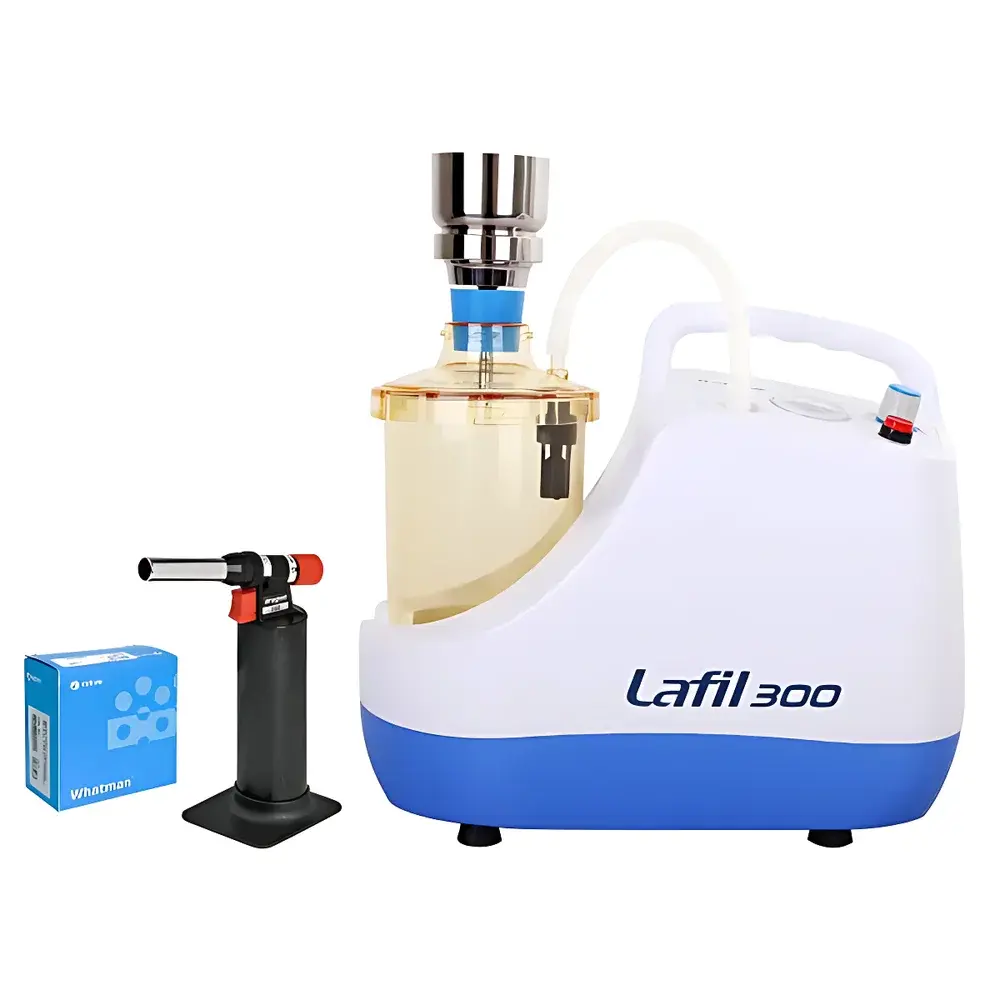
ROCKER Lafil300-SF10 Stainless Steel Vacuum Filtration System for Microbial Testing
| Brand | ROCKER |
|---|---|
| Origin | Taiwan |
| Model | Lafil300-SF10 |
| Power | 65 W |
| Current Draw | 0.7 A |
| Ultimate Vacuum | 99 mbar (685 mmHg) |
| Air Flow Rate | 23 L/min |
| Motor Speed | 1450 RPM |
| Funnel Capacity | 100 mL |
| Waste Bottle Capacity | 1200 mL |
| Compatible Membrane Diameter | 47 mm |
| Effective Filtration Area | 11.6 cm² |
| Tubing ID | 8 mm (5/16 inch) |
| Dimensions (W×D×H) | 33.5 × 24.5 × 30 cm |
| Funnel Material | SS316 Stainless Steel |
| Waste Bottle Material | Polycarbonate (PC) |
| Filter Support Plate Material | SS316 Stainless Steel |
| Overflow Protection | PPL Float Valve |
Overview
The ROCKER Lafil300-SF10 is a compact, integrated vacuum filtration system engineered specifically for microbiological testing applications requiring rapid, reliable, and sterile sample processing. Based on the principle of negative-pressure-driven membrane filtration, the system draws liquid samples through a sterilized 47 mm diameter membrane—typically cellulose ester or mixed cellulose ester (MCE)—to capture microorganisms for subsequent enumeration or isolation. Its design integrates a quiet, oil-free diaphragm vacuum pump with a purpose-built stainless steel filtration assembly, eliminating the need for external vacuum sources or complex tubing setups. The Lafil300-SF10 conforms to standard methodologies described in ISO 7218, ASTM D5465, and USP , supporting quantitative microbial enumeration in pharmaceutical water systems, environmental monitoring, food and beverage quality control, and clinical laboratory workflows.
Key Features
- Integrated SS316 stainless steel filtration assembly: Includes a precision-machined funnel and support plate, both fabricated from electropolished 316 stainless steel—compatible with flame sterilization (e.g., using ROCKER Dragon 100 electronic Bunsen burner) and repeated autoclaving at 121 °C for 20 minutes.
- Polycarbonate (PC) waste bottle with float-activated overflow protection: The 1200 mL PC receiver bottle incorporates a polypropylene (PPL) float valve that mechanically seals the gas inlet line upon reaching maximum fill level, preventing liquid ingress into the vacuum pump and ensuring uninterrupted operation during high-throughput batch filtration.
- Space-efficient industrial design: With footprint dimensions of only 33.5 × 24.5 cm, the system occupies less than 50% of the bench space required by conventional pump + manifold + bottle configurations. A recessed, rimmed platform secures the waste bottle against accidental displacement during handling.
- Optimized vacuum performance: Delivers stable ultimate vacuum down to 99 mbar (685 mmHg) and continuous airflow of 23 L/min at rated load—sufficient to maintain consistent transmembrane pressure across low-resistance membranes (e.g., 0.45 µm Pall GN-6 MCE) without compromising microbial retention integrity.
- Robust electrical architecture: Operates at 220 V / 50 Hz (also available in 110 V / 60 Hz variant), with a low-power 65 W motor drawing only 0.7 A—minimizing heat generation and enabling extended unattended operation in temperature-sensitive lab environments.
Sample Compatibility & Compliance
The Lafil300-SF10 accommodates all standard 47 mm disc membranes—including nitrocellulose (NC), polyethersulfone (PES), nylon, and mixed cellulose ester (MCE)—with an effective filtration area of 11.6 cm². Its SS316 funnel and support plate ensure compatibility with aggressive solvents and caustic cleaning agents used in biofilm removal or endotoxin decontamination protocols. The system supports GLP- and GMP-aligned workflows: the stainless steel components meet FDA-compliant material specifications (ASTM F86, ISO 10993-5), while the PC waste bottle complies with USP Class VI biocompatibility requirements. When paired with certified sterile filters (e.g., Pall GN-6, 0.45 µm), the system satisfies sterility testing requirements per USP and EP 2.6.1.
Software & Data Management
As a standalone benchtop filtration instrument, the Lafil300-SF10 does not incorporate embedded software or digital interfaces. However, its mechanical repeatability and stable vacuum output enable seamless integration into validated laboratory information management systems (LIMS) via manual entry or barcode-assisted logging. All physical components—including the funnel, support plate, and waste bottle—are uniquely serialized for traceability. Documentation packages include equipment qualification templates (IQ/OQ), calibration certificates for vacuum gauge verification (NIST-traceable), and materials compliance statements aligned with EU RoHS Directive 2011/65/EU and REACH Regulation (EC) No. 1907/2006.
Applications
- Quantitative microbial enumeration in purified water and WFI systems per pharmacopeial methods (USP , EP 2.2.47)
- Environmental monitoring of cleanrooms and isolators (ISO 14644-1, EU GMP Annex 1)
- Microbial limit testing of non-sterile pharmaceutical products (USP )
- Coliform and E. coli detection in food, dairy, and beverage matrices (AOAC 991.14, ISO 9308-1)
- Pre-filtration of cell culture supernatants prior to downstream analysis (e.g., ELISA, PCR)
- Routine sterility testing of medical device extracts and packaging leachables
FAQ
Is the Lafil300-SF10 suitable for use with corrosive or organic solvents?
Yes—the SS316 stainless steel funnel and support plate exhibit excellent resistance to dilute acids, alkalis, and common organic solvents (e.g., ethanol, isopropanol, acetone). Avoid prolonged exposure to concentrated halogenated solvents or hypochlorite solutions.
Can the polycarbonate waste bottle be autoclaved?
Yes—the PC bottle is rated for steam sterilization at 121 °C for up to 20 minutes. Repeated autoclaving may cause gradual hazing; visual inspection before each use is recommended.
What filter types are validated for use with this system?
Pall GN-6 (0.45 µm MCE), Sartorius SM11047 (0.45 µm CA), and Millipore HATF (0.45 µm MCE) have been verified for compatibility. Membrane integrity must be confirmed post-filtration via bubble point or diffusion test per ASTM F838.
Does the system comply with 21 CFR Part 11 requirements?
While the Lafil300-SF10 itself is hardware-only and does not generate electronic records, its design supports Part 11–compliant documentation practices when used within a controlled environment with audit-trail-enabled LIMS or paper-based SOPs.
How often should the vacuum pump maintenance be performed?
Under normal laboratory use (≤4 hrs/day), inspect the diaphragm and valves every 6 months; replace consumable parts annually or after 1,000 operating hours—whichever occurs first. A maintenance log template is included in the user manual.




