
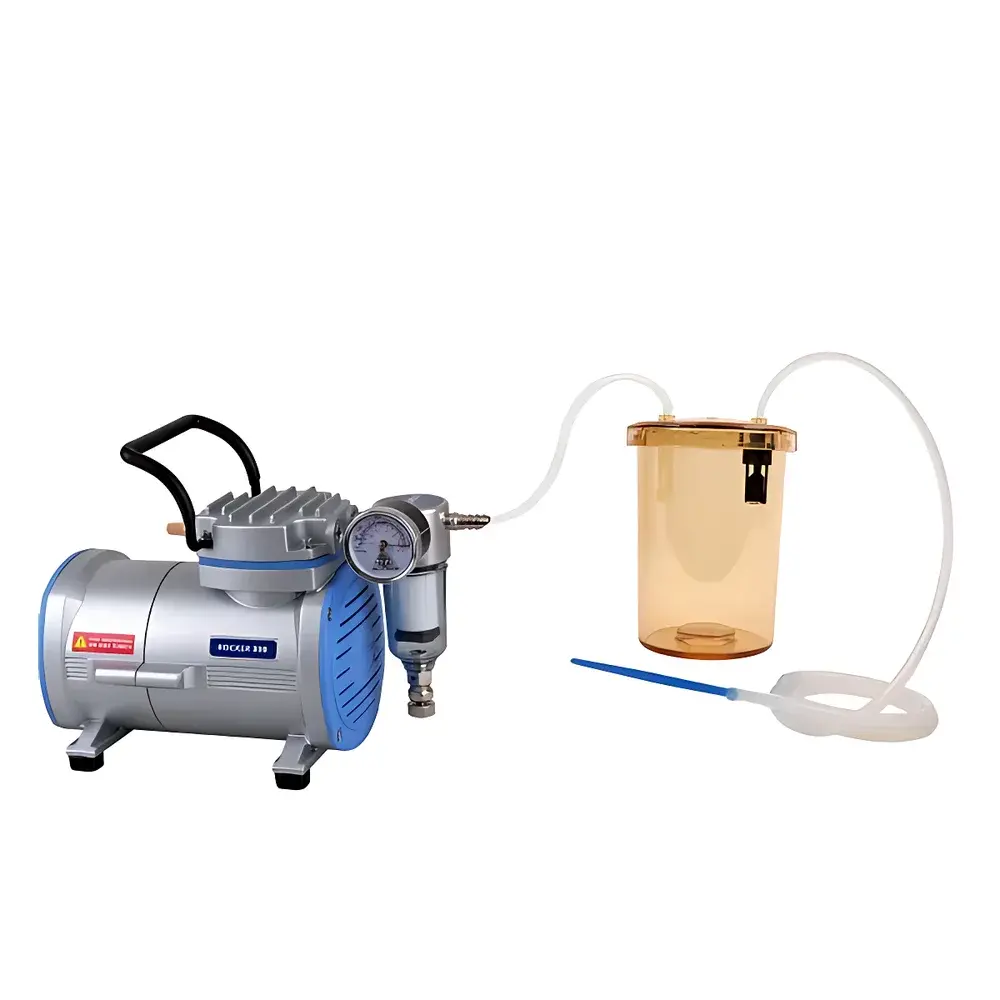
ROCKER R300-PES1L Vacuum Liquid Aspiration System
| Brand | ROCKER |
|---|---|
| Origin | Taiwan |
| Model | R300-PES1L |
| Ultimate Vacuum | 105 mbar |
| Maximum Flow Rate | 20 L/min |
| Motor Speed | 1450 rpm |
| Power Input | 220 V / 50 Hz |
| Noise Level | 50.0 dB(A) |
| Dimensions (W×D×H) | 26.8 × 13.5 × 20.4 cm |
| Net Weight | 4.1 kg |
| Vacuum Bottle Capacity | 1200 mL PES |
| Sterilization | Autoclavable (121 °C, 20 min) |
| Inlet Hose ID | 8 mm (5/16 inch) |
| Safety Certifications | CE, CSA |
| IP Rating | IP30 |
| Built-in Vacuum Regulator | Yes |
| Float Ball Overflow Protection | Yes |
| Inlet Air Filter | Yes |
| Thermal Overload Protection | Yes |
Overview
The ROCKER R300-PES1L Vacuum Liquid Aspiration System is a compact, oil-free vacuum pump engineered for precision liquid removal in bioscience, clinical diagnostics, and routine laboratory workflows. Utilizing a brushless induction motor and optimized diaphragm architecture, the system generates controllable negative pressure via volumetric displacement—enabling consistent aspiration across variable viscosities and volumes without oil contamination or lubricant degradation. Its fixed ultimate vacuum of 105 mbar (10.5 kPa, –682 mmHg) and adjustable flow rate up to 20 L/min support reliable handling of aqueous solutions, culture media, supernatants, and buffered reagents. Designed for benchtop integration, the unit operates silently at ≤50.0 dB(A), minimizing acoustic interference in shared lab environments. The integrated vacuum regulator allows real-time pressure modulation—critical for delicate cell harvesting or low-suction protocols where over-aspiration must be avoided.
Key Features
- Oil-free diaphragm pump technology eliminates maintenance requirements associated with oil-lubricated systems—no oil changes, no vapor backstreaming, and full compatibility with sterilization-critical applications.
- Built-in thermal overload protection automatically interrupts operation if internal temperature exceeds safe thresholds, ensuring long-term motor integrity and user safety.
- Dual-stage inlet filtration includes a replaceable particulate filter and hydrophobic barrier, preventing aerosol ingress and protecting the pump from moisture-induced corrosion.
- Vacuum regulation via integrated precision needle valve enables stepless adjustment from near-atmospheric to 105 mbar—supporting method-specific suction profiles per SOP or regulatory requirement.
- IP30-rated enclosure provides protection against solid objects ≥2.5 mm; suitable for standard laboratory environments but not for wet or splash-prone areas unless externally shielded.
- CE and CSA certifications confirm compliance with IEC 61000-6-3 (EMC) and IEC 61010-1 (safety) standards—essential for procurement in EU and North American institutions subject to GLP/GMP audits.
Sample Compatibility & Compliance
The R300-PES1L is validated for use with aqueous, mildly acidic or basic, and low-viscosity biological liquids (e.g., PBS, DMEM, trypsin-EDTA, centrifuged serum). The 1200 mL polyethersulfone (PES) vacuum bottle is autoclavable at 121 °C for 20 minutes, supporting reuse under ISO 13485-aligned cleaning validation protocols. Float-ball–actuated overflow cutoff prevents cross-contamination between batches and ensures uninterrupted workflow continuity during high-throughput aspiration tasks. All wetted components—including the 200 cm silicone suction tubing (ID 8 mm) and POM (polyoxymethylene) 150 mm aspiration tip—are chemically resistant to common laboratory solvents and compatible with USP Class VI biocompatibility testing. No component contains latex, phthalates, or heavy metals above ICH Q3D thresholds.
Software & Data Management
This standalone aspiration system operates without embedded firmware or digital interfaces; it is intentionally designed as an analog, electromechanical tool to ensure operational reliability, electromagnetic immunity, and audit readiness in regulated environments. All operating parameters—including vacuum setpoint, runtime duration, and maintenance intervals—are documented manually per institutional SOPs. The absence of microprocessors or network connectivity inherently satisfies FDA 21 CFR Part 11 requirements for non-electronic records, eliminating validation burdens associated with electronic data capture. Service logs, calibration checks (via external pressure gauge verification), and filter replacement dates are maintained in paper-based or LIMS-integrated tracking systems per ISO/IEC 17025 clause 7.7.
Applications
- Cell culture maintenance: gentle aspiration of spent media from T-flasks, multiwell plates, and bioreactors without disturbing adherent monolayers.
- Clinical sample processing: rapid decanting of urine, CSF, or pleural effusions into diagnostic analyzers while maintaining specimen integrity.
- Microbiology labs: vacuum-assisted transfer of broth cultures, wash buffers, and staining solutions during Gram staining or ELISA plate washing.
- Pathology specimen preparation: controlled aspiration of formalin-fixed tissue supernatants prior to embedding or sectioning.
- Educational laboratories: robust platform for teaching vacuum physics, fluid dynamics, and biosafety principles in undergraduate life science curricula.
FAQ
Is the R300-PES1L suitable for aspiration of organic solvents?
No. The PES bottle and silicone tubing are not chemically rated for acetone, chloroform, or ethanol concentrations >10%. Use only with aqueous or buffer-based solutions.
Can the vacuum bottle be sterilized using ethylene oxide (EtO)?
Yes—PES material is EtO-compatible per ISO 10993-7. However, autoclaving at 121 °C remains the recommended sterilization method for routine reuse.
What is the expected service life of the inlet air filter under continuous operation?
Under typical lab conditions (8 h/day, ambient dust levels), the filter should be replaced every 6 months or after 1,000 operating hours—whichever occurs first.
Does the system meet ISO 5356-1 for medical gas pipeline compatibility?
No. The R300-PES1L is a self-contained benchtop device and does not interface with central vacuum supply networks.
Is the float ball mechanism certified to IEC 60601-1 for medical electrical equipment?
Not applicable—the unit is classified as laboratory equipment per IEC 61010-1, not medical electrical equipment.
Related Products



