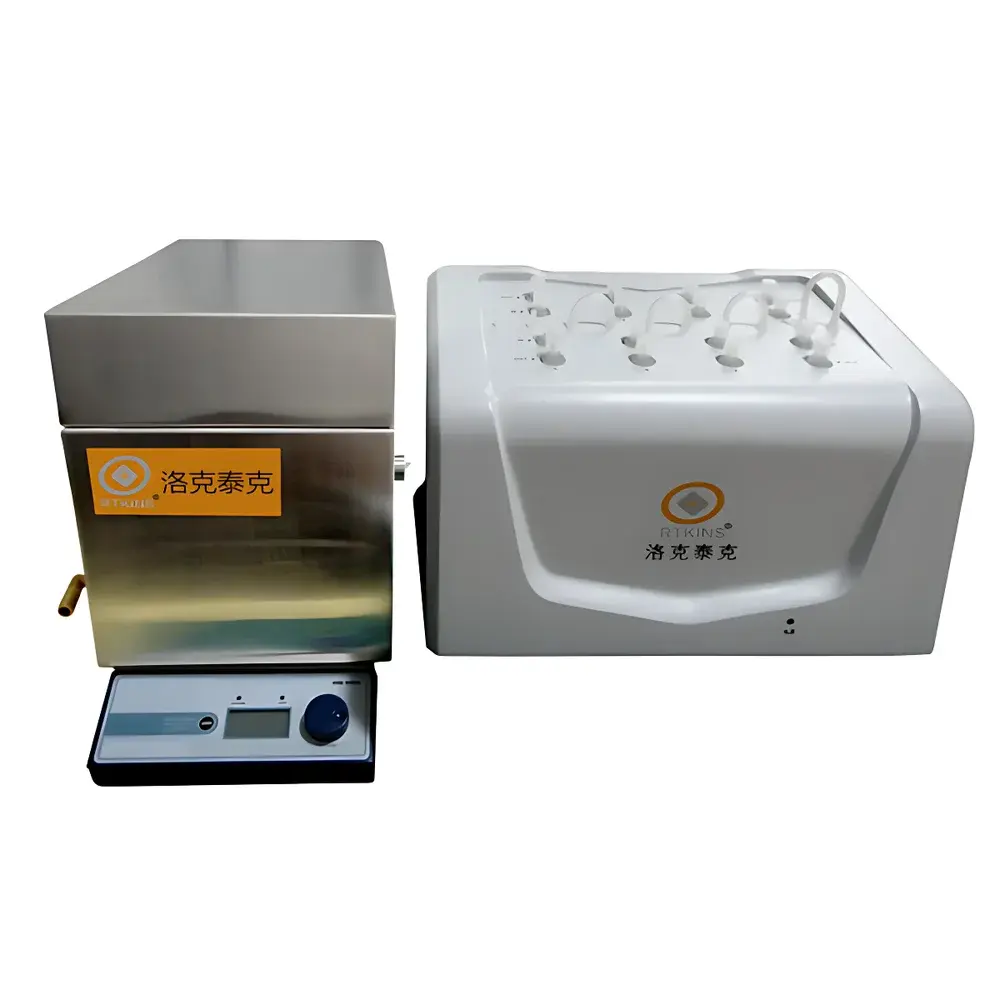
Rocktek RTK BRE Microbial Respirometry System
| Brand | Rocktek |
|---|---|
| Origin | Hubei, China |
| Manufacturer Type | Authorized Distributor |
| Product Origin | Domestic (China) |
| Model | RTK BRE |
| Pricing | Available Upon Request |
| Measurement Modes | Aerobic Oxygen Uptake Rate (OUR) & Anaerobic Gas Production Rate |
| Channel Capacity | Scalable Multi-Channel (8 channels × N modules) |
| Software-Controlled Autonomous Operation | Up to 6 months continuous unattended operation |
| Aerobic Measurement Precision | ±0.05 mg O₂ |
| Anaerobic Measurement Precision | ±0.03 mL gas |
| Data Logging Intervals | Configurable from 1 minute to 24 hours |
| Compliant Standards | OECD 301C, 301F, 302C, 209, 224, 311 |
| Application Flexibility | Liquid-phase (aqueous), solid-phase (compost/soil), and slurry-based biodegradation assays |
Overview
The Rocktek RTK BRE Microbial Respirometry System is an engineered platform for quantitative, real-time monitoring of microbial metabolic activity under controlled aerobic and anaerobic conditions. Based on closed-circuit respirometric principles, the system precisely measures oxygen consumption rate (OUR) in aerobic biodegradation assays or cumulative biogas production (CO₂, CH₄, or total headspace gas) in anaerobic systems—without requiring manual sampling or gas chromatographic analysis. Its dual-mode architecture enables seamless transition between standardized test protocols, supporting both regulatory-compliant biodegradability assessments and exploratory kinetic studies in environmental microbiology, wastewater treatment optimization, and bioprocess development.
Key Features
- Dual-mode operation: Simultaneous support for aerobic respiration (O₂ uptake) and anaerobic fermentation (gas evolution), configurable per channel
- High-precision electrochemical O₂ sensors with ±0.05 mg resolution and thermal mass-flow gas detectors with ±0.03 mL accuracy
- Modular multi-channel design: Standard 8-channel base unit scalable to N × 8 via synchronized controller expansion
- Uninterrupted autonomous operation: Continuous data acquisition for up to 180 days without manual intervention
- Flexible reactor compatibility: Interchangeable vessels for aqueous BOD testing, solid-phase compost/soil incubation, slurry digestion, and toxicity screening
- Temperature-controlled chamber integration (optional): Maintains ±0.5 °C stability across 15–40 °C operating range
- Calibration traceability: Onboard zero/span verification routines aligned with ISO/IEC 17025 calibration practices
Sample Compatibility & Compliance
The RTK BRE system accommodates diverse sample matrices—including activated sludge, freshwater/marine sediments, industrial effluents, compost amendments, synthetic polymers, pharmaceutical intermediates, and agrochemical formulations. It is validated for full compliance with internationally recognized biodegradation testing standards: OECD Guidelines 301C (DOC removal), 301F (manometric respirometry), 302C (inherent biodegradability), 209 (activated sludge respiration inhibition), 224 & 311 (anaerobic biodegradation); ISO Standards 9408 (ultimate aerobic biodegradability in water), 17556 (aerobic biodegradation in soil), and 13641-1/13641-2 (anaerobic inhibition); ASTM Methods D5338 (aerobic composting), E2170-01 (anaerobic aquatic biodegradation); US EPA OPPTS 835.3400 (anaerobic biodegradation in sediment/water systems); and Chinese National Standards GB/T 21218, GB/T 21802, GB/T 21801, GB 7488, and GB/T 19276.1. All measurement workflows support GLP-aligned audit trails and metadata tagging for regulatory submission readiness.
Software & Data Management
The proprietary BRE Control Suite provides browser-based configuration, real-time visualization, and automated report generation. Each channel logs timestamped O₂ depletion or gas volume data at user-defined intervals (1 min to 24 h), with raw values stored in encrypted SQLite databases compliant with FDA 21 CFR Part 11 requirements for electronic records and signatures. The software includes built-in calculation modules for BOD₃, BOD₅, BOD₇, BOD₂₈, and BOD₄₂ extrapolation; first-order degradation kinetics modeling; lag-phase identification; and IC₅₀/EC₅₀ derivation for toxicity endpoints. Export formats include CSV, PDF summary reports, and XML-compatible structured data for LIMS integration.
Applications
- Regulatory biodegradability dossier preparation for REACH, TSCA, and China MEPP submissions
- Performance evaluation of novel biopolymers, surfactants, and green solvents under OECD/ISO protocols
- Activated sludge health monitoring and inhibition screening in municipal and industrial WWTPs
- Kinetic characterization of anaerobic digestion efficiency in co-digestion trials (e.g., food waste + sewage sludge)
- Soil bioremediation potential assessment of hydrocarbon-contaminated sites
- BOD surrogate development and validation for rapid wastewater quality control
- Academic research in microbial ecology, enzymatic pathway elucidation, and metabolic flux analysis
FAQ
Does the RTK BRE system require external gas supply or vacuum pumps?
No—its closed-loop respirometry design operates autonomously using internal pressure regulation and sensor-based feedback control.
Can the system distinguish between CO₂ and CH₄ in anaerobic mode?
Standard configuration measures total gas volume; optional IR-based gas-speciation modules are available for CO₂/CH₄ differentiation.
Is remote monitoring supported?
Yes—the BRE Control Suite enables secure HTTPS access from any network-connected device with role-based user permissions.
How is temperature uniformity maintained across multiple reactors?
Each reactor module features independent PID-controlled heating elements and embedded Pt100 sensors; chamber-level air circulation ensures ±0.5 °C inter-vessel consistency.
What validation documentation is provided with the instrument?
Factory calibration certificates, IQ/OQ protocol templates, and a complete set of SOPs aligned with ISO/IEC 17025 and GLP requirements are included.