
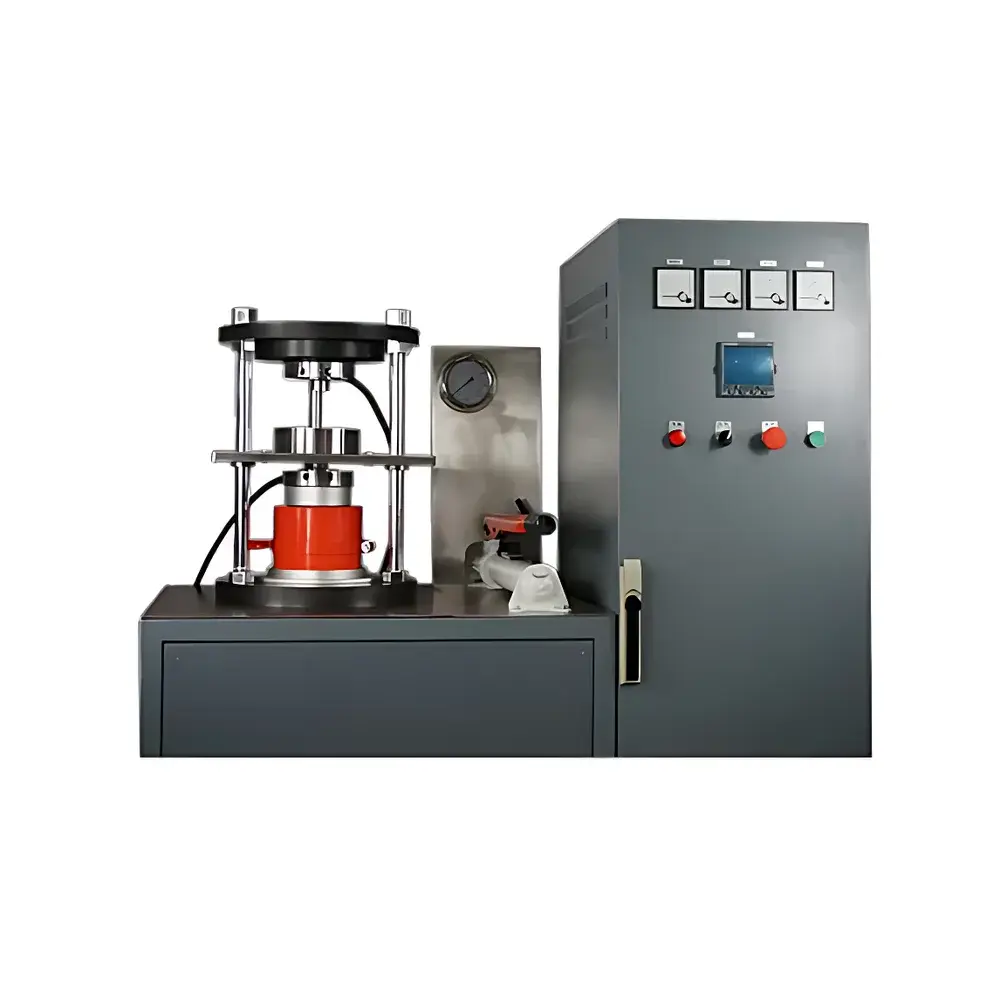
Rocktek RTK-PC-2 High-Temperature High-Pressure Press with Automated Pressure Control
| Brand | Rocktek |
|---|---|
| Origin | Hubei, China |
| Model | RTK-PC-2 |
| Pressure Range | 0–4 GPa |
| Temperature Range | 25–1800 °C |
| Chamber Diameter Options | 10 / 13 / 19 mm |
| Automation | Fully Automated Pressure Ramp & Hold |
| Heating/Cooling Rate Control | Yes |
| Continuous Operation Duration | Hours to Days |
| Compliance | Designed for GLP-aligned laboratory workflows |
Overview
The Rocktek RTK-PC-2 is a uniaxial high-temperature high-pressure (HTHP) press engineered for reproducible generation of static pressure environments up to 4 GPa and temperatures up to 1800 °C. It operates on the principle of mechanical force transmission through precision-ground anvils and pressure-transmitting media (e.g., NaCl, MgO, or borosilicate glass), enabling quasi-hydrostatic stress conditions within sample chambers. Unlike dynamic or shock-compression systems, the RTK-PC-2 delivers sustained, time-stable pressure states essential for solid-state synthesis, phase-transition studies, and in situ property characterization under geophysically relevant conditions. Its modular architecture supports interchangeable pressure assemblies and heating configurations, allowing adaptation to diverse experimental geometries—including resistive furnace-based, graphite-heated, or hybrid laser-assisted variants. The system is explicitly designed for integration into university laboratories, national research centers, and industrial R&D facilities requiring controlled, repeatable HTHP parameter space exploration without reliance on synchrotron or multi-anvil infrastructure.
Key Features
- Automated Pressure Control: Integrated RTK-developed servo-hydraulic actuation system enables programmable pressure ramping, dwell stabilization, and long-term hold (up to 72+ hours) with sub-0.5% pressure deviation over time—critical for kinetic studies and metastable phase nucleation.
- Precision-Machined Core Components: Anvil sets, pressure columns, and furnace housings are fabricated from high-strength, low-creep alloys (e.g., Ni-based superalloys and hardened tool steels), ensuring dimensional stability and thermal fatigue resistance across repeated thermal cycling.
- Modular Chamber Configuration: Interchangeable pressure cells accommodate 10 mm, 13 mm, or 19 mm internal diameters—enabling scalability from microgram-scale mineral physics experiments to gram-scale ceramic sintering or catalyst testing.
- Thermal Management Architecture: Dual-zone heating control (furnace + external thermal shielding) coupled with active cooling channels ensures radial and axial temperature gradients ≤ ±5 °C at 1600 °C—verified via embedded thermocouple mapping protocols.
- Operator-Safe Mechanical Design: Full-enclosure safety interlocks, redundant pressure relief paths, and real-time hydraulic line monitoring comply with ISO 13857 and EN 60204-1 requirements for laboratory machinery.
Sample Compatibility & Compliance
The RTK-PC-2 accommodates a broad range of sample containment media—including noble metal capsules (Pt, Au, Ir), ceramic sleeves (Al2O3, ZrO2), and salt matrices (NaCl, KCl)—supporting both reducing and oxidizing atmospheres when used with gas-purged or vacuum-sealed assemblies. All standard configurations meet ASTM E220 calibration traceability requirements for thermocouples (Type C, B, S) and conform to ISO/IEC 17025 guidelines for measurement uncertainty reporting in materials testing laboratories. Optional accessories include integrated XRD-compatible flanges, electrical feedthroughs for resistivity measurements, and magnetic field coils for magneto-structural coupling studies—each certified to IP54 environmental protection rating.
Software & Data Management
Control is executed via Rocktek’s proprietary HTHP-Studio v3.2 software suite, running on Windows-based industrial PCs. The interface provides synchronized logging of pressure (via calibrated load cell), temperature (dual-point thermocouple inputs), time, and auxiliary sensor data (e.g., displacement, current draw) at user-defined intervals down to 100 ms resolution. Raw datasets export in HDF5 format with embedded metadata (including instrument ID, calibration certificates, and operator annotations), ensuring FAIR (Findable, Accessible, Interoperable, Reusable) compliance. Audit trails record all parameter modifications, user logins, and emergency stop events—fully aligned with FDA 21 CFR Part 11 electronic record requirements when configured with digital signature modules.
Applications
The RTK-PC-2 serves as a foundational platform for experimental petrology (e.g., mantle mineral phase diagrams, melt–solid equilibria), advanced ceramics processing (SiC, AlN densification), quantum material synthesis (iron-based superconductors, topological insulators), and planetary analog studies (ice-VII stability fields, Fe–Si–O phase relations). In materials science, it enables direct observation of pressure-induced amorphization, ferroelectric switching thresholds, and hydrogen storage kinetics in complex hydrides. Industrial users apply it for accelerated aging tests of aerospace sealants, high-pressure sintering of tungsten carbide tools, and qualification of nuclear fuel matrix behavior under accident-simulated conditions.
FAQ
What pressure media are compatible with the RTK-PC-2?
Standard operation uses NaCl or MgO as hydrostatic pressure-transmitting media; non-hydrostatic configurations support graphite or borosilicate glass for directional stress applications.
Can the system be retrofitted with in situ diagnostics?
Yes—optical access ports (25 mm clear aperture), electrical feedthroughs (up to 20 A), and XRD-compatible gasket designs are available as factory-installed options.
Is third-party calibration support provided?
Rocktek supplies NIST-traceable calibration certificates for load cells and thermocouples; annual recalibration services are offered through ISO/IEC 17025-accredited partners in Europe and North America.
What maintenance intervals are recommended?
Hydraulic fluid replacement every 12 months; anvil surface inspection and re-polishing every 200 operational cycles or per visual wear assessment.
Does the system support remote operation?
Full remote control and monitoring are enabled via secure VPN-configured Ethernet connection, including live data streaming and alarm notification via SMTP or SMS gateway integration.



