
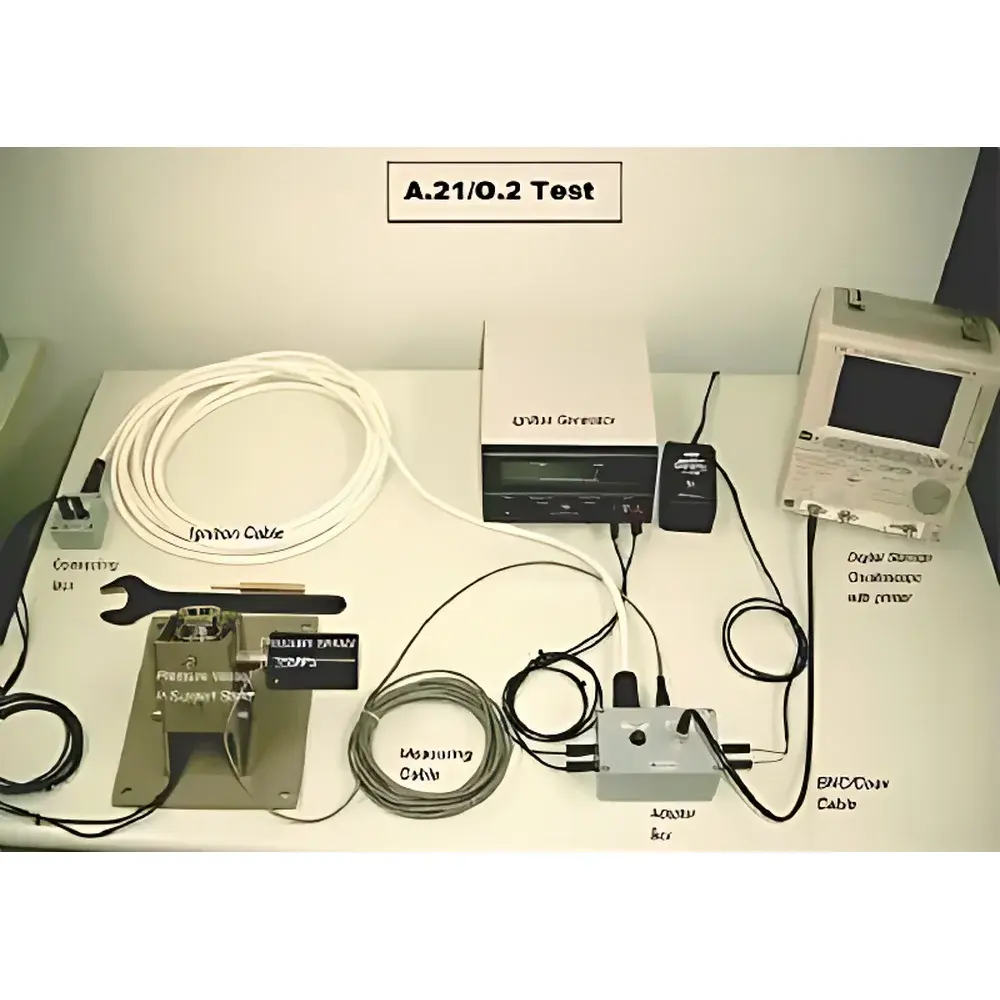
R&P A.21/O.2 Oxidizing Liquids Test Apparatus
| Brand | R&P |
|---|---|
| Origin | Germany |
| Model | A.21/O.2 Oxidizing Liquids Test Apparatus |
| Compliance | UN Manual of Tests and Criteria, Rev. 4 |
| Pressure Range | 690–2070 kPa (0–500 psi) |
| Response Time | <5 ms |
| Sensor Accuracy | ±0.2% FS |
| Ignition Wire | NiCr, 25 cm × 0.6 mm, 3.85 Ω/m |
| Burst Disc | Aluminum, 0.2 mm thick, burst pressure ≈ 320 psi |
| Power Supply | 10 A / 16 V constant current |
| Data Acquisition | Digital storage oscilloscope with PC interface and printer output |
| Remote Ignition Distance | ≥2 m |
| Enclosure | Stainless steel box-type support frame |
Overview
The R&P A.21/O.2 Oxidizing Liquids Test Apparatus is a rigorously engineered benchtop system designed to assess the oxidizing potential of liquid substances in accordance with internationally recognized transport safety protocols. It implements the O.2 test method — a standardized closed-vessel combustion acceleration assay — to quantitatively evaluate whether a test liquid, when intimately mixed with a defined combustible reference material (typically cellulose), enhances flame propagation rate or peak pressure development beyond baseline thresholds, or induces spontaneous ignition under confinement. The apparatus operates on the principle of controlled thermal initiation within a calibrated stainless-steel pressure vessel, followed by high-speed dynamic pressure measurement to capture transient combustion kinetics. Its design reflects the physical requirements stipulated in Section 34.4.2 of the United Nations *Manual of Tests and Criteria*, Fourth Revised Edition, and fully aligns with the procedural and instrumentation specifications of GB/T 21620–2008, China’s national standard for oxidizing liquid classification.
Key Features
- Stainless-steel pressure vessel with integrated side-arm configuration for reproducible sample loading and gas-phase access
- High-fidelity pressure transducer with ≤5 ms response time and ±0.2% full-scale accuracy, chemically inert to hot decomposition gases and metal oxide particulates
- Dedicated constant-current ignition module (10 A / 16 V) driving a precision NiCr wire igniter (25 cm length, 0.6 mm diameter, 3.85 Ω/m resistance)
- Explosion-relief aluminum burst disc (0.2 mm thickness, nominal burst pressure 320 psi) mounted in fail-safe orientation
- Modular hardware architecture enabling reconfiguration for supplementary tests including time-pressure analysis per UN Test O.1
- Remote ignition control cabinet physically isolated from the reaction chamber (>2 m separation), meeting IEC 61000-4-2 ESD and EN 60079-0 intrinsic safety considerations for operator protection
- Robust stainless-steel support frame engineered to absorb mechanical shock and contain minor venting events without structural compromise
Sample Compatibility & Compliance
The A.21/O.2 apparatus accommodates liquid samples up to 10 mL volume, compatible with aqueous, organic, and halogenated formulations — provided they do not corrode 316 stainless steel or degrade the aluminum burst disc at ambient temperature. All operational parameters, calibration procedures, and pass/fail criteria conform explicitly to the O.2 test protocol defined in UN ST/SG/AC.10/Rev.4 and its harmonized national implementation in GB/T 21620–2008. The system supports audit-ready documentation for regulatory submissions under IMDG Code, IATA DGR, and ADR frameworks. Instrument qualification includes documented as-found/as-left calibration records traceable to NIST-certified pressure standards, satisfying GLP-compliant laboratory requirements for hazardous substance classification.
Software & Data Management
Data acquisition is performed via an embedded digital storage oscilloscope synchronized with the ignition trigger. Raw time–pressure waveforms are captured at ≥1 MHz sampling rate and stored permanently in binary format (.bin) with embedded metadata (timestamp, operator ID, environmental conditions). Optional PC-based software enables annotation of test runs with customizable fields: company name, sample ID, batch number, mass, density, ambient temperature/humidity, and observer notes. Export formats include CSV (for statistical analysis in MATLAB or JMP), PDF reports (with embedded waveform plots and pass/fail determinations), and XML (compatible with LIMS integration). Audit trails record all user actions, parameter modifications, and data exports in compliance with FDA 21 CFR Part 11 requirements for electronic records and signatures.
Applications
- Hazard classification of industrial solvents, battery electrolytes, and pharmaceutical intermediates prior to shipping or storage
- Regulatory dossier preparation for REACH registration, CLP labeling, and SDS authoring (Section 9: Physical and chemical properties)
- Formulation screening during R&D of new oxidizer-stabilized propellants or energetic materials
- Verification testing for UN certification bodies and third-party inspection agencies (e.g., TÜV, SGS, BV)
- Root-cause analysis of thermal runaway incidents involving liquid oxidizers in process vessels or transport containers
FAQ
What safety standards does the A.21/O.2 comply with?
It meets the mechanical, electrical, and procedural requirements of UN Manual of Tests and Criteria Rev.4 Section 34.4.2 and GB/T 21620–2008, including pressure containment integrity, ignition energy control, and data traceability.
Can the instrument be used for solid oxidizer testing?
No — the A.21/O.2 is specifically configured for liquids. Solid oxidizer evaluation requires the complementary A.1/A.2 series apparatus per UN Test O.1.
Is calibration certification included with delivery?
Yes — each unit ships with a factory calibration certificate referencing NIST-traceable pressure standards, valid for 12 months under normal operating conditions.
How is data integrity ensured during long-term archival?
Waveform files are checksum-verified upon save; metadata embedding prevents manual alteration; software enforces role-based access control and immutable audit logs per 21 CFR Part 11.
What maintenance intervals are recommended?
Burst discs must be replaced after every test run; pressure sensor zero-check is required before each daily session; annual full recalibration is advised for ISO/IEC 17025-accredited laboratories.



