
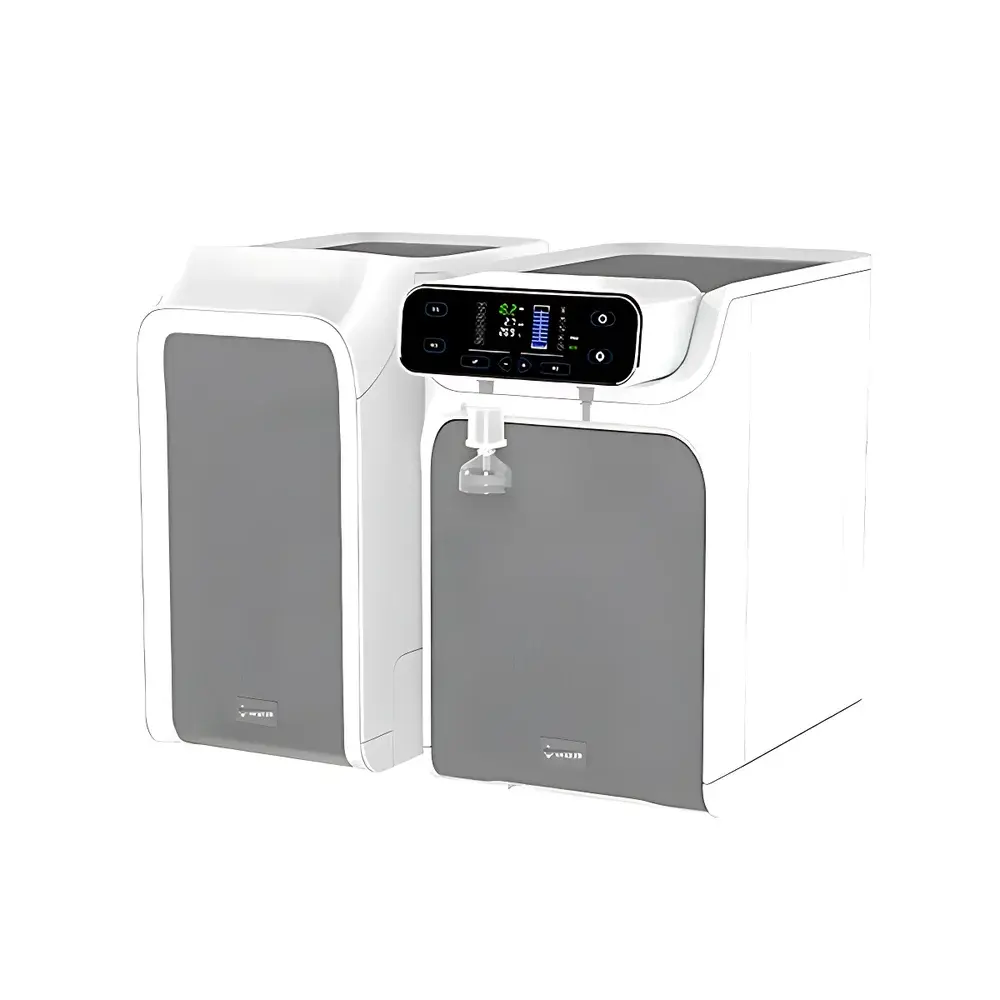
RSJ UNIQ Intelligent Ultra-Pure Water System
| Brand | RSJ |
|---|---|
| Origin | Fujian, China |
| Manufacturer Type | Direct Manufacturer |
| Origin Category | Domestic |
| Model | UNIQ |
| Quotation | Upon Request |
| Purified Water Grade | Type I (ASTM D1193-06 Grade I / GB/T 6682-2008 Grade I) |
| Resistivity | 18.2 MΩ·cm @ 25 °C |
| Heavy Metals & Soluble Silica | <0.01 ppb |
| Total Organic Carbon (TOC) | <3 ppb |
| Microbial Count | <0.001 CFU/mL |
| Endotoxin | <0.001 EU/mL |
| Particles (>0.2 µm) | <1 particle/mL |
| Integrated TOC Monitor Range | 1.0–999 ppb |
| Dual-Grade Dual-Quantitative Dispensing | Up to 2 L/min, ±1% volumetric accuracy |
| Storage Capacity | 25 L (modular expansion available) |
| Feed Water | Municipal tap water, 5–40 °C, 1–6 bar pressure |
| Disinfection | RO/UP circuit UV-LED + chemical-free thermal or ozone-compatible protocol |
| Power Input | AC 100–240 V, 50 Hz |
| Rated Power | 120 W |
| Dimensions (Reservoir Unit) | 280 × 490 × 555 mm (W×D×H) |
| (Main Unit w/ EZ-DSP Faucet) | 330 × 575 × 545 mm (W×D×H) |
Overview
The RSJ UNIQ Intelligent Ultra-Pure Water System is an integrated, modular laboratory water purification platform engineered for precision-critical applications in analytical chemistry, life sciences, and pharmaceutical quality control. It employs a multi-stage purification architecture combining activated carbon prefiltration, reverse osmosis (RO), electrodeionization (EDI), dual-wavelength UV photooxidation (185/254 nm), and sequential ultrafiltration—including a dedicated endotoxin-removing membrane and optional DNase/RNase-retentive final filter. The system delivers consistent Type I ultrapure water per ASTM D1193-06 (2018), GB/T 6682-2008 (Grade I), GB/T 11446.1-2013, and GB/T 33087-2016 standards, with real-time resistivity monitoring at 18.2 MΩ·cm @ 25 °C and TOC suppression below 3 ppb under validated operational conditions. Its closed-loop, bag-based storage design eliminates headspace exposure and microbial recontamination—addressing a key failure mode in conventional stainless-steel or polyethylene reservoirs.
Key Features
- Modular Service Architecture: All core purification modules—including RO membrane cartridge, EDI stack, UV lamps, and terminal filters—are tool-free, hot-swappable units. Routine maintenance requires no certified technician; standard operating procedures are embedded in the HMI and accessible via QR-coded module labels.
- Intuitive Human-Machine Interface: A 7-inch capacitive touchscreen displays real-time resistivity, TOC, temperature, flow rate, and consumable lifetime. Critical status indicators (e.g., low UV intensity, filter saturation, bag replacement due date) are color-coded and prioritized on the home screen.
- EZ-DSP Integrated Dispensing Station: A single-faucet, dual-grade interface supports simultaneous or independent delivery of purified water (ECO mode, <5 µS/cm) and ultrapure water (PRO mode), each with programmable volume dispensing (1 mL–9.99 L), gravimetric calibration traceability, and automatic air purge.
- Cloud-Enabled Remote Management: Built-in Wi-Fi/Ethernet connectivity enables secure TLS 1.2–encrypted data transmission to RSJ’s ISO 27001–certified cloud platform. Administrators receive predictive alerts for consumable depletion, performance drift, and disinfection scheduling—fully auditable for GLP/GMP compliance.
- Bag-Based Sterile Storage: Proprietary single-use polymer reservoirs eliminate biofilm formation and eliminate cleaning validation requirements. Each bag is gamma-irradiated, pyrogen-free, and certified to USP and , with batch-specific CoA documentation.
Sample Compatibility & Compliance
The UNIQ system is validated for continuous production of water meeting stringent specifications required across regulated environments. Its output complies with pharmacopeial monographs including USP “Water for Pharmaceutical Purposes”, EP 2.2.44 “Purified Water”, and JP XVII “Purified Water”. For cell culture and molecular biology workflows, the system achieves endotoxin levels <0.001 EU/mL and nuclease activity below detection limits (DNase <4 pg/mL, RNase <1 pg/mL, protease <0.15 µg/mL) when equipped with the optional 5 kDa ultrafiltration cartridge. All electronic logs—including dispensing events, calibration records, alarm histories, and user authentication—support FDA 21 CFR Part 11 compliance via configurable audit trails, electronic signatures, and role-based access control.
Software & Data Management
RSJ CloudLink software provides centralized fleet management for multi-unit installations. Each UNIQ unit logs timestamped metadata for every dispense event: volume, grade selected, resistivity/TOC at point-of-use, operator ID, and ambient temperature/humidity. Data is retained locally for ≥12 months and synchronized hourly to encrypted cloud storage with version-controlled backups. Export formats include CSV, PDF (with digital signature), and direct integration into LIMS via RESTful API. System diagnostics—including UV lamp spectral decay curves, pump duty cycle histograms, and pressure differential trends across filtration stages—are visualized as interactive time-series charts for root-cause analysis during quality investigations.
Applications
- Analytical Instrumentation: HPLC/UPLC mobile phase preparation, ICP-MS sample introduction, AAS blank correction, and GC-MS solvent dilution—all requiring sub-ppb metal and organic contamination control.
- Life Science Research: Serum-free mammalian cell culture media formulation, CRISPR-Cas9 transfection buffer preparation, qPCR master mix dilution, and LC-MS/MS proteomics sample cleanup where nuclease or endotoxin carryover compromises assay fidelity.
- Quality Control Laboratories: USP TOC system suitability testing, pharmacopeial water system validation (IQ/OQ/PQ), and routine environmental monitoring of purified water distribution loops per ISO 14644-1 Class 5 cleanroom requirements.
- General Laboratory Use: Glassware rinsing prior to trace-metal analysis, autoclave feed water for sterile process validation, and reagent grade water for titration and spectrophotometry where conductivity stability directly impacts measurement uncertainty.
FAQ
What regulatory standards does the UNIQ system support for audit readiness?
The system generates full electronic records compliant with FDA 21 CFR Part 11, EU Annex 11, and ISO/IEC 17025:2017. Audit trails include user actions, parameter changes, alarm acknowledgments, and calibration verifications—with immutable timestamps and digital signatures.
Can the TOC monitor be calibrated in-house, and what is its measurement uncertainty?
Yes—the integrated TOC sensor supports two-point calibration using NIST-traceable sucrose and potassium hydrogen phthalate standards. Typical measurement uncertainty is ±0.5 ppb (k=2) within the 1–50 ppb range, verified annually per ISO 17025-accredited service.
How is microbial contamination prevented during long-term storage?
The disposable bag reservoir eliminates static water contact surfaces. Combined with continuous recirculation through a 0.22 µm sterilizing-grade filter and periodic UV-C irradiation (254 nm) of the loop, bioburden remains below 0.001 CFU/mL without chemical sanitization.
Is the system compatible with existing lab infrastructure such as building automation or LIMS?
Yes—RSJ CloudLink offers native OPC UA and MQTT protocols for integration with BMS platforms, and REST API endpoints support automated data ingestion into major LIMS vendors (e.g., LabVantage, STARLIMS, Thermo Fisher SampleManager).
What is the expected service life of the EDI module under typical lab usage?
With municipal feed water meeting specified inlet criteria (hardness <100 ppm CaCO₃, chlorine 18.0 MΩ·cm for ≥24 months or 15,000 L of ultrapure output—whichever occurs first—per RSJ’s accelerated life testing protocol (IEC 60721-3-3 Class 3K5).



