
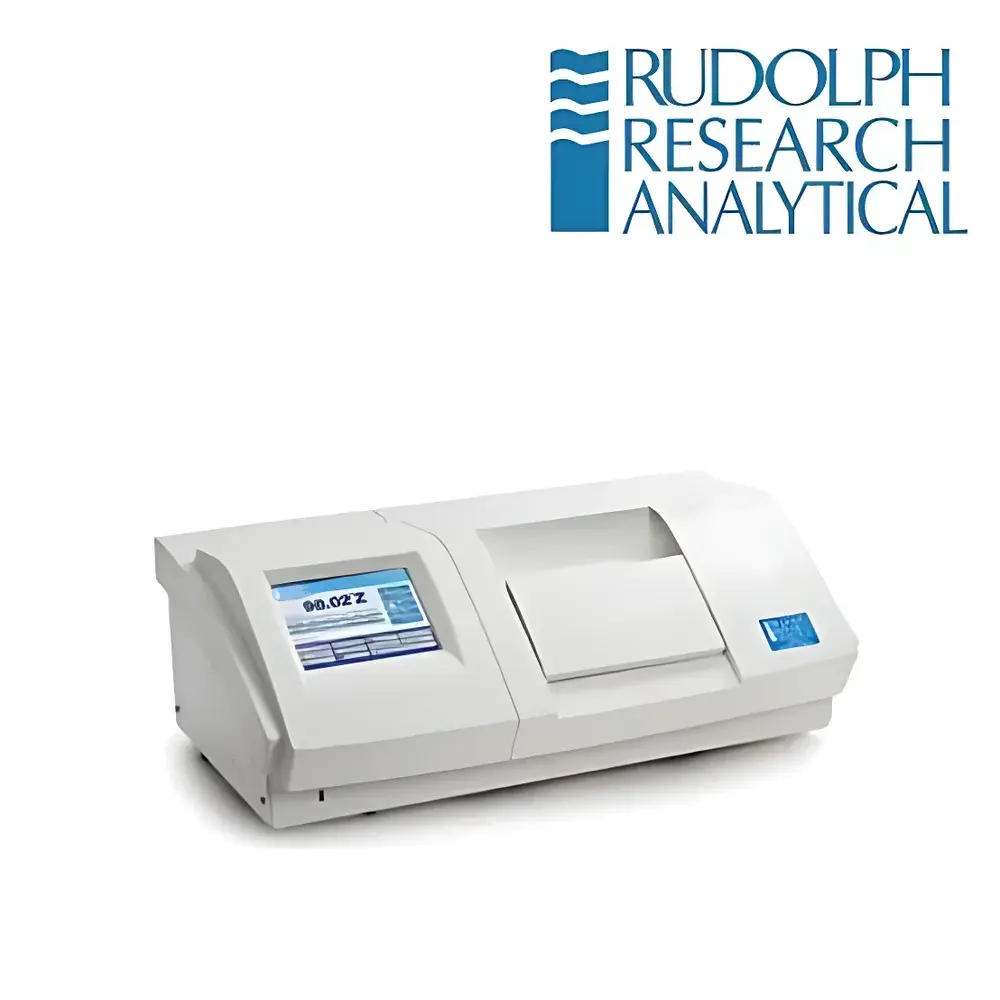
Rudolph AUTOPOL 880 Digital Polarimeter
| Brand | Rudolph |
|---|---|
| Origin | USA |
| Model | AUTOPOL 880 |
| Measurement Wavelengths | 589 nm and 880 nm |
| Wavelength Switching | Automatic |
| Optical Rotation Range | ±225°Z |
| Resolution | 0.01°Z |
| Optical Element | Calcite Prism |
| Temperature Control Range | 20–40 °C |
| Temperature Accuracy | ±0.1 °C |
| Calibration | One-Touch Auto-Calibration |
| Measurement Modes | Sucrose Concentration (°Z), Specific Rotation (°), Purity, or User-Defined Parameters |
| Sample Type | Non-Destructive Analysis |
Overview
The Rudolph AUTOPOL 880 Digital Polarimeter is a high-precision, thermally stabilized polarimetric instrument engineered for accurate and reproducible measurement of optical rotation in sucrose solutions and other optically active substances. Based on the fundamental principle of polarimetry—quantifying the angular rotation of plane-polarized light as it passes through chiral media—the AUTOPOL 880 delivers traceable, metrologically sound results essential for sugar industry compliance, quality assurance, and process validation. Designed and manufactured in the United States by Rudolph Research Analytical, a leader in polarimetric instrumentation since 1949, the AUTOPOL 880 integrates dual-wavelength capability (589 nm sodium D-line and 880 nm near-infrared) to support both traditional saccharimetric reporting (°Z) and advanced correction protocols required under modern international trade standards.
Key Features
- Dual-wavelength optical system (589 nm and 880 nm) with fully automated wavelength selection—enabling simultaneous verification, temperature-independent correction, and compliance with ISO 2047 and ICUMSA Method GS2/3-15.
- Integrated Peltier-controlled sample compartment maintaining temperature stability within ±0.1 °C across the 20–40 °C operating range—critical for minimizing thermal drift and ensuring repeatability per ASTM D1006 and USP <788>.
- High-resolution detection system delivering 0.01°Z resolution over a full ±225°Z range—suitable for concentrated cane syrup, beet molasses, and refined sucrose solutions without dilution.
- Calcite-based polarizing optics providing long-term stability, minimal birefringence drift, and immunity to UV degradation—ensuring calibration integrity over extended service intervals.
- One-touch auto-calibration using certified quartz control plates traceable to NIST standards—eliminating manual zeroing and reducing operator-induced variability.
- Non-destructive measurement architecture compatible with reusable cells, flow-through cuvettes, and inline process adapters—supporting both laboratory QC and pilot-scale process monitoring.
Sample Compatibility & Compliance
The AUTOPOL 880 accommodates standard 100 mm and 200 mm pathlength cells (including jacketed and thermostatted variants), as well as custom cell geometries for viscous or particulate-laden samples. It meets the technical requirements of major global sugar regulatory frameworks, including ICUMSA (International Commission for Uniform Methods of Sugar Analysis), the U.S. FDA’s guidance for food-grade sucrose quantification, and EU Regulation (EC) No 1234/2007 Annex IV. Its measurement algorithm is validated against reference materials certified under ISO/IEC 17025-accredited laboratories, and its audit trail functionality satisfies GLP and GMP documentation requirements—including full electronic record retention, user access controls, and 21 CFR Part 11-compliant signature workflows when paired with Rudolph’s POLARIS software suite.
Software & Data Management
Controlled via Rudolph’s POLARIS v5.x software platform, the AUTOPOL 880 supports automated method execution, real-time data visualization, statistical trend analysis (e.g., moving averages, control charts), and export to CSV, PDF, or LIMS-compatible XML formats. The software includes built-in calculation modules for °Z-to-%w/w conversion per ICUMSA Pol-Sac tables, purity index derivation from dual-wavelength ratios, and customizable report templates aligned with internal QA documentation standards. All measurement events—including calibration logs, temperature profiles, and user actions—are timestamped and cryptographically signed to support regulatory inspections and internal audits.
Applications
- Raw sugar and refinery QC: Determination of polarization purity, invert sugar content, and sucrose equivalence in centrifugals, affination liquors, and finished white sugar.
- Trade settlement analysis: Certified °Z reporting for international contracts governed by ICUMSA, USDA, or FAS standards.
- R&D in carbohydrate chemistry: Kinetic monitoring of enzymatic hydrolysis, mutarotation studies, and chiral impurity profiling in synthetic glycosides.
- Beverage and confectionery manufacturing: In-process verification of syrup concentration, batch consistency checks, and raw material release testing.
- Pharmaceutical excipient qualification: Verification of dextrose, lactose, and mannitol optical activity per USP monographs and EP 2.2.7.
FAQ
What does “°Z” represent, and how is it different from specific rotation (°)?
°Z (Zwick scale) is a saccharimetric unit defined by ICUMSA for sucrose solutions at 20 °C using the 589 nm wavelength. It differs from specific rotation in that it incorporates standardized pathlength, concentration, and temperature conventions—making it directly applicable to commercial sugar grading.
Can the AUTOPOL 880 measure non-sucrose chiral compounds?
Yes—the instrument reports raw optical rotation (°) and supports user-defined calibration curves, enabling quantification of fructose, glucose, menthol, amino acids, and pharmaceutical actives when referenced against appropriate standards.
Is temperature control mandatory for accurate °Z readings?
Yes—ICUMSA mandates measurement at 20.0 °C ±0.1 °C for official °Z certification. The AUTOPOL 880’s integrated Peltier system ensures strict adherence to this requirement without external chillers or baths.
How often must the instrument be recalibrated?
NIST-traceable quartz control plates are recommended for daily verification; full recalibration is typically performed quarterly or after mechanical shock, per laboratory SOPs aligned with ISO/IEC 17025 Clause 6.5.
Does the system support integration with factory automation networks?
Via optional Ethernet/IP or Modbus TCP modules, the AUTOPOL 880 can transmit measurement values and status codes to SCADA, MES, or DCS platforms—enabling closed-loop concentration control in continuous crystallization lines.




