
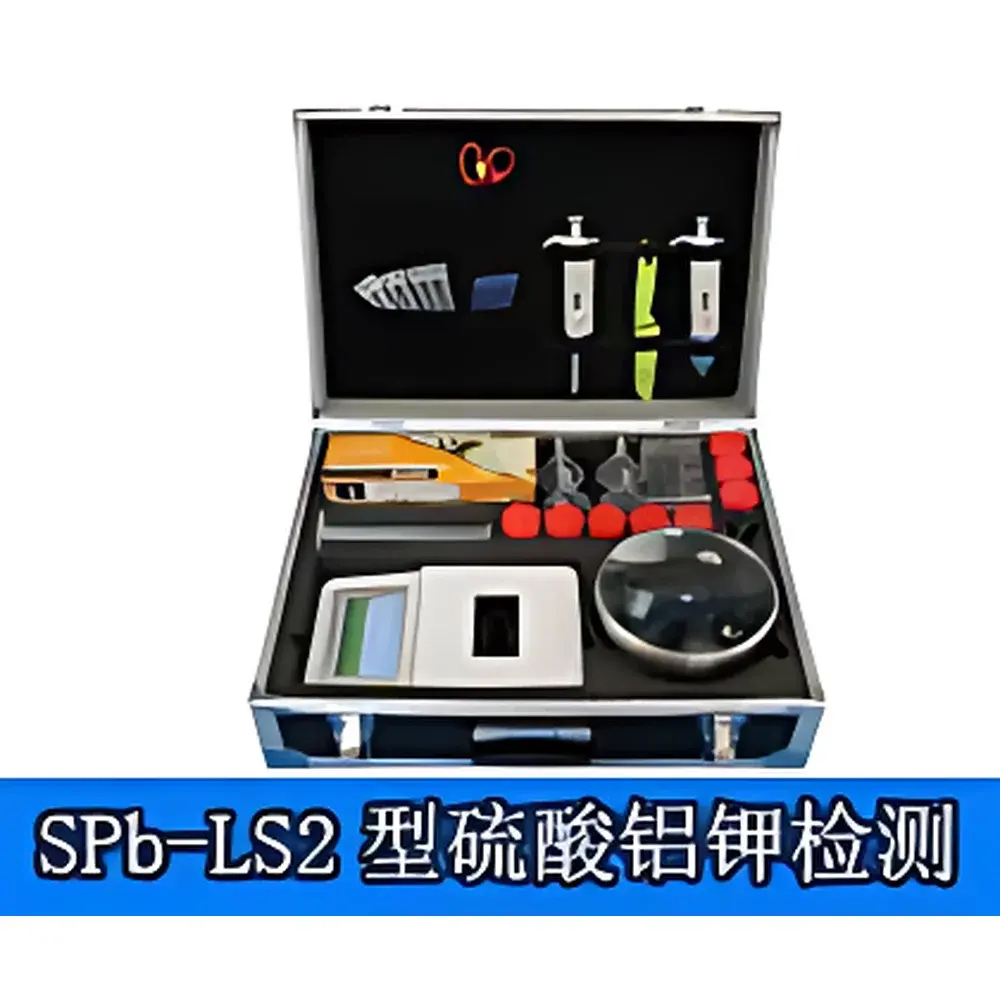
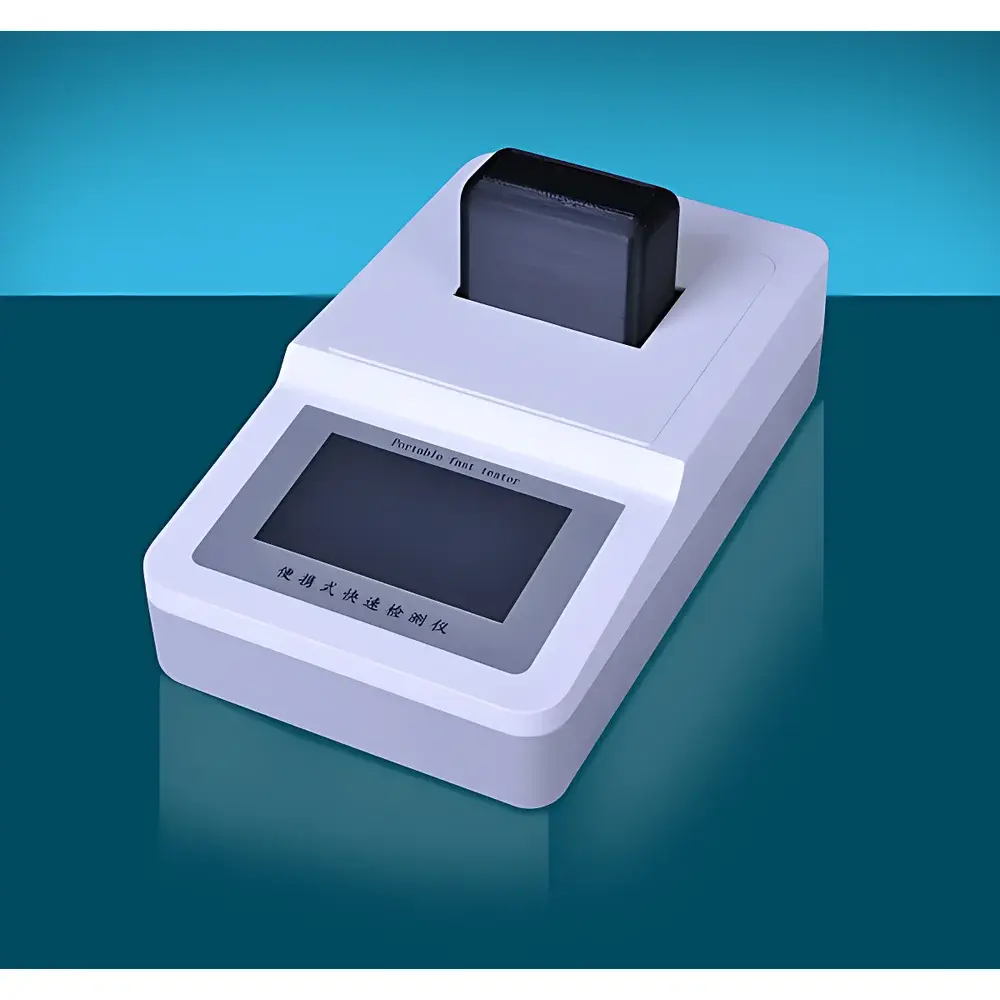
Ruixin SPb-LS2 Potassium Aluminum Sulfate Analyzer
| Brand | Ruixin |
|---|---|
| Origin | Shanghai, China |
| Manufacturer Type | Authorized Distributor |
| Country of Origin | China |
| Model | SPb-LS2 |
| Price | USD 920 (FOB Shanghai) |
| Functionality | Single-Analyte Detection |
| Sample Format | Dedicated Single-Sample Cartridge |
| Wavelength | 630 nm |
| Assay Time | ≤ 180 s |
| Optical Repeatability (Transmittance) | ≤ 0.2% |
| Detection Channels | 1 |
Overview
The Ruixin SPb-LS2 Potassium Aluminum Sulfate Analyzer is a portable, single-wavelength photometric analyzer engineered for rapid, field-deployable quantification of potassium aluminum sulfate (commonly known as alum) in food matrices. It operates on the principle of visible-light absorbance spectroscopy at a fixed wavelength of 630 nm, where alum—after derivatization with a standardized colorimetric reagent—forms a stable chromophore whose absorbance intensity is linearly proportional to concentration within the 0–200 mg/kg range. Designed specifically for regulatory and quality assurance use in food supply chains, the SPb-LS2 meets the functional requirements of rapid screening protocols mandated by GB 5009.182–2017 (National Food Safety Standard – Determination of Aluminum in Foods) and aligns with the methodological framework of AOAC Official Method 2015.01 for aluminum-based food additives. Its compact architecture, integrated lithium-ion power system, and self-calibrating optical path eliminate dependency on laboratory infrastructure, enabling consistent performance in mobile inspection units, market surveillance vehicles, or decentralized field laboratories.
Key Features
- Portable form factor (245 × 170 × 75 mm; 1.2 kg) with built-in rechargeable Li-ion battery supporting ≥8 hours of continuous operation
- 4.3-inch high-resolution TFT-LCD capacitive touchscreen with full Chinese GUI and intelligent Chinese handwriting input support
- Self-aligning optical system with automatic zero/100% transmittance calibration at startup—no manual reference adjustment required
- Dual-mode photometric display: absorbance (0.000–4.000, resolution 0.001) and transmittance (0.00–100.00%, resolution 0.01%) for cross-method validation and auxiliary assay development
- Embedded thermal printer generating compliant test reports containing analyte concentration, Chinese sample name, detection date, operator ID, and testing institution
- On-device data storage (≥10,000 records) with timestamped audit trail and local recall functionality
- Optical stability ≤ 0.3% over 3 minutes (drift), ensuring measurement integrity during sequential batch analysis
Sample Compatibility & Compliance
The SPb-LS2 is validated for aqueous extracts prepared from solid food samples—including wheat flour, vermicelli, steamed buns, and preserved fruits—following standardized pretreatment per GB/T 5009.182. It accepts pre-loaded reagent cartridges or user-prepared colorimetric reaction mixtures in standard 10-mm optical cuvettes. The instrument complies with electromagnetic compatibility (EMC) standards GB/T 18268.1–2010 and safety specification GB 4793.1–2018. While not certified under ISO/IEC 17025, its performance parameters satisfy internal QA/QC criteria for Level I rapid screening instruments used in accordance with China’s Market Supervision General Administration (SAMR) Technical Guidance on Rapid Food Testing (No. 123, 2021). Data output formats are compatible with national food safety monitoring platforms via RS232 or USB-to-serial bridge.
Software & Data Management
The embedded firmware supports GLP-compliant data handling: each result is automatically stamped with date/time, operator ID (input via touchscreen), and instrument serial number. All measurements are stored with immutable metadata and cannot be edited post-acquisition. Export is supported via USB mass storage mode (CSV format) or real-time transmission via RS232 to centralized LIMS or municipal food safety dashboards. No proprietary software installation is required for basic data retrieval; raw files contain ASCII-encoded fields including Abs, %T, concentration (mg/kg), and QC flags. Audit logs record power-on events, calibration triggers, and print actions—enabling traceability for internal audits or SAMR inspection.
Applications
- Routine surveillance of alum adulteration in starch-based staple foods across wholesale markets and rural distribution centers
- On-site verification during unannounced inspections by provincial CDC laboratories and municipal market regulation bureaus
- Pre-screening prior to confirmatory ICP-MS analysis in accredited food testing labs
- Training and capacity building for frontline inspectors in resource-constrained settings due to minimal consumables and intuitive workflow
- Integration into mobile food safety labs mounted on inspection vans equipped with GPS-synchronized reporting modules
FAQ
What is the detection limit for potassium aluminum sulfate using this instrument?
The limit of detection (LOD) is 2 mg/kg in solid food samples following standardized extraction and color development.
Does the instrument require external calibration standards before each use?
No—optical path auto-calibration occurs at power-on; only routine verification with a control standard every 24 hours is recommended per operational SOP.
Can the SPb-LS2 be used for other analytes besides potassium aluminum sulfate?
It is configured exclusively for alum detection at 630 nm; modification for alternate assays would require hardware-level recalibration and revalidation, which is not supported under warranty.
Is the thermal printer report accepted as official documentation during regulatory inspections?
Yes—the printed report includes all mandatory fields specified in SAMR Notice No. 45 (2020) for rapid test evidence, provided the instrument’s calibration status is current and operator ID is authenticated.
How is data security maintained during RS232 transmission?
Data packets are transmitted in plain-text ASCII without encryption; secure transfer requires integration with an external middleware layer implementing TLS or signed API handshaking—outside the device’s native capability.




