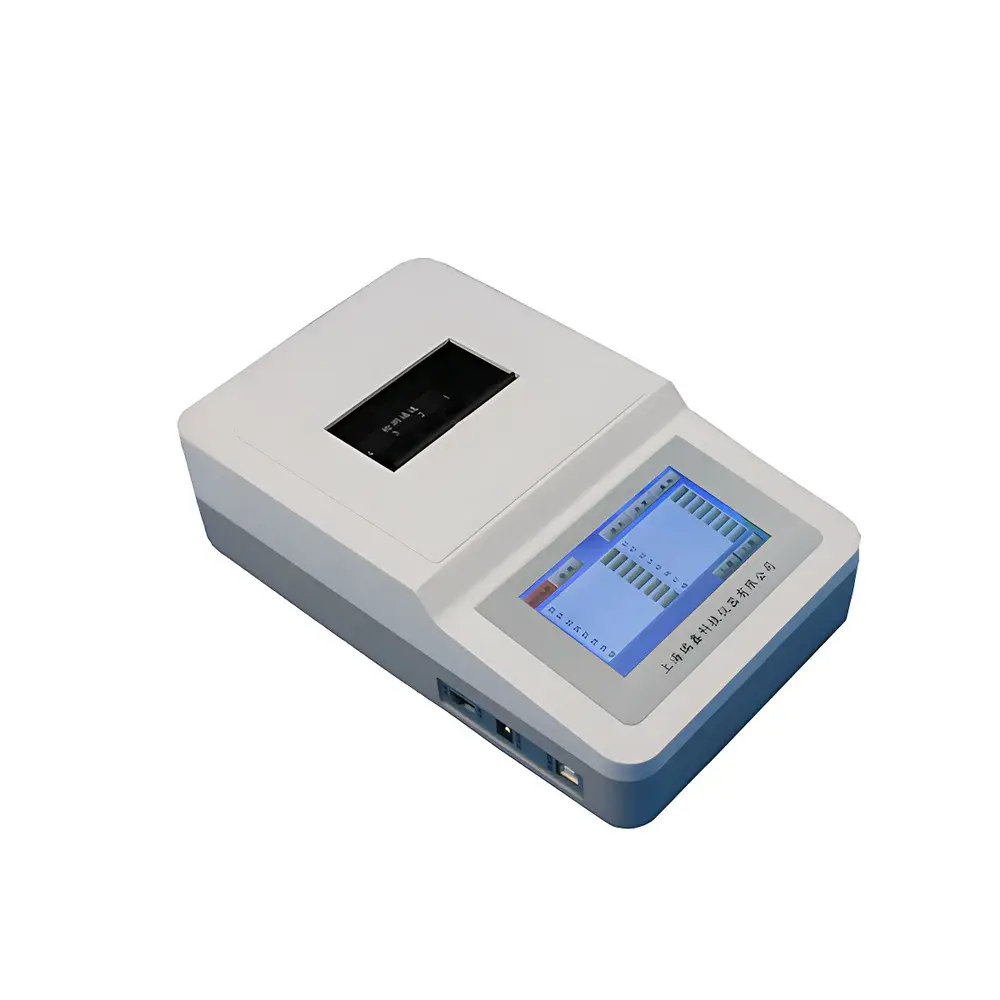
Ruixin SPb-TJ2 Sodium Saccharin Rapid Detection Analyzer
| Brand | Ruixin |
|---|---|
| Origin | Shanghai, China |
| Manufacturer Type | Authorized Distributor |
| Country of Manufacture | China |
| Model | SPb-TJ2 |
| Price Range | USD 2,800–4,200 (FOB Shanghai) |
| Functionality | Single-Analyte Detection System |
| Sample Format | Dedicated Single-Sample Cartridge |
| Optical Wavelength | 630 nm |
| Assay Time | ≤ 180 seconds per sample |
| Photometric Repeatability | ≤ 0.2% RSD |
| Detection Channels | 1 |
Overview
The Ruixin SPb-TJ2 Sodium Saccharin Rapid Detection Analyzer is a compact, field-deployable photometric analyzer engineered for quantitative determination of sodium saccharin in food matrices—including beverages, confectionery, preserved fruits, and processed dairy products. It operates on the principle of visible-spectrum absorption photometry at a fixed wavelength of 630 nm, where sodium saccharin—after derivatization via standardized colorimetric reaction—forms a stable chromophore with defined molar absorptivity. The instrument implements a dual-mode optical readout (absorbance and transmittance), enabling direct concentration calculation using pre-calibrated calibration curves stored in firmware. Designed to meet the operational requirements of regulatory field laboratories and mobile inspection units, the SPb-TJ2 complies with core methodological expectations outlined in GB 5009.28–2023 (National Food Safety Standard for Determination of Saccharin Sodium in Foods) and aligns with general validation criteria referenced in AOAC Official Method 2015.01 and ISO/IEC 17025:2017 for rapid screening instrumentation.
Key Features
- Integrated 4.3-inch high-resolution TFT color touchscreen with full Chinese GUI—supports stylus and predictive Chinese input for sample annotation and operator logging.
- Self-calibrating optical path system: automatic zero and 100% T initialization at power-on, eliminating manual baseline adjustment and reducing operator dependency.
- Dual photometric display: simultaneous real-time readout of absorbance (0.000–4.000 AU, resolution 0.001) and transmittance (0.00–100.00%, resolution 0.01%), facilitating method transfer and cross-platform verification.
- Onboard thermal printer: generates traceable hard-copy reports containing analyte concentration (g/kg), Chinese-labeled sample ID, date/time stamp, analyst ID, and testing unit—fully compliant with GLP documentation requirements.
- Triple-power architecture: rechargeable Li-ion battery (≥8 hours continuous operation), AC 220 V input, and DC 5 V external supply—enabling uninterrupted use in vehicles, pop-up labs, or remote checkpoints.
- Embedded data management: automatic storage of ≥10,000 test records with timestamped metadata; supports chronological or sample-ID-based retrieval via touchscreen interface.
Sample Compatibility & Compliance
The SPb-TJ2 is validated for aqueous extracts prepared from solid and liquid food samples according to GB 5009.28–2023 extraction protocols. It accepts single-use, pre-packaged reagent cartridges designed for sodium saccharin-specific color development—minimizing cross-contamination and inter-operator variability. While not a primary reference method, its performance characteristics (LOD: 0.05 g/kg; linear range: 0.0–1.0 g/kg; repeatability ≤0.2% RSD) satisfy screening-level acceptance criteria under China’s SAMR Food Safety Risk Monitoring Program. Instrument firmware includes audit-trail logging for calibration events, user logins, and result modifications—supporting basic 21 CFR Part 11 readiness when deployed in GMP-adjacent environments.
Software & Data Management
Data export is supported via RS-232 serial interface and USB 2.0 port, enabling seamless integration with LIMS platforms or centralized food safety surveillance networks (e.g., national market supervision cloud platforms). Raw absorbance values, calculated concentrations, and metadata are exported in CSV format without proprietary encryption. Firmware supports firmware-over-the-air (FOTA) updates through USB drive—ensuring alignment with evolving national standard revisions. No cloud subscription or vendor-hosted software is required; all processing occurs locally on-device.
Applications
- Routine surveillance testing by municipal market regulation bureaus during routine inspections and unannounced sampling campaigns.
- On-site verification in food logistics hubs, wholesale markets, and cold-chain distribution centers to confirm label compliance prior to retail release.
- Supplemental screening in QC laboratories where HPLC confirmation is reserved for non-conforming results—reducing analytical turnaround time by >70%.
- Training and capacity-building for frontline inspectors in county-level CDC and health supervision institutions.
- Integration into mobile food safety detection vehicles equipped with multi-analyte modules (e.g., combined with nitrite, formaldehyde, or pesticide residue analyzers).
FAQ
Is the SPb-TJ2 certified for official regulatory reporting?
It is approved as a rapid screening device under China’s GB/T 27404–2008 guidelines for laboratory quality control of rapid detection methods—not as a definitive quantification method. Confirmatory analysis by HPLC or LC-MS/MS is required for enforcement actions.
Can the instrument be used for other sweeteners?
No. The optical filter, reagent formulation, and calibration curve are optimized exclusively for sodium saccharin. Cross-reactivity with acesulfame-K, cyclamate, or aspartame has not been validated.
What maintenance is required?
Daily optical path verification using supplied blank cuvettes; biannual photometer verification with NIST-traceable neutral density filters; no consumable optics or lamps require replacement within first 36 months of operation.
Does it support English language interface?
Firmware currently supports Chinese only; English UI localization is available upon OEM agreement for international distribution partners.
How is data integrity ensured during transmission?
All RS-232 and USB exports include CRC-16 checksums; no authentication or encryption layer is implemented—users must enforce transport-layer security at the network level if transmitting over public infrastructure.