
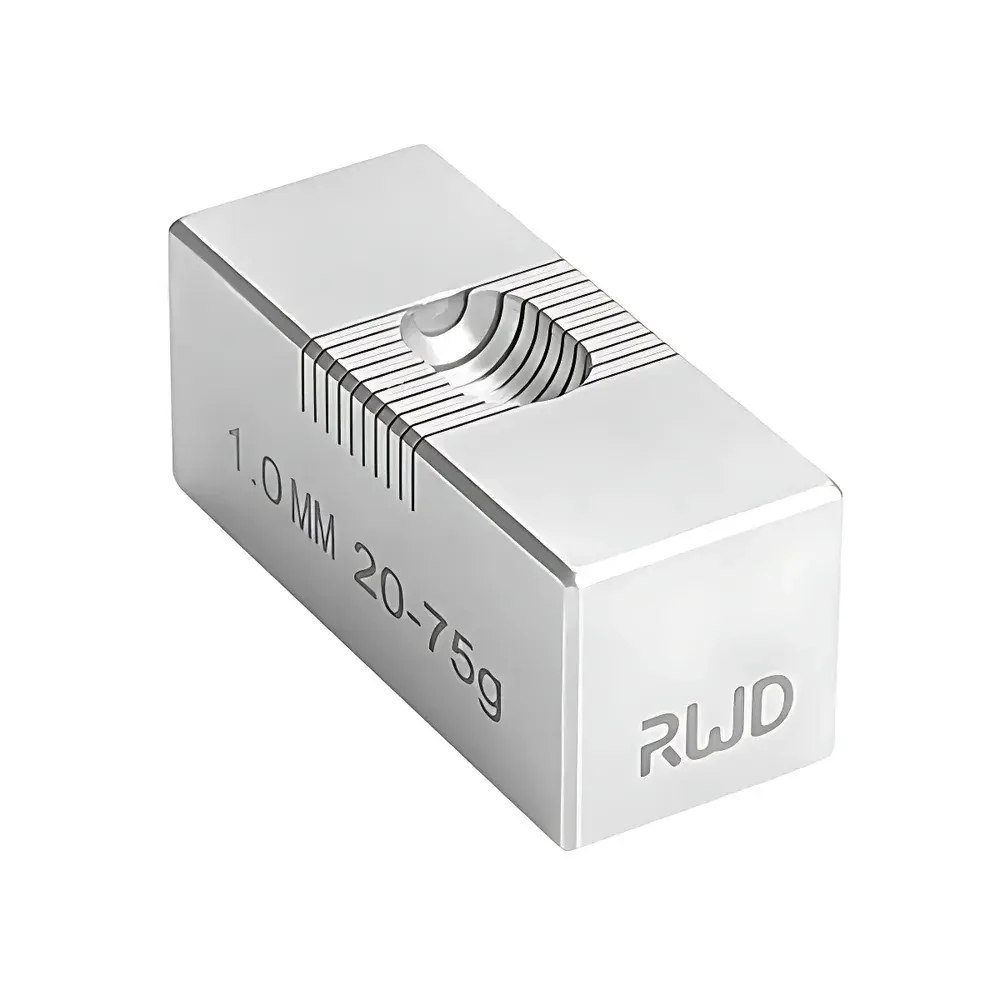
RWD 68719 Stainless Steel Mouse and Juvenile Rat Coronary Heart Tissue Mold
| Brand | RWD |
|---|---|
| Origin | Shenzhen, China |
| Manufacturer Type | OEM Manufacturer |
| Country of Origin | China |
| Model | 68719 |
| Price | Upon Request |
| Animal Weight Range | 20–75 g |
| Sectioning Orientation | Coronary |
| Section Thickness | 1.0 mm |
| Mold Dimensions (A × B × Depth) | 8.3 × 12.7 × 4.8 mm |
| Material | Electropolished 316L Stainless Steel |
| Sterilization Compatibility | Autoclavable (121°C, 20 min), Dry Heat, Cold Ethanol Wipe, Cryogenic Use |
Overview
The RWD 68719 Stainless Steel Mouse and Juvenile Rat Coronary Heart Tissue Mold is a precision-engineered histological tool designed for reproducible, orientation-specific sectioning of small rodent hearts in preclinical cardiovascular research. Engineered for use in ischemia-reperfusion, myocardial infarction, and cardiac remodeling studies, the mold facilitates standardized coronal alignment—ensuring consistent anatomical plane registration across serial sections. Constructed from medical-grade 316L stainless steel with electropolished surface finish, it eliminates galvanic corrosion risk and supports full compatibility with cryosectioning workflows, paraffin embedding protocols, and post-fixation handling. Unlike polymer or aluminum alternatives, this mold maintains dimensional stability under thermal cycling (−80°C to +135°C), resists pitting during repeated ethanol or sodium hypochlorite decontamination, and withstands mechanical stress from cryostat blade contact without deformation.
Key Features
- Precision-machined coronal cavity geometry ensures accurate anterior–posterior alignment of ventricular and atrial structures, minimizing inter-specimen orientation variance.
- Electropolished 316L stainless steel surface provides non-porous, low-protein-binding topology—critical for minimizing tissue adhesion and preserving antigen integrity during frozen sectioning.
- Autoclavable up to 121°C for 20 minutes per cycle; validated for repeated sterilization without loss of dimensional accuracy or surface reflectivity.
- Thermally inert construction enables direct placement on chilled metal stages or dry ice platforms prior to embedding—eliminating thermal shock-induced tissue cracking.
- Integrated depth stop (4.8 mm) and fixed-width slot (8.3 mm × 12.7 mm) standardize embedding volume and prevent lateral compression of fragile myocardial tissue during OCT compound infiltration.
Sample Compatibility & Compliance
The RWD 68719 mold is validated for use with murine and juvenile rat hearts weighing 20–75 g—commonly corresponding to C57BL/6 mice (8–12 weeks), BALB/c neonates (P7–P14), and Sprague-Dawley juveniles (P21–P28). It complies with ISO 13485:2016 design control requirements for laboratory instrumentation and meets material biocompatibility criteria per ISO 10993-5 (cytotoxicity) and ISO 10993-10 (irritation/sensitization). Its seamless, weld-free architecture satisfies GLP-compliant lab documentation standards for traceable, non-integrated tools used in regulated toxicology and pharmacodynamics studies.
Software & Data Management
While the RWD 68719 is a passive mechanical device requiring no firmware or software integration, its geometric consistency directly supports digital pathology workflows. When paired with automated slide scanners (e.g., Leica Aperio AT2, Hamamatsu NanoZoomer), standardized section thickness (1.0 mm) and coronal plane fidelity enable reliable 3D reconstruction of myocardial perfusion territories using serial-section immunohistochemistry (IHC) or lectin-based vascular labeling. All RWD tissue molds ship with a serialized certificate of conformance, including metrology verification data (CMM report available upon request), supporting audit readiness for FDA 21 CFR Part 11–aligned quality systems.
Applications
- Standardized coronary sectioning for TTC (triphenyltetrazolium chloride) staining in acute ischemia models.
- Pre-embedding orientation of hearts prior to OCT freezing for cryo-EM sample preparation or spatial transcriptomics (e.g., 10x Genomics Visium).
- Controlled-thickness sectioning for quantitative assessment of infarct size, fibrosis area (Masson’s trichrome), and capillary density (CD31 IHC).
- Structural alignment of hearts from transgenic lines (e.g., α-MHC-Cre; Rosa26-tdTomato) to ensure regional comparability across cohorts.
- Supporting echocardiography–histology correlation studies by anchoring section planes to standardized echocardiographic views (e.g., short-axis at papillary muscle level).
FAQ
Can the RWD 68719 mold be used with adult rat hearts?
No—adult rat hearts (typically >250 g) exceed the internal cavity dimensions. For rats weighing 175–400 g, use model 68720 (1.0 mm) or 68722 (0.5 mm).
Is the mold compatible with vibratome sectioning?
Yes, though primarily optimized for cryostat and microtome use; its rigidity prevents flexure during low-speed vibratome cutting when embedded in 4% PFA-fixed agarose.
Does electropolishing affect stainless steel corrosion resistance?
Electropolishing enhances passive oxide layer uniformity and removes embedded iron contaminants, improving long-term resistance to chloride-induced pitting—particularly critical in saline-based fixation protocols.
Can multiple molds be sterilized simultaneously in one autoclave cycle?
Yes—stacking is permitted provided airflow pathways remain unobstructed; validation per EN 285 is recommended for institutional sterilization SOPs.
What is the expected service life under daily GLP use?
With proper cleaning (non-abrasive detergent, ultrasonic bath optional) and avoidance of acidic fixatives (e.g., Bouin’s solution), typical lifespan exceeds 5 years with no measurable dimensional drift (±0.02 mm tolerance maintained per ASME B89.1.10M).




