
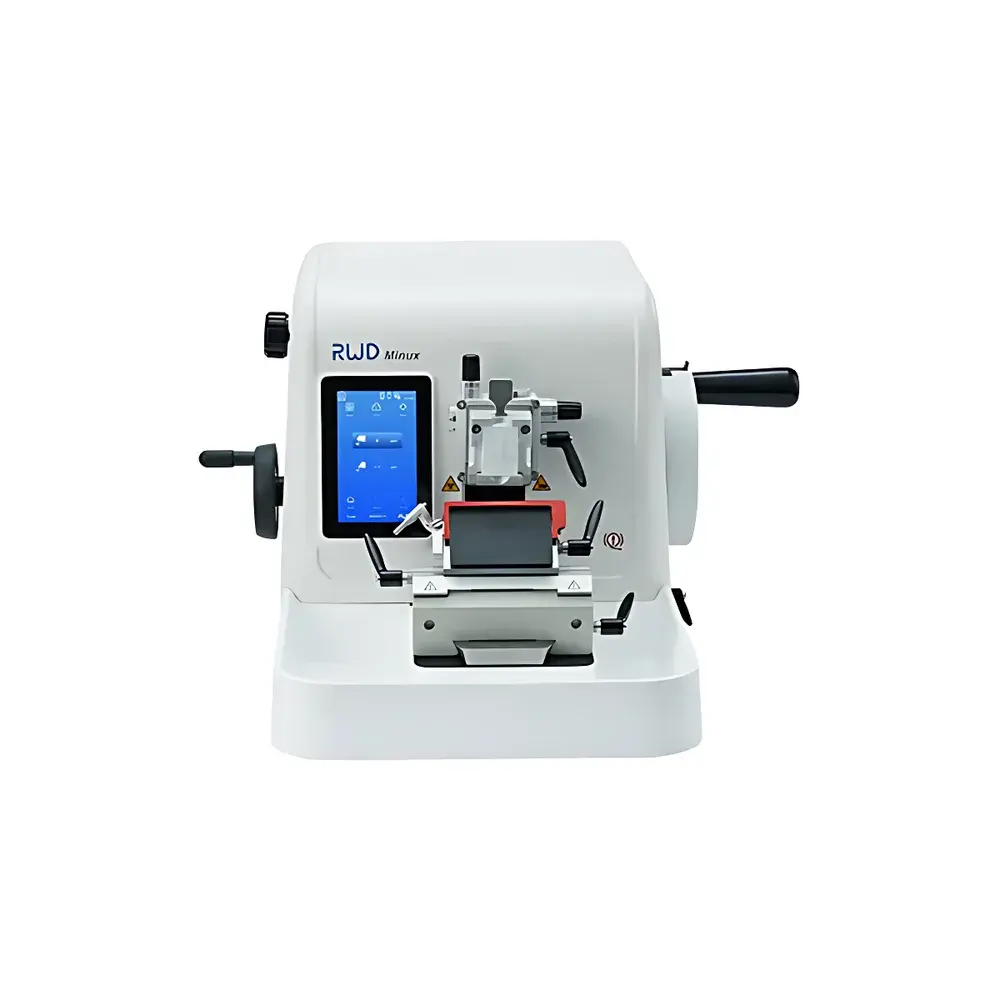
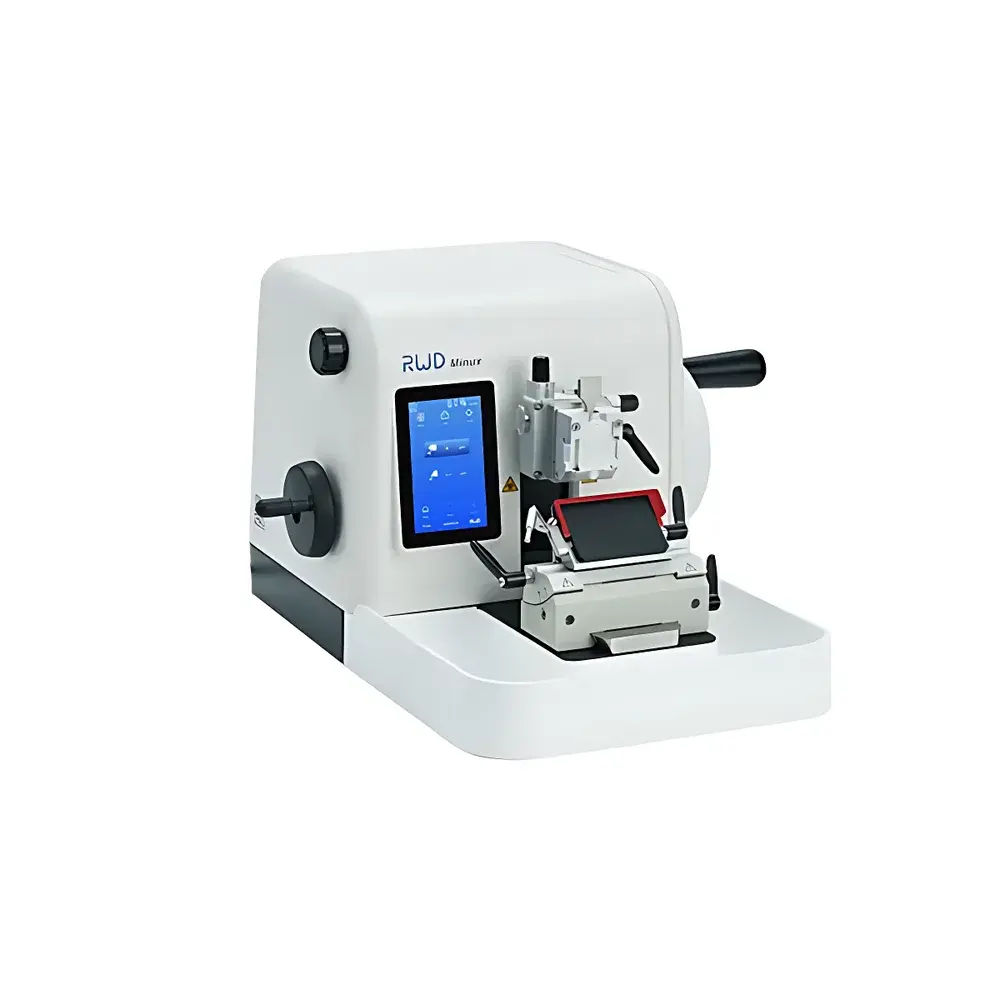
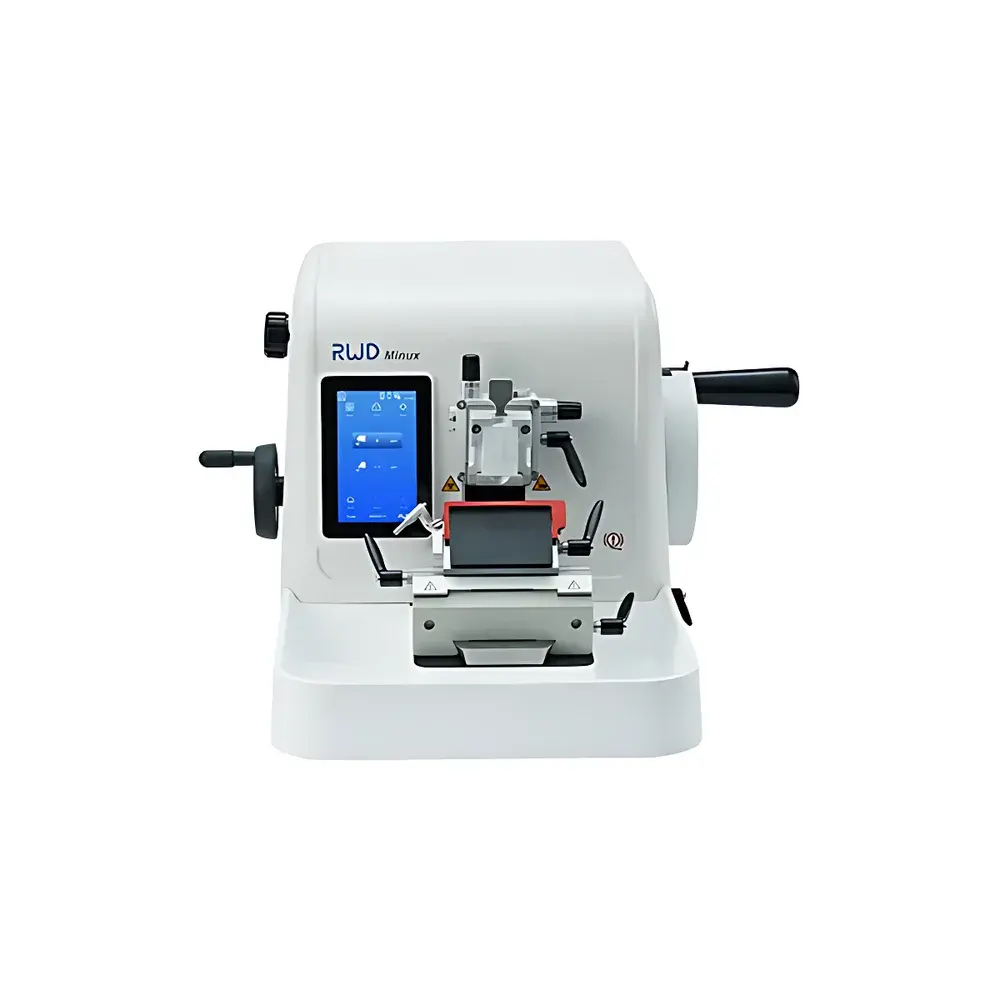
RWD S710 Rotary Microtome for Paraffin Sectioning
| Brand | RWD |
|---|---|
| Origin | Guangdong, China |
| Manufacturer Type | Direct Manufacturer |
| Origin Category | Domestic (China) |
| Model | S710 |
| Quotation | Upon Request |
| Section Thickness Range | 0.5 – 100 µm |
| Maximum Specimen Size | 60 × 50 × 40 mm |
| Horizontal Travel | 28 mm |
| Vertical Travel | 70 mm |
Overview
The RWD S710 Rotary Microtome is a precision-engineered instrument designed for consistent, high-fidelity paraffin-embedded tissue sectioning in histopathology, research laboratories, and core pathology facilities. Built upon the proven mechanical architecture of the RWD S700 series, the S710 introduces a dual-mode advancement: motorized specimen advance integrated with tactile manual control—enabling both reproducible automation and intuitive operator-directed sectioning. Its operation adheres to the fundamental principles of rotary microtomy, where a fixed-angle knife shears thin sections from a paraffin-embedded block mounted on a movable specimen holder, with precise vertical displacement governed by calibrated micrometer mechanisms. The S710 is engineered for stability under continuous use, featuring rigid cast-alloy construction, low-vibration drive transmission, and thermal-stable base design to minimize drift during extended sectioning sessions.
Key Features
- Motor-driven specimen advancement with programmable step resolution down to 0.5 µm, ensuring exceptional repeatability across serial sections and reducing inter-operator variability.
- Dual-mode operation: seamless switching between motorized feed and fine-tuned manual advancement via ergonomic side-mounted handwheel—preserving established technician workflows while enabling automation scalability.
- Modular external control interface compatible with optional standalone control box (RWD CBox-S710), supporting footswitch activation, remote start/stop, and integration into lab-wide digital workflow systems.
- Optimized specimen stage geometry with 28 mm horizontal travel and 70 mm vertical travel, accommodating standard cassette-based blocks and oversized specimens up to 60 × 50 × 40 mm without reorientation or trimming compromises.
- Knife holder compliant with universal tungsten-carbide and disposable blade standards (e.g., Leica RM2235, Thermo HM355S), facilitating rapid blade changes and alignment consistency.
- Integrated anti-static coating on specimen clamp and stage surfaces to mitigate electrostatic charge buildup—a common cause of ribbon distortion in low-humidity environments.
Sample Compatibility & Compliance
The S710 accommodates standard formalin-fixed, paraffin-embedded (FFPE) tissue blocks, as well as harder materials including decalcified bone biopsies and resin-embedded specimens (e.g., methyl methacrylate). Its adjustable specimen orientation system supports coronal, sagittal, and oblique plane sectioning with ±15° tilt capability. All mechanical adjustments conform to ISO 13485:2016 design control requirements for medical device manufacturing. The microtome’s operational documentation and calibration procedures support GLP-compliant environments; traceable adjustment logs can be maintained manually or synchronized with LIMS-integrated platforms. While not FDA-cleared as an IVD device, the S710 meets essential performance criteria outlined in ASTM E2131-21 (Standard Guide for Preparation of Tissue Sections for Microscopic Examination) and aligns with best practices referenced in College of American Pathologists (CAP) Laboratory Accreditation Checklists.
Software & Data Management
The S710 operates as a hardware-centric platform with embedded firmware—not reliant on PC-hosted software for core functionality. However, its optional CBox-S710 control module supports RS-232 and USB-C connectivity for bidirectional communication with laboratory information systems (LIS) or digital pathology workstations. Firmware versioning, section count logging, and user-defined parameter presets (e.g., thickness, speed, pause intervals) are stored locally with non-volatile memory retention. Audit trail functionality—including timestamped parameter changes and operator ID tagging—is available when deployed with RWD’s optional LabTrack™ middleware (v2.3+), which complies with FDA 21 CFR Part 11 requirements for electronic records and signatures in regulated settings.
Applications
- Routine diagnostic histology: generation of 3–5 µm sections for H&E and special stains in clinical pathology labs.
- Preclinical research: serial sectioning of rodent brain, tumor xenografts, and developmental tissue blocks at sub-micron increments for 3D reconstruction.
- Quality assurance in biobanking: standardized sectioning protocols across multiple operators to ensure inter-lab comparability of archived FFPE samples.
- Teaching laboratories: dual-mode interface enables novice users to learn manual technique while gradually transitioning to motor-assisted precision.
- Correlative microscopy: production of adjacent sections for parallel immunohistochemistry (IHC), in situ hybridization (ISH), and electron microscopy grid preparation.
FAQ
Does the S710 support cryosectioning?
No—the S710 is specifically optimized for room-temperature paraffin sectioning. It lacks refrigerated stage cooling or cryo-adapted knife geometry required for frozen tissue.
Can the motorized feed be disabled for full manual operation?
Yes—motor power can be fully disengaged via front-panel toggle, reverting the instrument to purely mechanical handwheel-driven advancement without affecting calibration integrity.
Is routine maintenance documented in English?
Yes—comprehensive English-language service manuals, torque specifications, and preventive maintenance schedules are provided with each unit and accessible via RWD’s secure technical portal.
What is the recommended calibration frequency?
RWD recommends verification of section thickness accuracy using NIST-traceable gauge blocks every 200 operating hours or quarterly—whichever occurs first—especially in GLP/GMP-regulated environments.
Are replacement parts globally available?
Yes—key wear components (knife holders, specimen clamps, feed gears) are stocked in RWD’s EU distribution hub (Rotterdam) and US logistics center (Chicago), with typical lead time under 5 business days for standard orders.



