
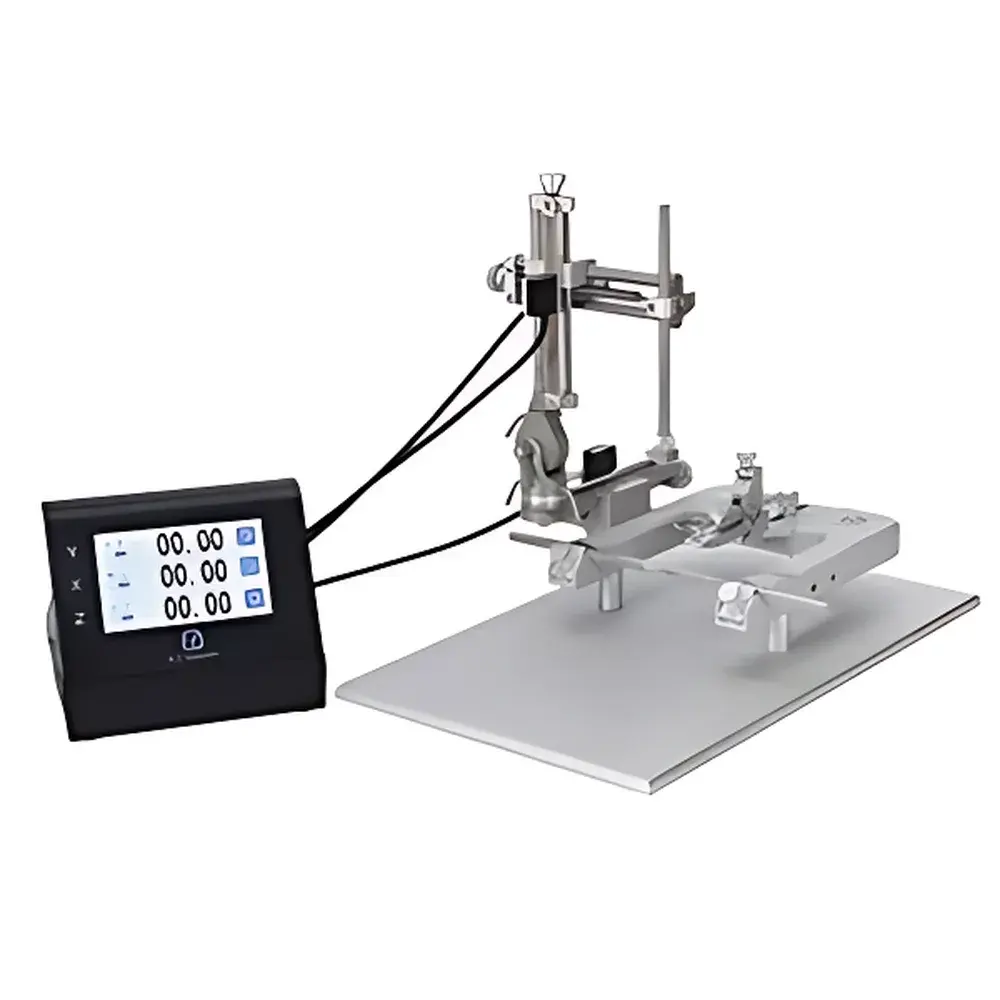
RWD Single-Arm Digital Stereotaxic Instrument
| Origin | Beijing, China |
|---|---|
| Manufacturer Type | Authorized Distributor |
| Origin Category | Domestic (PRC) |
| Model | RWD Single-Arm Digital Stereotaxic Instrument |
| Price Range | USD 7,000 – 14,000 |
| Display | 5-inch HD LED capacitive touchscreen |
| Positional Resolution | 10 µm |
| Zeroing Function | One-touch axis-specific zero reset across X/Y/Z travel range |
| Power Options | AC adapter + optional rechargeable Li-ion battery module |
| Connector Standard | Industrial-grade imported locking connectors (color-coded: red/blue/black for X/Y/Z axes) |
| Base Compatibility | Standard rat stereotaxic frame mounting interface |
| Included Accessories | Base plate, left-hand 3D manipulator arm with integrated displacement sensors, rat ear bar set (18° angle), rat head holder, universal clamp |
Overview
The RWD Single-Arm Digital Stereotaxic Instrument is a precision neurosurgical positioning system engineered for reproducible intracranial targeting in rodent models. It operates on the fundamental principles of stereotaxic coordinate geometry—leveraging standardized brain atlases (e.g., Paxinos & Watson) to translate anatomical landmarks into three-dimensional Cartesian coordinates relative to bregma and lambda. Unlike analog mechanical systems, this instrument integrates high-fidelity linear displacement sensors directly into the X-, Y-, and Z-axis translation mechanisms of the left-hand manipulator arm. Real-time positional data is processed and rendered on a dedicated 5-inch HD capacitive touchscreen, eliminating parallax error, vernier interpolation ambiguity, and manual calculation steps inherent in traditional vernier-scale instruments. Its rigid aluminum alloy frame and low-backlash lead-screw actuation ensure sub-10 µm repeatability—critical for microinjection, electrode implantation, optogenetic fiber placement, and cranial window surgery where spatial accuracy directly impacts experimental validity.
Key Features
- Integrated triaxial displacement sensing with 10 µm resolution across full travel range (X: ±25 mm, Y: ±25 mm, Z: ±30 mm), calibrated per ISO 9001 traceable procedures
- Capacitive 5-inch HD touchscreen display with anti-glare coating and adjustable viewing angle mount—designed for ergonomic operation under surgical lighting conditions
- One-touch digital zeroing function per axis, enabling rapid re-referencing to any physical position without mechanical disengagement or recalibration
- Color-coded, IP65-rated industrial connectors (red = X, blue = Y, black = Z) for sensor-to-display signal integrity and maintenance-free long-term reliability
- Dual-power architecture supporting continuous AC operation or field-deployable operation via optional UL-certified rechargeable lithium-ion battery pack (runtime ≥8 hrs at typical usage load)
- Modular mechanical design compliant with standard RWD and Kopf base plate footprints, allowing seamless integration into existing stereotaxic workstations
Sample Compatibility & Compliance
The instrument is validated for use with adult Sprague-Dawley and Wistar rats (250–500 g) using the included 18° angled ear bars and adjustable head clamp assembly. All structural components meet ASTM F2100 Level 3 biocompatibility requirements for non-implantable surgical support devices. The electronics subsystem complies with IEC 61000-6-3 (EMI emission) and IEC 61000-6-2 (immunity) standards. Firmware supports audit-trail logging (user ID, timestamp, coordinate values, zero-event flags) in alignment with GLP documentation requirements. Device firmware versioning and calibration history are exportable as CSV for regulatory submission packages.
Software & Data Management
While the instrument operates as a standalone hardware system, its embedded controller supports USB-C data export of session logs—including coordinate snapshots, zeroing events, and timestamped positional sequences. Exported files are compatible with MATLAB, Python (pandas), and LabChart for downstream trajectory reconstruction and statistical analysis. Optional firmware update service provides version-controlled patches addressing sensor drift compensation algorithms and display responsiveness enhancements. No cloud connectivity or proprietary software installation is required—ensuring full data sovereignty and compatibility with air-gapped laboratory networks.
Applications
- Unilateral intracerebral microinjection of viral vectors, tracers, or pharmacological agents into defined nuclei (e.g., striatum, hippocampus, prefrontal cortex)
- Precise placement of chronic EEG, LFP, or single-unit recording electrodes with <100 µm target deviation
- Implantation of optical fibers for optogenetic stimulation or fiber photometry with angular alignment verification
- Craniotomy positioning and dural puncture guidance during in vivo two-photon imaging preparation
- Validation studies requiring NIST-traceable positional reproducibility across multi-site preclinical trials
- Training platform for stereotaxic technique certification under AAALAC-accredited animal care programs
FAQ
Is the instrument compatible with mouse stereotaxic procedures?
Yes—when used with optional mouse-specific ear bars and bite bars (sold separately), the system supports C57BL/6 and BALB/c mice (20–35 g) with positional scaling maintained via software-defined coordinate offsets.
Can the digital arm be retrofitted onto an existing analog RWD base?
Yes—the left-arm manipulator is mechanically and electrically interoperable with all RWD Series 2000 and 3000 base plates manufactured after 2018.
Does the device support FDA 21 CFR Part 11 compliance?
The embedded audit trail meets core requirements for electronic records; full Part 11 implementation requires integration with validated third-party ELN/LIMS platforms for electronic signatures and role-based access control.
What is the calibration interval recommendation?
Annual calibration is recommended per ISO/IEC 17025 guidelines; RWD-certified service centers provide NIST-traceable verification reports with each calibration event.
Is technical support available outside mainland China?
Yes—RWD maintains authorized service partners in the US, Germany, Japan, and Australia, with remote diagnostics support and English-language firmware documentation provided upon registration.





