
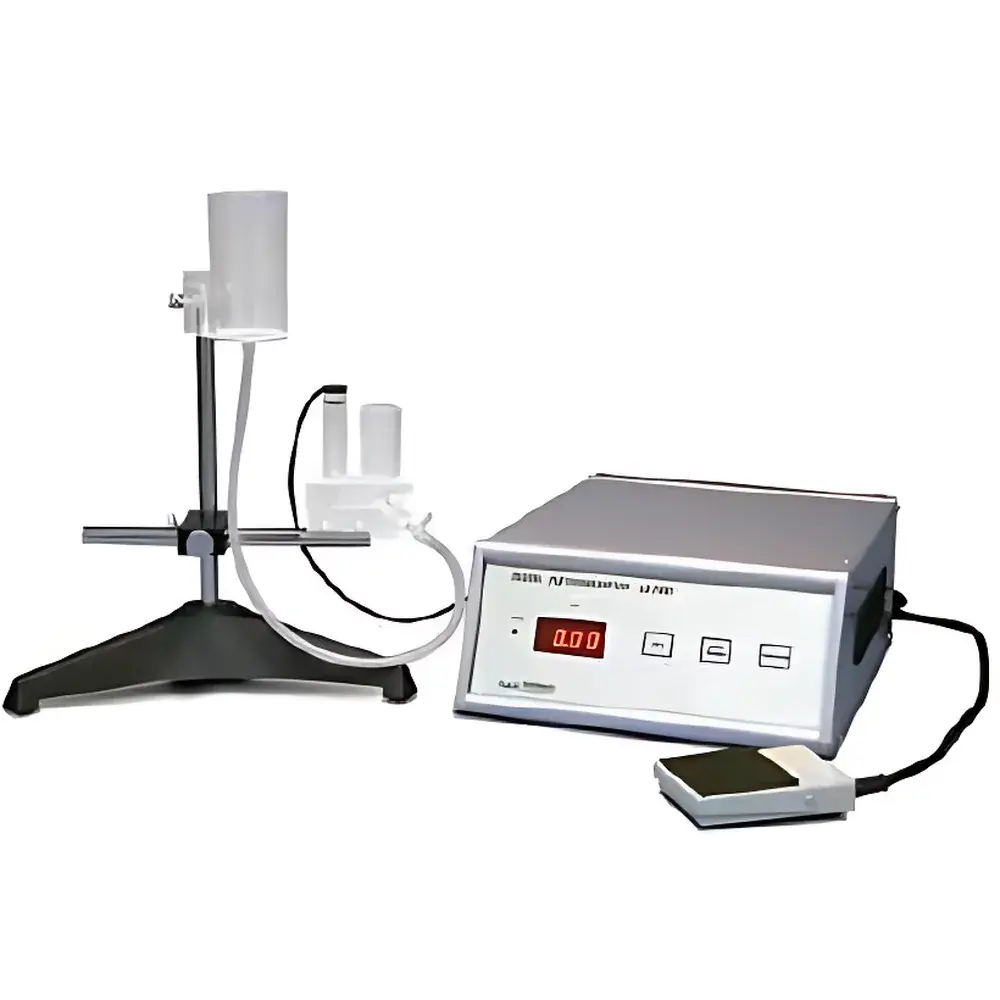
Panlab LE7500 Limb Volume Plethysmograph
| Brand | Harvard Apparatus |
|---|---|
| Origin | USA |
| Manufacturer Type | Authorized Distributor |
| Country of Origin | Imported |
| Model | LE7500 |
| Price Range | USD 1,400 – 7,000 |
| Control Unit Dimensions (W × D × H) | 280 × 280 × 110 mm |
| Stimulus Unit Dimensions (W × D × H) | 230 × 220 × 300 mm |
| Activation | Front-panel keypad or footswitch |
| Resolution | 0.01 mL (3-digit display) |
| Chamber Material | Methyl methacrylate (PMMA) |
| Frame Material | Stainless steel |
| Electrode Material | Platinum |
| Certification | CE-marked |
| Measurement Parameter | Paw volume (displacement-based plethysmography) |
| Interface | RS-232 serial connection to PC |
| Software Control | PC-based acquisition and analysis interface |
| Auto-zero function | Footswitch-triggered |
Overview
The Panlab LE7500 Limb Volume Plethysmograph is a precision displacement-based volumetric measurement system engineered for quantitative assessment of edema in rodent hind paws during preclinical inflammation studies. It operates on the principle of fluid displacement within a sealed, temperature-stable water-filled chamber—functioning as a calibrated hydrostatic plethysmograph. When a restrained animal’s paw is immersed, the displaced water volume corresponds directly to the paw’s geometric volume, enabling high-reproducibility longitudinal tracking of inflammatory swelling. Designed exclusively for small-animal research, the LE7500 integrates mechanical stability, electrochemical inertness, and digital signal fidelity to support rigorous pharmacodynamic evaluation of anti-inflammatory compounds under GLP-aligned experimental conditions.
Key Features
- Displacement-based measurement architecture with 0.01 mL resolution, optimized for detecting subtle volumetric changes (±0.5% CV typical across repeated measurements)
- Chemically inert PMMA immersion chamber and platinum electrodes ensure long-term stability and resistance to saline or pharmacological agent carryover
- Dual activation modes: tactile front-panel keypad and hands-free footswitch—enabling operator-controlled timing without disturbing animal restraint
- RS-232 serial interface supports direct integration with Windows-based acquisition software for timestamped data logging, real-time visualization, and batch export
- Auto-zero calibration routine triggered via footswitch, compensating for thermal drift and meniscus variation prior to each measurement cycle
- Stainless steel structural frame provides vibration damping and consistent alignment between chamber, sensor assembly, and immersion port
- CE-marked design compliant with IEC 61000-6-2 (EMC immunity) and IEC 61000-6-3 (EMC emissions) standards for laboratory instrumentation
Sample Compatibility & Compliance
The LE7500 is validated for use with mice (C57BL/6, BALB/c, CD-1) and rats (Sprague-Dawley, Wistar) weighing 18–300 g. Paw immersion depth is adjustable via ergonomic positioning cradle; chamber geometry accommodates both unilateral and bilateral measurement protocols. All wetted surfaces meet USP Class VI biocompatibility requirements. Data acquisition workflows support ALF (Animal Laboratory Framework) metadata tagging and are compatible with audit-trail-enabled software configurations aligned with FDA 21 CFR Part 11 expectations when deployed with validated third-party platforms (e.g., Panlab’s Bioseb acquisition suite). The system conforms to ISO 10993-5 for cytotoxicity of non-implantable contact materials.
Software & Data Management
The LE7500 interfaces with Panlab’s Bioseb-compatible acquisition software (v5.2+), which provides synchronized time-series plotting, baseline subtraction, delta-volume computation, and group-wise statistical overlays. Raw data exports as CSV or MATLAB-compatible MAT files, preserving native 10 Hz sampling resolution. Software supports user-defined protocol templates—including multi-timepoint dosing schedules—and generates PDF reports with embedded metadata (operator ID, animal ID, ambient temperature, chamber calibration date). Audit trail functionality records all parameter modifications, zeroing events, and export actions with ISO 8601 timestamps and operator login attribution.
Applications
- Quantitative evaluation of acute and chronic inflammatory models: carrageenan-induced paw edema, CFA-mediated arthritis, LPS-challenge assays
- Pharmacokinetic/pharmacodynamic correlation studies linking plasma drug concentration to edema suppression kinetics
- Validation of novel NSAIDs, biologics, or small-molecule inhibitors targeting COX-2, TNF-α, IL-1β, or NLRP3 inflammasome pathways
- Neuropathic pain model characterization where edema co-occurs with mechanical allodynia (e.g., spared nerve injury + volume monitoring)
- Standardized endpoint measurement in OECD TG 407 (repeated-dose toxicity) and ICH S5(R3) reproductive toxicity studies requiring objective limb swelling metrics
FAQ
What species and strain ranges are supported by the LE7500?
The system is calibrated for mice (18–40 g) and rats (150–300 g); chamber geometry allows full immersion of hind paws without tail or body contact.
Is temperature control integrated into the measurement chamber?
No active thermoregulation is built-in; however, the PMMA chamber exhibits low thermal conductivity, and stable room temperature (20–24°C) is recommended to minimize water density drift.
Can the LE7500 be used for forepaw measurements?
Not recommended—chamber depth and restraint configuration are optimized for hind paw immersion; forepaw geometry introduces uncontrolled air entrapment artifacts.
Does the system support automated data export to LIMS or ELN platforms?
Yes—CSV output is structured for direct ingestion into LabVantage, Benchling, or Veeva Vault via configurable field mapping and scheduled FTP transfer.
How frequently must the system be recalibrated?
Annual verification against NIST-traceable volumetric standards is advised; daily auto-zero and weekly chamber cleaning with 70% ethanol maintain baseline integrity.




