
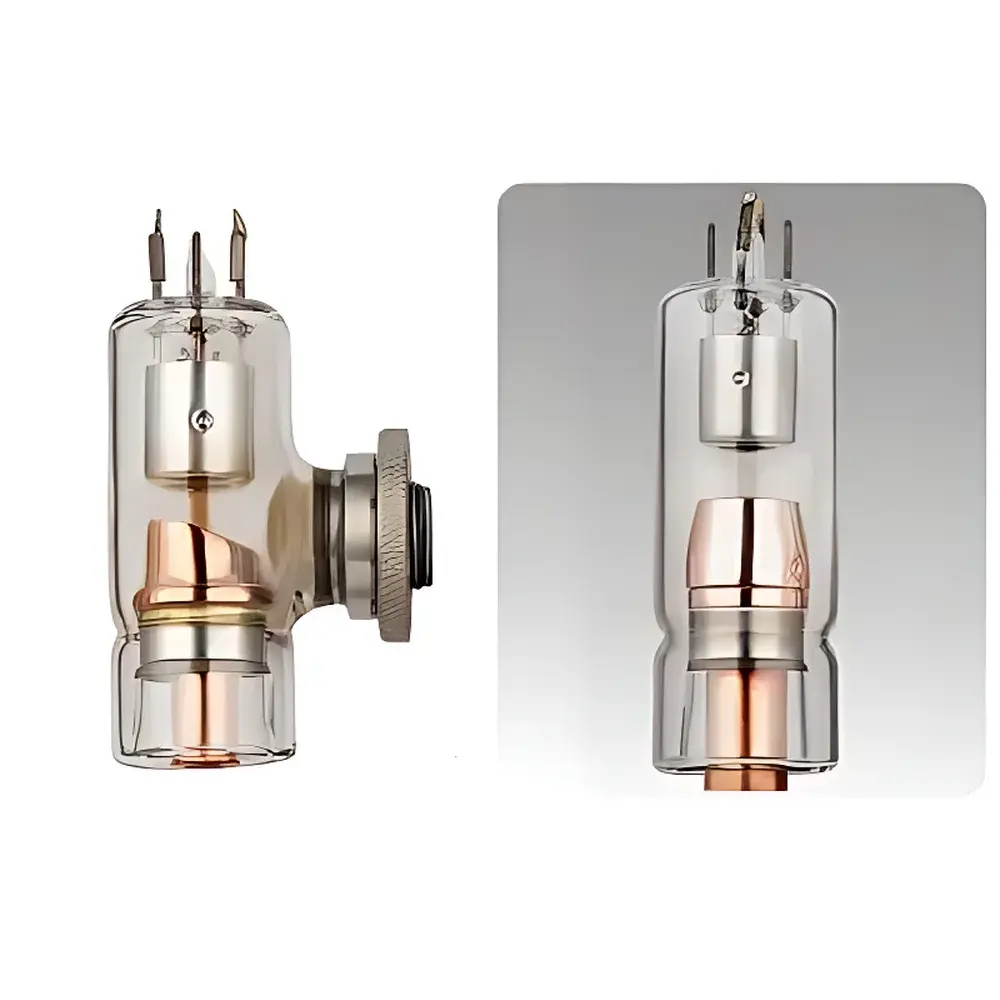
S005-1 Compact Microfocus X-ray Tube
| Origin | Beijing, China |
|---|---|
| Manufacturer Type | Authorized Distributor |
| Origin Category | Domestic (PRC) |
| Model | S005-1 |
| Pricing | Available Upon Request |
| Max. Tube Voltage | 10–100 kV |
| Max. Tube Current | 10–100 µA |
| Max. Output Power | 10 W |
| Focal Spot Size | 0.05 mm |
| X-ray Window Material | Beryllium or Glass |
| Radiation Beam Angle | 20°, 28°, or 30° |
| Operation Mode | Continuous Duty |
Overview
The S005-1 Compact Microfocus X-ray Tube is a high-stability, continuously operated radiation source engineered for integration into benchtop and portable X-ray radiographic inspection systems. Designed according to fundamental principles of thermionic emission and electron-beam-to-X-ray conversion in vacuum diode architecture, it generates bremsstrahlung and characteristic X-rays through electron deceleration at a tungsten or molybdenum target. Its 0.05 mm nominal focal spot enables high spatial resolution imaging—critical for non-destructive evaluation (NDE) of microelectronics, additive-manufactured components, thin-walled composites, and precision castings. Operating across a flexible 10–100 kV tube voltage range with fine current control (10–100 µA), the tube delivers stable output up to 10 W—optimized for low-dose, high-contrast applications where thermal management and geometric unsharpness must be tightly controlled.
Key Features
- Microfocus design with ≤0.05 mm effective focal spot size, supporting sub-50 µm system-level spatial resolution under optimal geometric magnification
- Continuous-duty operation with active air or forced-air cooling architecture—no duty-cycle limitations typical of pulsed or flash X-ray sources
- Selectable radiation beam angles (20°, 28°, or 30°) to accommodate varying detector standoff distances and field-of-view requirements in compact NDT enclosures
- Interchangeable X-ray window options: ultra-thin beryllium (Be) for enhanced low-energy transmission (<20 keV), or borosilicate glass for improved mechanical robustness and higher kV stability
- Integrated high-voltage feedthrough and vacuum-tight ceramic-metal sealing compliant with ISO 9001-certified manufacturing protocols
- Electrical interface compatible with standard industrial HV power supplies (e.g., Spellman, UltraVolt) via SHV or MHV connectors
Sample Compatibility & Compliance
The S005-1 is suitable for inspecting low-to-medium atomic number (Z) materials including polymers, aluminum alloys, magnesium, PCB laminates, solder joints, and ceramic substrates. Its low-power, microfocus configuration minimizes heat-induced distortion in temperature-sensitive samples—making it appropriate for in-line QA/QC stations and laboratory-based failure analysis workflows. The tube conforms to IEC 61331-1:2014 (requirements for diagnostic X-ray tube assemblies) and meets electromagnetic compatibility (EMC) Class B limits per CISPR 11. When integrated into full systems, it supports compliance pathways for ASTM E2737 (standard guide for digital radiographic testing), ISO 17636-2 (radiographic testing of welds), and EN 462-1 (image quality indicators). Radiation shielding and interlock integration must follow local regulatory frameworks (e.g., NRC 10 CFR Part 20, EU Directive 2013/59/Euratom).
Software & Data Management
As a hardware component—not a standalone system—the S005-1 requires integration with third-party acquisition platforms such as Varian PaxScan controllers, Teledyne DALSA Xineos SDKs, or open-source frameworks like DCMTK and OpenCV-based reconstruction pipelines. It does not include embedded firmware or proprietary software. However, its analog HV and filament control signals support real-time parameter logging via PLC or DAQ systems, enabling traceable exposure records aligned with GLP/GMP documentation requirements. For regulated environments, integration with audit-trail-capable software (e.g., compliant with FDA 21 CFR Part 11) is achievable through external controller synchronization and metadata tagging of acquisition parameters (kV, µA, exposure time, focal spot selection).
Applications
- High-resolution digital radiography (DR) of electronic assemblies, including BGAs, flip-chip packages, and flex-rigid PCBs
- In-process inspection of powder-bed fusion (PBF) and binder-jetted metal parts for porosity, lack-of-fusion, and residual powder entrapment
- Non-destructive metrology of microfluidic channels, MEMS devices, and medical device components (e.g., stents, catheter tips)
- Academic and industrial research in X-ray phase-contrast imaging (PCI) using edge-enhancement techniques at low divergence
- Custom-built computed tomography (CT) modules for laboratory-scale µCT systems with <5 µm voxel resolution
FAQ
Is the S005-1 certified for medical use?
No. This tube is classified as an industrial/research-grade X-ray source and is not designed, tested, or certified for human diagnostic or therapeutic applications.
What cooling method is recommended for continuous operation?
For sustained operation at ≥5 W, forced-air convection with ≥20 CFM airflow directed across the anode housing is required. Passive cooling is only permissible below 2 W and ambient temperatures ≤25°C.
Can the focal spot size be verified independently?
Yes—using pinhole or slit cameras per ISO 10642:2017, users may perform focal spot measurement during system qualification. Documentation of measured spot dimensions must be retained for QA audits.
Does the tube include radiation shielding?
No. Shielding (e.g., lead-lined enclosures, collimators, or beam stops) must be provided by the end-user system integrator in accordance with local radiation safety regulations.
What vacuum maintenance is required?
The tube is sealed and factory-evacuated to ≤1×10⁻⁶ Torr. No user-serviceable vacuum components are present; lifetime expectancy exceeds 5,000 hours under specified operating conditions.



