
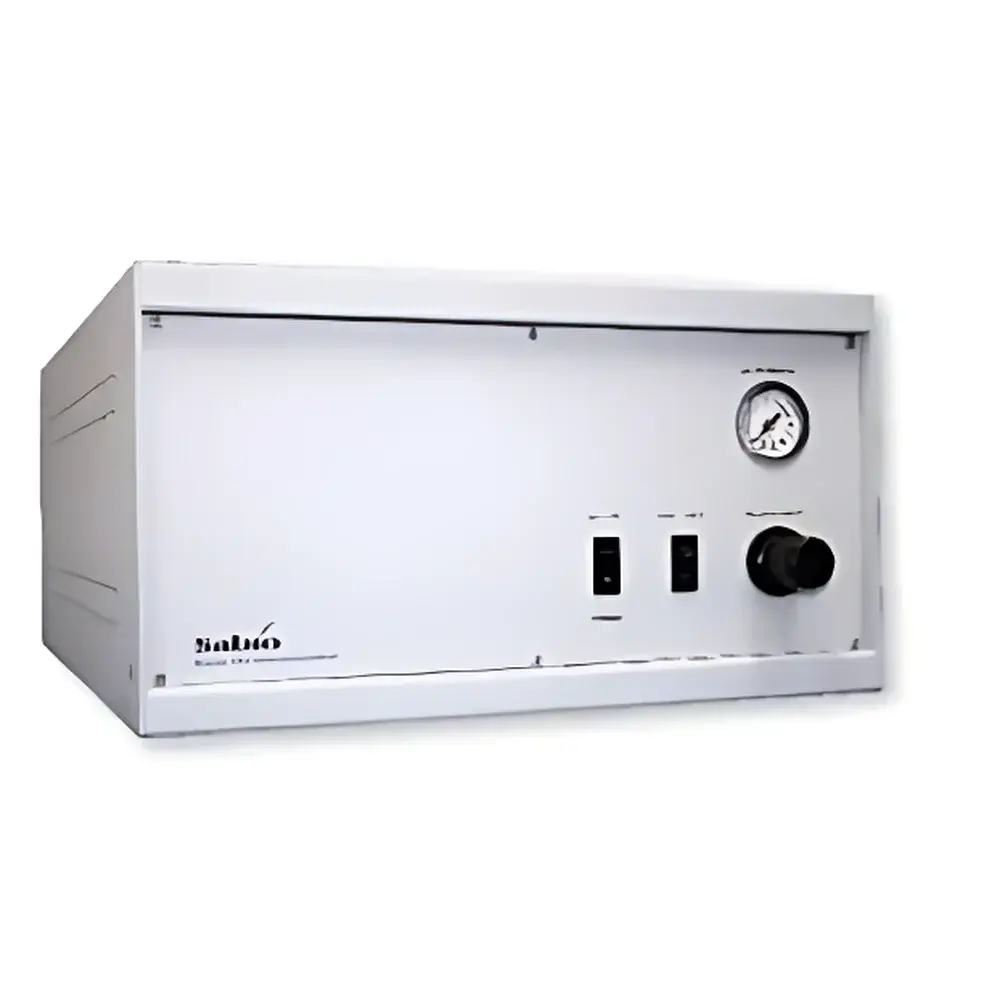
Sabio 1001 Zero Air Generator
| Brand | Sabio |
|---|---|
| Origin | Beijing, China |
| Model | 1001 |
| Output Pressure | 25 psi |
| Standard Flow Rate | 22 L/min (SLP) |
| Condensate Tank Capacity | 3.4 L |
| Air Purity | NO/NO₂/O₃/H₂S/SO₂ < 0.5 ppb, CO < 25 ppb, HC < 200 ppb |
| Dew Point | ≤ −20 °C at 15 L/min |
| Dimensions | 222 mm (H) × 412 mm (W) × 565 mm (D) |
| Power Supply | 220 VAC, 50 Hz |
| Compressor Type | Brushless, Oil-Free |
| Condensate Drain | Automatic or Manual |
| Optional | Built-in CO oxidation catalyst, HC oxidation catalyst, pressure switch, flow meter, rack-mount kit, LED dew point display |
Overview
The Sabio 1001 Zero Air Generator is an engineered solution for laboratories and analytical facilities requiring ultra-pure, hydrocarbon-free, and reactive-gas-scrubbed air as a carrier, purge, or calibration gas. It operates on a dual-stage purification architecture: first, compressed ambient air is dried via integrated refrigerated and desiccant-based dehumidification to achieve a dew point ≤ −20 °C at 15 L/min; second, the dried air passes sequentially through catalytic and chemisorptive media beds specifically formulated to remove nitrogen oxides (NO, NO₂), ozone (O₃), sulfur dioxide (SO₂), hydrogen sulfide (H₂S), carbon monoxide (CO), and non-methane hydrocarbons (NMHC). This multi-step process ensures compliance with stringent purity specifications required for trace-level environmental monitoring (e.g., EPA Method TO-14/TO-15), gas chromatography–flame ionization detection (GC-FID), and photometric ozone calibration. The system employs a brushless, oil-free scroll compressor—designed for continuous operation with minimal maintenance and zero risk of hydrocarbon contamination—making it suitable for ISO/IEC 17025-accredited laboratories where instrument baseline stability and method reproducibility are critical.
Key Features
- Stable 22 L/min output at 25 psi—calibrated and verified per ISO 8573-1 Class 1:2:1 (solid particles, water, oil)
- 3.4 L condensate reservoir with dual-mode drainage: programmable automatic siphon or user-initiated manual purge
- Multi-bed purification train including high-efficiency particulate arrestor (HEPA), activated alumina desiccant, copper oxide catalyst (for CO oxidation), and proprietary metal oxide sorbents (for NOₓ, SO₂, O₃, H₂S, and NMHC removal)
- Integrated dew point sensor with optional LED display for real-time verification of drying performance
- Configurable pressure control via built-in pressure switch, enabling pump modulation in response to downstream demand fluctuations
- Rack-mount compatible chassis (2U height) with standardized mounting flanges and rear cable management provisions
Sample Compatibility & Compliance
The Sabio 1001 delivers air meeting or exceeding the purity thresholds defined in ASTM D6216 (Standard Specification for Zero Air Used in Ambient Air Monitoring), EPA 40 CFR Part 53 (for reference method analyzers), and ISO 8573-1:2010 Class 1 for oil content and Class 2 for water. Its certified output (<0.5 ppb NOₓ/O₃/H₂S/SO₂, <25 ppb CO, <200 ppb total hydrocarbons) supports regulatory-grade applications including continuous emission monitoring systems (CEMS), ambient air quality networks (AQS), and laboratory calibration of chemiluminescence NOₓ analyzers and UV photometric ozone monitors. All internal wetted materials comply with USP Class VI biocompatibility requirements, and the unit’s electrical design conforms to IEC 61010-1 for safety in laboratory environments.
Software & Data Management
While the Sabio 1001 operates as a standalone hardware platform without embedded firmware or cloud connectivity, its analog and digital interface options support integration into facility-wide monitoring infrastructures. A 0–10 VDC analog output is available for dew point or outlet pressure telemetry; optional RS-485 Modbus RTU enables communication with building management systems (BMS) or SCADA platforms. For GLP/GMP-regulated operations, users may deploy external data loggers compliant with FDA 21 CFR Part 11 to record time-stamped pressure, flow, and dew point values—establishing an auditable chain of custody for zero air qualification records.
Applications
- Carrier gas supply for GC-FID, GC-ECD, and GC-MS systems requiring low-background hydrocarbon integrity
- Purge gas for dynamic dilution calibrators (e.g., ENVEA, Mesa Labs, Horiba models)
- Zero gas for span calibration of ambient air analyzers (O₃, NO, NO₂, SO₂, CO)
- Instrument blank verification in EPA Method 25A and ASTM D6348 testing protocols
- Lab air supply for FTIR spectroscopy, laser absorption gas sensors, and cleanroom environmental monitoring
FAQ
What is the recommended maintenance schedule for the Sabio 1001?
Filter cartridges and chemical scrubbers require replacement every 6–12 months depending on ambient intake air quality and daily runtime; compressor service interval is rated at ≥20,000 hours.
Can the unit be installed in a temperature-controlled equipment room?
Yes—operating ambient range is 10–35 °C with relative humidity ≤80% non-condensing; avoid locations with direct sunlight or proximity to HVAC exhaust vents.
Is third-party certification available for the delivered air purity?
Sabio provides factory test reports documenting initial purity validation against ISO 8573-1 and ASTM D6216; accredited third-party verification (e.g., by an ISO/IEC 17025 lab) can be arranged upon request.
Does the 1001 model support redundant operation or parallel configuration?
Not natively—but dual-unit installations with manifolded outputs and automatic switchover valves are supported via custom engineering consultation.
How is moisture removal validated during routine operation?
The integrated dew point sensor provides continuous feedback; users may also perform periodic verification using chilled mirror hygrometry per ISO 8573-4.



