
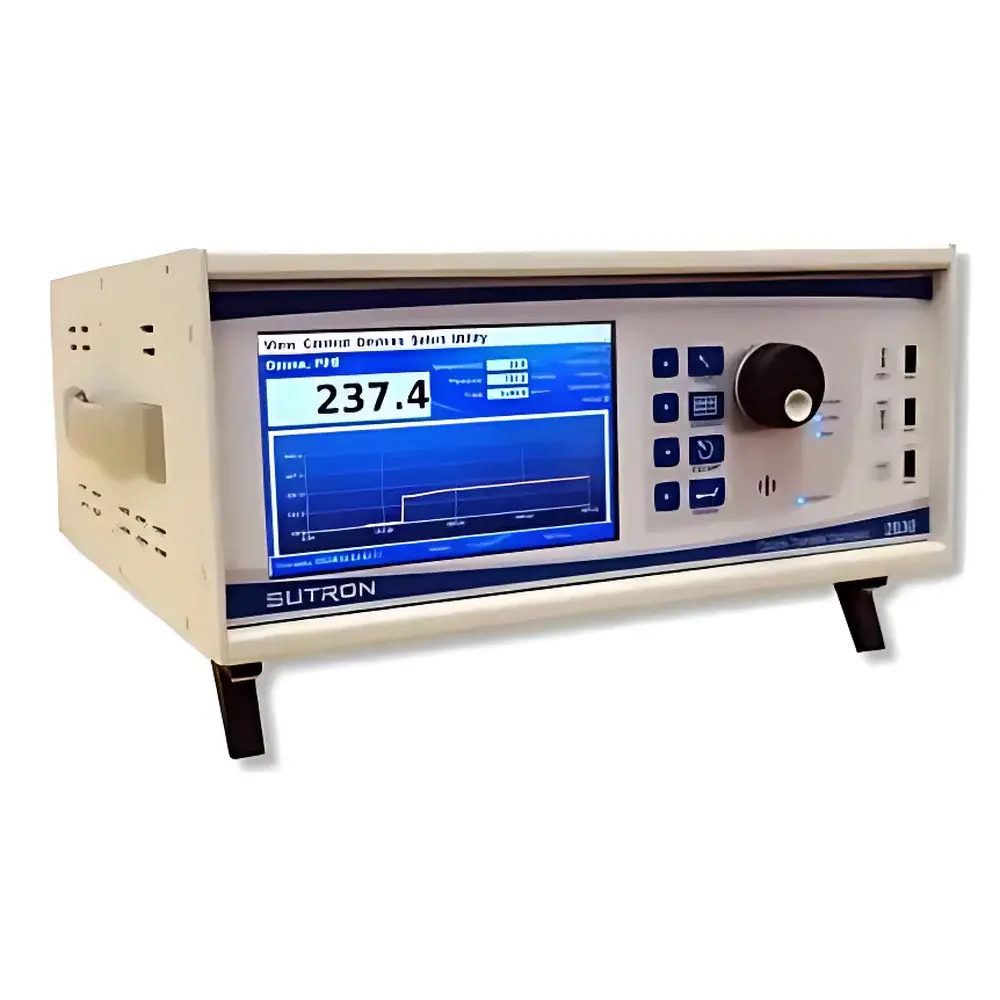
Sabio 2030 Portable Ozone Analyzer
| Brand | Sabio |
|---|---|
| Model | 2030 |
| Measured Species | O₃ |
| Measurement Principle | UV Absorption Spectrophotometry |
| Range Options | 0–100 ppb, 0–200 ppb, 0–500 ppb, 0–1 ppm, 0–2 ppm |
| Zero Noise | <0.6 ppb |
| Limit of Detection | <1 ppb |
| Zero Drift | <1 ppb/24 h or <2 ppb/7 days |
| Span Drift | <1% per month |
| Response Time (T90) | 20 s (10 s lag) |
| Accuracy | ±1 ppb |
| Linearity | <1% FS |
| Sample Flow Rate | 1.0 LPM |
| Operating Temperature | 5–45 °C |
| Analog Outputs | 0–0.1 V, 0–1 V, 0–2 V, 0–5 V, 0–10 V (user-configurable, 4 channels) |
| Power Supply | 196–264 VAC, 50–60 Hz |
| Integrated High-Precision Ozone Generator | Output Range 0.05–1.5 ppm at 5 SLM, Accuracy ±2% of setpoint or ±3.0 ppb at 5 SLM |
| Environmental Compensation | Automatic temperature and pressure compensation |
| Connectivity | Ethernet (TCP/IP), USB, RS-232/RS-485 |
| Data Logging | Onboard non-volatile memory with timestamped records |
| Display | Large backlit TFT LCD with touch interface |
| Physical Design | Portable chassis with integrated side handles, ruggedized instrument case, built-in zero-air source |
Overview
The Sabio 2030 Portable Ozone Analyzer is a field-deployable, laboratory-grade instrument engineered for precise, real-time quantification of gaseous ozone (O₃) across ambient air, indoor environments, industrial process streams, and calibration laboratories. It operates on the fundamental principle of ultraviolet absorption spectrophotometry at 254 nm — a method traceable to NIST standards and widely accepted under EPA Method EQOA-0102 and ISO 13964. The analyzer employs a dual-beam optical path with temperature-stabilized UV lamp and high-sensitivity photodetector to ensure long-term stability and minimize interference from humidity, particulates, or co-absorbing species such as NO₂. Its compact, shock-resistant enclosure meets IP54 environmental protection requirements, enabling reliable operation in mobile monitoring vehicles, cleanroom support zones, and outdoor air quality stations without external shielding.
Key Features
- Five selectable measurement ranges (0–100 ppb through 0–2 ppm) optimized for regulatory compliance, occupational health monitoring, and ozone generator validation
- Onboard high-precision ozone generator (0.05–1.5 ppm at 5 SLM) with certified accuracy of ±2% of setpoint — eliminating dependency on external calibration gas cylinders
- Integrated zero-air source with catalytic scrubber ensures stable baseline verification without external compressed air supply
- Automatic real-time compensation for ambient temperature and barometric pressure, referenced to standard conditions (25 °C, 101.325 kPa)
- Four independently configurable analog outputs (0–0.1 V to 0–10 V) supporting SCADA integration, DCS interfacing, and redundant data acquisition
- Full-featured embedded operating system with menu-driven interface accessible via resistive touchscreen, front-panel membrane keypad, or external USB keyboard/mouse
- Comprehensive internal data logging with microSD card support, storing timestamped concentration values, diagnostic flags, and environmental metadata at user-defined intervals (1 s to 1 h)
Sample Compatibility & Compliance
The Sabio 2030 accepts sample gas at a nominal flow rate of 1.0 LPM, accommodating both active sampling (via integrated pump) and passive line connection. Inlet conditioning includes hydrophobic particulate filtration (0.5 µm) and optional heated sample line option for dew point control. The analyzer complies with IEC 61000-4 electromagnetic compatibility standards and meets safety requirements per UL 61010-1 and EN 61010-1. It supports GLP/GMP workflows through audit-trail-enabled firmware (optional Part 11-compliant software module available), and its measurement methodology aligns with ASTM D5110–22 (Standard Test Method for Determination of Ozone in Ambient Air by UV Absorption) and EU Directive 2008/50/EC Annex IX.
Software & Data Management
Firmware v3.2+ provides secure remote access via Ethernet TCP/IP using HTTP/HTTPS or Modbus TCP protocols. The embedded web server delivers live concentration plots, calibration history, alarm status, and system diagnostics through any modern browser. Raw data export is supported in CSV and XML formats, with time synchronization via NTP servers. Optional Sabio DataLink Suite (Windows-based) enables automated report generation compliant with ISO/IEC 17025 documentation requirements, including uncertainty budgeting per GUM (JCGM 100:2008). All configuration changes and calibration events are logged with operator ID, timestamp, and hash-verified integrity.
Applications
- Ambient air quality monitoring networks (AQN) for regulatory reporting under national air quality standards
- Indoor air quality assessment in hospitals, pharmaceutical cleanrooms, and semiconductor fabrication facilities
- Validation and routine performance verification of ozone-based water disinfection systems and HVAC oxidation units
- Field calibration and bump testing of fixed-site ozone monitors and personal exposure meters
- Research applications involving atmospheric chemistry, photochemical reaction kinetics, and oxidative stress modeling
- Mobile emission testing for vehicle exhaust and industrial stack screening where portability and rapid deployment are critical
FAQ
What ozone concentration ranges does the Sabio 2030 support?
It offers five factory-configurable ranges: 0–100 ppb, 0–200 ppb, 0–500 ppb, 0–1 ppm, and 0–2 ppm — selected during initial setup or via firmware update.
Is the instrument suitable for unattended long-term deployment?
Yes. With onboard data logging, temperature/pressure compensation, and low-drift optics, it maintains metrological integrity over 30-day continuous operation when installed per manufacturer’s site guidelines.
Does the analyzer require external calibration gases?
No. The integrated ozone generator and zero-air source enable full span-zero verification without external gas cylinders — though certified ozone standards may be used for independent verification.
Can the Sabio 2030 be integrated into existing facility SCADA systems?
Yes. Four isolated analog outputs and native Modbus TCP/Ethernet support allow direct integration with Allen-Bradley, Siemens, Honeywell, and Schneider Electric control platforms.
What maintenance intervals are recommended?
Lamp replacement every 12 months; particulate filter replacement every 3 months under typical ambient conditions; annual factory recalibration recommended for ISO/IEC 17025 compliance.



