
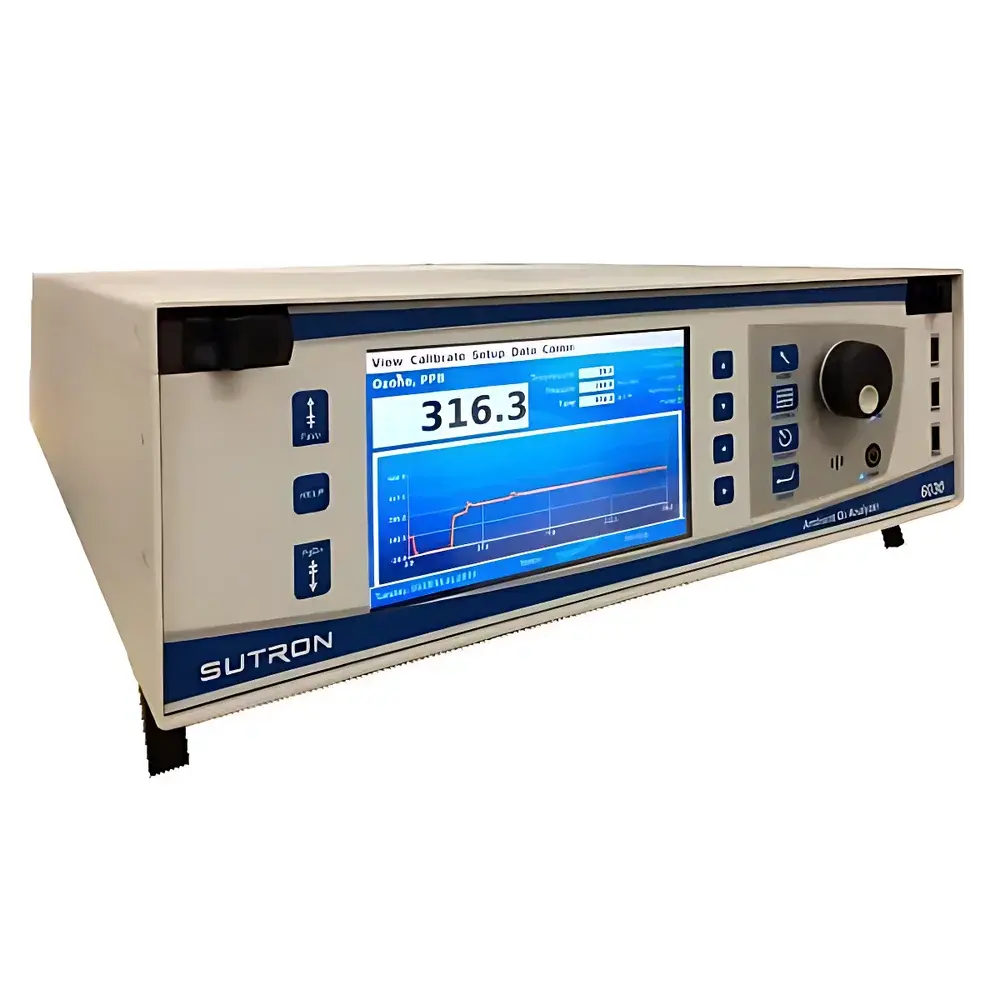
Sabio Model 6050 CO Analyzer
| Brand | Sabio |
|---|---|
| Origin | USA |
| Model | Model 6050 |
| Detection Principle | Non-Dispersive Infrared (NDIR) with Gas Filter Correlation (GFC) |
| Measurement Range | 0–200 ppm (user-selectable) |
| Resolution | 0.01 ppm |
| Units | ppm, ppb |
| Display | 7-inch high-resolution color TFT LCD (touch-enabled) |
| Communication Interfaces | Ethernet (TCP/IP), USB 2.0 (front-panel & rear), RS-232/485 |
| Analog I/O | 4-channel configurable voltage/current inputs & outputs |
| Digital I/O | 8-channel opto-isolated inputs/outputs |
| Environmental Compensation | Automatic temperature and barometric pressure compensation |
| Data Logging | Internal non-volatile memory (≥30 days at 1-min intervals) |
| Compliance | Meets EPA Method 40 CFR Part 53 reference equivalent performance criteria for CO analyzers |
| Software | Embedded menu-driven firmware with diagnostic suite, barcode-enabled time-series visualization, and remote configuration via web interface |
Overview
The Sabio Model 6050 CO Analyzer is a laboratory- and field-deployable trace gas monitoring instrument engineered for continuous, high-fidelity measurement of carbon monoxide (CO) in ambient air and indoor environments. It operates on the principle of Non-Dispersive Infrared (NDIR) spectroscopy enhanced by Gas Filter Correlation (GFC) technology—a method that eliminates spectral interference from water vapor, carbon dioxide, and other common atmospheric constituents. Unlike conventional broadband NDIR systems, GFC employs a mechanically modulated reference cell filled with pure CO to isolate the characteristic absorption band near 4.6 µm, thereby delivering exceptional selectivity and long-term stability without frequent calibration drift. Designed to meet U.S. Environmental Protection Agency (EPA) Performance Specification 40 CFR Part 53 for Class I reference-equivalent analyzers, the Model 6050 supports regulatory-grade air quality monitoring, occupational health surveillance, and research applications requiring sub-ppb detection capability and metrological traceability.
Key Features
- Gas Filter Correlation (GFC) NDIR optical architecture ensures immunity to cross-sensitivity from CO2, H2O, CH4, and hydrocarbons
- User-selectable measurement range (0–200 ppm) with auto-ranging capability and 0.01 ppm resolution
- 7-inch capacitive touch-enabled color TFT LCD with intuitive icon-based navigation and real-time waveform display
- Integrated data logging system storing ≥30 days of 1-minute averaged data in non-volatile flash memory
- Dual communication architecture: Ethernet (TCP/IP) for network integration and remote diagnostics; USB 2.0 (front and rear) for firmware updates and data export; RS-232/485 for legacy SCADA or PLC interfacing
- Four programmable analog I/O channels supporting voltage (±10 V) or current (4–20 mA) input/output configurations for external sensor integration or control signal output
- Eight opto-isolated digital I/O lines compatible with dry-contact or TTL-level triggering for alarm relays, pump control, or synchronization with co-located instrumentation
- Real-time automatic compensation for ambient temperature (−30 to +50 °C) and barometric pressure (60–110 kPa), referenced to NIST-traceable sensors
Sample Compatibility & Compliance
The Model 6050 is optimized for analysis of ambient air, stack effluent dilutions, and indoor air samples delivered via certified sampling lines (e.g., heated stainless-steel or fluoropolymer tubing). It complies with EPA Reference Method EQOA-01 for CO and satisfies the performance requirements outlined in ISO 4223-1:2022 (Air quality — Vocabulary and general principles for gas analyzers). Its internal sample path incorporates a particulate filter (≤2.5 µm cut-off), hydrophobic membrane, and optional catalytic scrubber for ozone removal—ensuring robust operation under variable humidity and contamination conditions. The analyzer is validated per GLP (Good Laboratory Practice) guidelines and supports audit-ready data integrity through timestamped event logs, user-access level controls, and password-protected configuration changes.
Software & Data Management
Firmware is managed through a browser-accessible embedded web server supporting HTTPS encryption and role-based authentication (admin/operator/user tiers). The menu-driven interface enables full configuration of sampling parameters—including integration time, zero/span frequency, alarm thresholds, and analog scaling—without external software. Barcode scanning functionality permits rapid association of measurement records with sample IDs or location tags, generating time-series plots directly on the display. Exported datasets adhere to CSV and NetCDF-4 formats, preserving metadata such as instrument serial number, calibration history, and environmental compensation coefficients. Optional integration with Sabio’s Centralized Environmental Data Platform (CEDP) enables automated ingestion into cloud-hosted QA/QC dashboards compliant with 21 CFR Part 11 electronic record requirements.
Applications
- Ambient air quality monitoring networks (AQS, EEA, national reference stations)
- Indoor air quality (IAQ) assessment in commercial buildings, schools, and healthcare facilities
- Occupational exposure monitoring in industrial settings (e.g., boiler rooms, parking garages, welding zones)
- Validation and intercomparison studies for low-cost sensor networks
- Mobile platform deployment (vehicle-mounted or UAV-integrated) with GPS-synchronized logging
- Research on CO oxidation kinetics, atmospheric chemistry modeling, and emission source apportionment
FAQ
What is the minimum detectable concentration (MDL) for CO using the Model 6050?
The instrument achieves an MDL of ≤0.03 ppm (3σ of zero air baseline over 1-hour integration), verified per EPA 40 CFR Part 53 Appendix A.
Does the analyzer require daily manual zeroing or span calibration?
No—automatic zero tracking and periodic span verification are supported; however, routine calibration every 7–14 days is recommended for regulatory reporting compliance.
Can the Model 6050 operate unattended for extended periods?
Yes—its solid-state optical design, wide operating temperature range, and internal battery-backed clock enable continuous operation for >6 months with scheduled remote diagnostics and data retrieval.
Is the firmware upgradable in the field?
Yes—updates are performed via front-panel USB drive or secure OTA (Over-The-Air) delivery through the Ethernet interface, with version rollback and integrity checksum validation.
How does the GFC technology improve measurement accuracy compared to standard NDIR?
GFC actively rejects spectral overlap by dynamically alternating between CO-absorbing and non-absorbing optical paths, reducing interference-induced bias by >95% relative to conventional broadband detectors.
Related Products



