
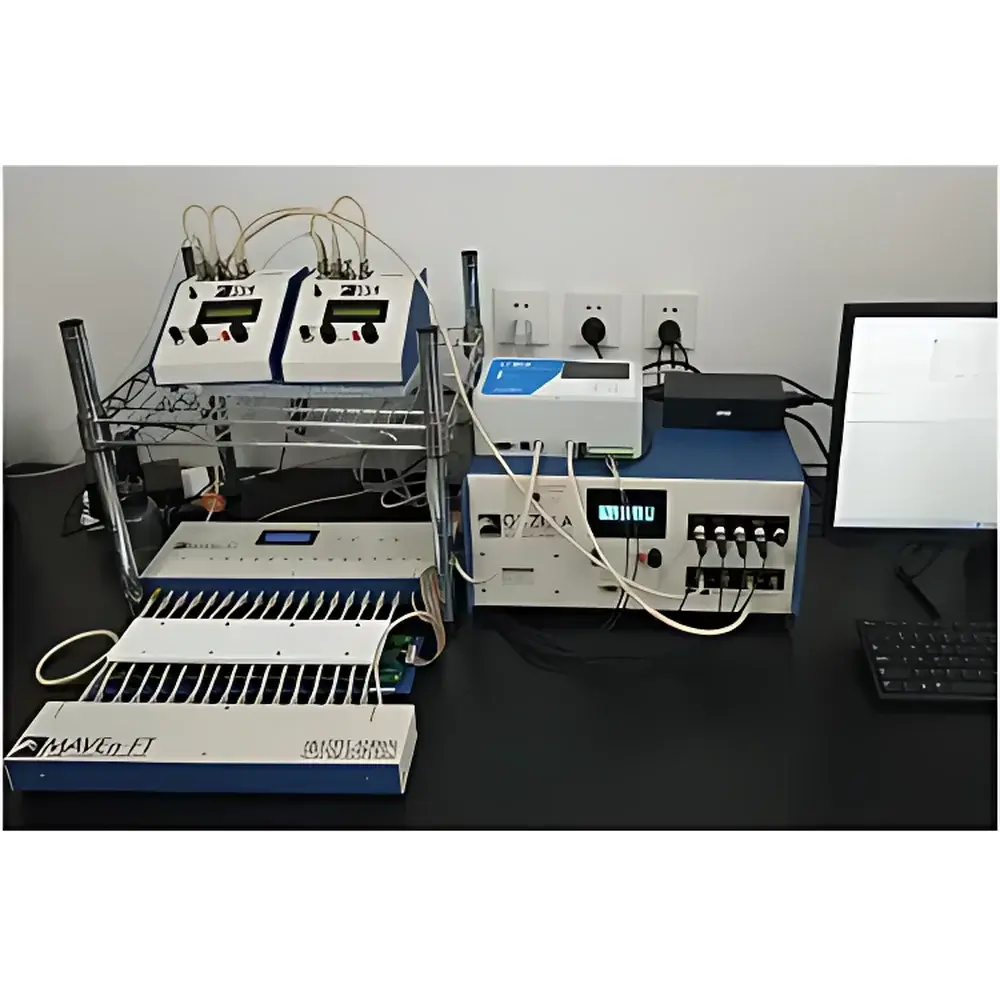
Sable SSI Drosophila Energy Metabolism Monitoring System
| Brand | Sable |
|---|---|
| Origin | USA |
| Manufacturer Type | Authorized Distributor |
| Product Category | Imported Scientific Instrument |
| Model | SSI Drosophila |
| Instrument Type | Research-Grade Small Animal (Drosophila & Micro-Invertebrate) Respirometry System |
| Key Measurement Parameters | Real-time CO₂ production (VCO₂), O₂ consumption (VO₂), respiratory quotient (RQ), water vapor pressure (H₂O), activity (via IR beam interruption), optional temperature & feeding behavior |
| Channel Configurations | 8-channel standard (7 sample + 1 baseline), expandable to 16-, 24-, or custom N-channel modular configurations |
| Analytical Principle | Open-flow indirect calorimetry with dual-wavelength NDIR CO₂ detection, paramagnetic or fuel-cell O₂ sensing, differential gas analysis architecture for single-fly resolution |
| Compliance Framework | Designed for GLP-compliant metabolic phenotyping |
| Software Platform | ExpeData™ (Windows-based, real-time acquisition, automated RQ/EE calculation, event-triggered sampling, batch analysis, export to CSV/MAT/Excel) |
| Optional Modules | AD-2 Infrared Activity Monitor, FLIC Feeding Behavior Module, MAVEn™ High-Density Integration Chassis, RH-300 Water Vapor Analyzer, SS4 Secondary Sampling Unit, MFC-2 Mass Flow Controller |
Overview
The Sable SSI Drosophila Energy Metabolism Monitoring System is a research-grade, open-flow indirect calorimetry platform engineered for high-fidelity, long-term respirometric phenotyping of Drosophila melanogaster and other micro-invertebrates (e.g., mites, aphids, mosquito larvae). Unlike conventional whole-chamber or push-pull systems optimized for rodents, this system employs a differential gas analysis architecture—integrating precision paramagnetic O₂ analyzers (Model 840 or dual-channel high-accuracy variant) and dual-wavelength non-dispersive infrared (NDIR) CO₂ analyzers (CA-10 or ultra-sensitive 0–3000 ppm differential variant)—to resolve metabolic signals from individual flies in real time. Its core measurement principle relies on continuous, low-flow (5–2000 mL/min) airstream delivery through borosilicate glass respirometry chambers, enabling quantification of oxygen consumption (VO₂), carbon dioxide production (VCO₂), respiratory quotient (RQ = VCO₂/VO₂), evaporative water loss (EWL), and derived energy expenditure (EE) under controlled environmental conditions. The system operates across multiple validated respirometric modes—including continuous open-flow, intermittent sampling, flow-injection, and closed-system protocols—supporting rigorous experimental design in circadian biology, neurogenetics, metabolic disease modeling, and ecophysiology.
Key Features
- Modular, scalable architecture: Standard 8-channel configuration (7 sample + 1 baseline) with seamless expansion to 16-, 24-, or N-channel setups via RM8 multiplexer and UI-3 12-channel data acquisition unit.
- Single-fly resolution capability: Differential O₂/CO₂ sensing combined with ultra-low-permeability borosilicate glass micro-chambers (0.5–1.0 mL volume, 9 mm diameter) minimizes gas diffusion artifacts and enables statistically robust n=1 metabolic time-series.
- Multi-parameter synchronization: Simultaneous acquisition of VO₂, VCO₂, RQ, H₂O (via RH-300), ambient temperature/pressure (integrated sensors), and behavioral metrics (via AD-2 infrared activity monitor operating at 900 nm, non-phototoxic and thermally neutral).
- Environmental control readiness: Compatible with optional Peltier-based thermal regulation modules and FLIC (Feeding-Locomotion-Interaction Chamber) units for integrated nutrition-behavior-metabolism studies.
- Hardware-level signal integrity: 24-bit A/D conversion (O₂ analyzer), 16-bit analog outputs, digital noise filtering (0.2–50 s adjustable), <0.002% pk-pk noise (O₂), <2 ppm noise (CO₂), and <0.01% 24-h drift—meeting ASTM E2578-18 specifications for respirometric stability.
- MAVEn™ integration option: Pre-configured high-density chassis integrating RM8, Model 840 O₂ analyzer, CA-10 CO₂ analyzer, MFC-2 mass flow controller, UI-3 DAQ, and ExpeData software—reducing setup complexity and inter-unit calibration variance.
Sample Compatibility & Compliance
The SSI system accommodates a broad spectrum of small biological models beyond D. melanogaster, including Caenorhabditis elegans, larval Tribolium, adult Aedes aegypti, and tick nymphs (0.0005–1 g mass range). All respirometry chambers are fabricated from low-gas-permeability borosilicate glass with precisely engineered dual-port geometry and OD 1.5 mm or 3.2 mm fittings to ensure laminar flow distribution and minimal boundary-layer interference. The platform conforms to ISO 8573-1:2010 compressed air purity standards for analytical gas streams and supports traceable calibration against NIST-traceable gas standards (e.g., 20.95% O₂/N₂, 0.5% CO₂/N₂). When deployed in regulated environments, ExpeData v5.0+ provides electronic signature support, audit trail logging, and user-access-tiered permissions—enabling alignment with FDA 21 CFR Part 11, EU Annex 11, and GLP/GMP documentation requirements for preclinical metabolic phenotyping.
Software & Data Management
ExpeData™ is the native acquisition and analysis environment, built on a deterministic real-time Windows kernel subsystem to guarantee sub-100 ms timestamp accuracy across all synchronized channels. It supports automated calculation of resting metabolic rate (RMR), non-resting EE, substrate utilization (via RQ trajectory analysis), and circadian amplitude/phase parameters using Lomb-Scargle periodograms. Raw data are stored in vendor-neutral HDF5 format with embedded metadata (chamber ID, calibration date, sensor serial numbers, operator ID), ensuring FAIR (Findable, Accessible, Interoperable, Reusable) compliance. Batch processing pipelines enable cross-genotype RQ curve fitting, activity-metabolism correlation matrices (Pearson/Spearman), and statistical comparison across light/dark cycles using mixed-effects linear models. Export modules generate publication-ready figures (SVG/PDF) and tabular outputs compatible with R, Python (Pandas/SciPy), and GraphPad Prism workflows.
Applications
This system has been cited in >120 peer-reviewed publications across disciplines including neurogenetics (Nature Communications, 2021: Nf1-mediated neuronal regulation of metabolic rate), sleep metabolism (Sleep, 2017), lipid homeostasis (Scientific Reports, 2022), and thermal tolerance physiology (CTmax determination). It is routinely applied to: (1) Quantifying genotype-specific deviations in basal metabolic rate and substrate switching under dietary challenge; (2) Mapping temporal coupling between locomotor activity bursts and transient VO₂ spikes during sleep fragmentation; (3) Assessing mitochondrial uncoupling in Parkinson’s disease fly models via RQ depression kinetics; (4) Validating CRISPR-Cas9 knock-in lines for obesity-related genes using 72-h continuous EE profiling; (5) Screening insecticide mode-of-action via dose-dependent suppression of VCO₂ dynamics; and (6) Ecological energetics modeling of ectotherm performance curves across thermal gradients.
FAQ
What is the minimum detectable metabolic signal for a single Drosophila?
The differential CO₂ analyzer (0–3000 ppm range) achieves 0.01 ppm resolution, corresponding to ~0.02 µL CO₂/h at 100 mL/min flow—a sensitivity sufficient to resolve metabolic transients from individual adult flies during wake-sleep transitions.
Can the system operate unattended for multi-day recordings?
Yes. With stable power conditioning, temperature-controlled enclosures, and ExpeData’s auto-recovery protocol, continuous 7–14 day acquisitions are routine; system drift remains within ±0.5% VO₂ over 120 h under ISO Class 5 cleanroom-equivalent airflow conditions.
Is calibration required before each experiment?
Zero/span calibration is recommended daily using certified span gases; however, the integrated temperature/pressure compensation algorithms and 24-h drift correction routines allow extended operation (up to 72 h) between calibrations when ambient stability is maintained.
How does the AD-2 activity monitor avoid motion-induced gas signal artifacts?
The AD-2 uses collimated 900 nm IR beams orthogonal to the gas flow axis; movement-induced signal modulation occurs independently of respiratory gas exchange, enabling mathematically decoupled activity and metabolic time-series via multivariate regression in ExpeData.
Does the system support custom chamber geometries for non-standard specimens?
Yes. Sable provides CAD-compatible chamber design templates and accepts OEM fabrication requests for species-specific dimensions (e.g., pupal chambers, larval tubes, or multi-fly group chambers) while maintaining gas-tight integrity and flow homogeneity specifications.




