
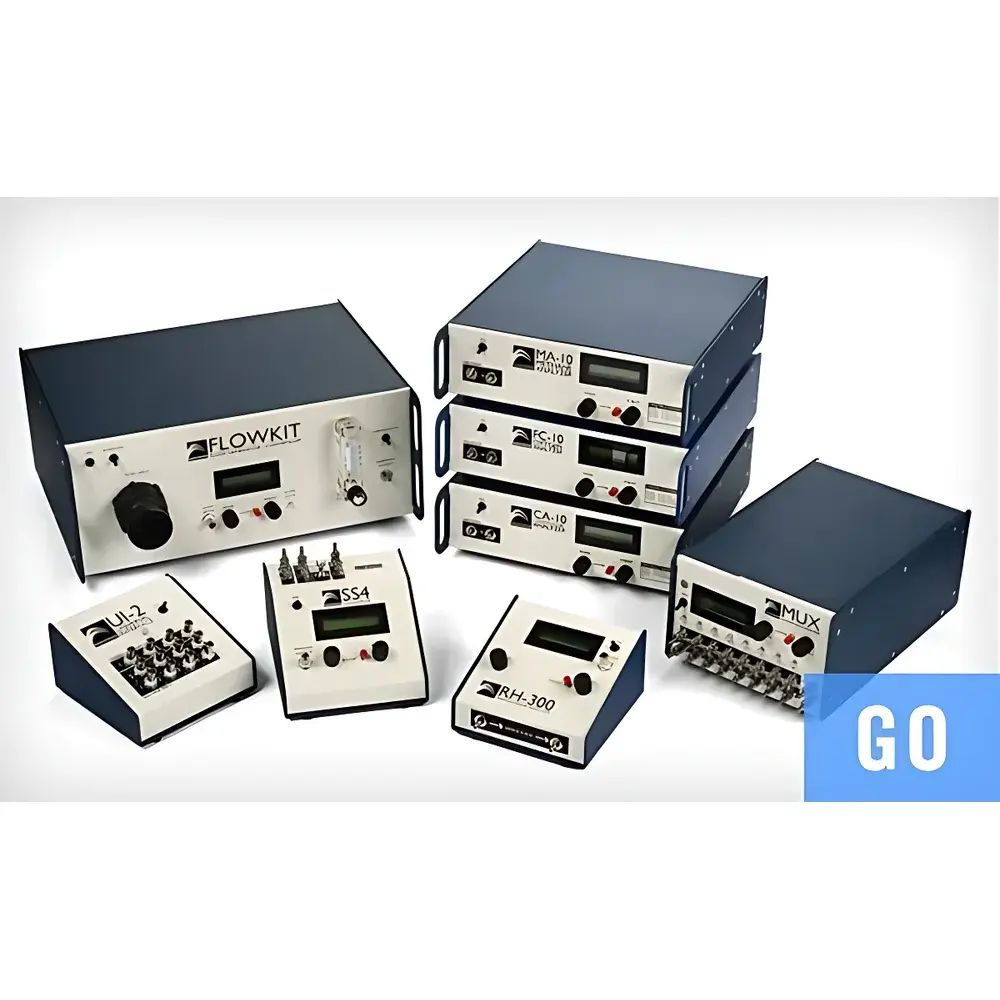
Sable SSI-System Multi-Channel Insect Respirometry Measurement System
| Brand | Sable |
|---|---|
| Origin | USA |
| Manufacturer Type | Authorized Distributor |
| Product Origin | Imported |
| Model | SSI-System |
| Price Range | USD 7,200 – 14,300 (FOB USA) |
Overview
The Sable SSI-System Multi-Channel Insect Respirometry Measurement System is a modular, research-grade closed- or open-flow respirometry platform engineered for high-precision, real-time quantification of CO₂ production, O₂ consumption, and respiratory quotient (RQ) in arthropods—particularly insects and acari. It operates on the fundamental principles of differential gas analysis: simultaneous measurement of upstream and downstream gas concentrations across a sealed or flow-through respirometry chamber enables calculation of metabolic rates via stoichiometric mass balance. The system adheres to established respirometric conventions defined in ASTM E2935–22 (Standard Practice for Measurement of Metabolic Rates in Small Organisms) and supports compliance with GLP-aligned experimental workflows. Its architecture integrates calibrated fuel-cell O₂ analyzers, dual-wavelength NDIR CO₂ sensors, and optional H₂O vapor detection to resolve sub-microliter-scale gas exchange dynamics—critical for studies involving minute specimens such as Drosophila melanogaster, Aedes aegypti, or Tetranychus urticae.
Key Features
- Modular channel scalability: Configurable from 1 to 8 independent measurement channels (7 sample + 1 baseline), with optional expansion to 16 or 24 channels via daisy-chained units
- Dual-gas capability: Simultaneous, synchronized acquisition of CO₂ (0–5% range, 1 ppm resolution) and O₂ (0–100%, 0.0001% resolution) with integrated temperature and barometric pressure compensation
- High-fidelity sensor suite: Includes factory-calibrated fuel-cell O₂ analyzers (drift <0.01%/hr), NDIR CO₂ analyzers (response time <0.5 s), and optional capacitive H₂O sensors (0–100% RH, ±1% accuracy)
- Precision flow control: MFS-2 or MFS-5 mass flow controllers (75–4000 mL/min, ±2% full-scale accuracy) paired with ultra-low-flow valves (down to 0–10 mL/min) for micro-respirometry applications
- Automated gas routing: 8-position solenoid-based multiplexer with <50 ms switching latency, supporting both push- and pull-mode configurations and stop-flow/flow-through protocols
- Integrated data acquisition: 12-channel DAQ unit with 16-bit analog inputs, dedicated thermistor ports (–5 to 60 °C), TTL digital I/O, and 100 Hz sampling rate
- Respirometry chambers: Borosilicate glass construction with flame-polished surfaces and Viton® low-permeability gaskets to minimize CO₂/H₂O adsorption artifacts
Sample Compatibility & Compliance
The SSI-System accommodates a broad spectrum of arthropod models—from fruit flies and aphids (500 mg)—using three standardized chamber geometries (RC, RC-2, RC-3) or custom-fabricated variants. All chambers are chemically inert, non-reactive to trace metabolites, and validated for negligible background CO₂ leakage (<0.02 µL/min) under controlled humidity. The system meets ISO/IEC 17025 requirements for measurement uncertainty estimation and supports audit-ready data logging per FDA 21 CFR Part 11 when used with Sable’s ExpeData™ software (electronic signatures, user access controls, and immutable audit trails). Protocols align with entomological standards including IOBC/WPRS guidelines for pesticide mode-of-action assessment and ICES recommendations for metabolic phenotyping in climate change studies.
Software & Data Management
ExpeData™ v6.3 (included) provides real-time visualization, automated RQ derivation, and batch processing of respirometric time-series. It implements iterative baseline correction, drift-compensated integration, and stoichiometric conversion (e.g., V̇O₂ → energy expenditure using Weibel–Hemmingsen coefficients). Raw sensor outputs (analog voltage, RS-232 ASCII streams) are timestamped with microsecond precision and archived in HDF5 format for interoperability with MATLAB, Python (via h5py), or R. Export modules generate CSV, Excel, and PDF reports compliant with journal submission standards (e.g., Journal of Experimental Biology, Physiological Entomology). Software validation documentation (IQ/OQ/PQ summaries) and electronic record retention policies are available upon request for regulated environments.
Applications
- Insect thermal biology: Quantifying Q₁₀ effects on metabolic rate across ecologically relevant temperature gradients (5–40 °C)
- Pesticide toxicology: Detecting sublethal metabolic disruption (e.g., mitochondrial uncoupling, cytochrome inhibition) following neonicotinoid or pyrethroid exposure
- Nutritional physiology: Discriminating substrate oxidation patterns (carbohydrate vs. lipid metabolism) via dynamic RQ profiling during dietary transitions
- Developmental energetics: Tracking ontogenetic shifts in mass-specific metabolic rate across instars or pupal stages
- Climate resilience screening: Assessing metabolic plasticity in response to chronic hypoxia, hypercapnia, or desiccation stress
- Comparative respirometry: Cross-species analyses of scaling relationships (Kleiber’s law) and evolutionary adaptations in respiratory efficiency
FAQ
What is the minimum detectable metabolic rate for a 0.2 mg Drosophila adult?
With the optional ultra-low-flow controller (0–10 mL/min) and high-sensitivity CO₂ analyzer (0–3000 ppm, 0.01 ppm resolution), the system achieves a detection limit of ~0.08 nmol CO₂/h—sufficient to resolve circadian fluctuations in individual flies.
Can the system measure water vapor flux simultaneously with CO₂ and O₂?
Yes—when equipped with the capacitive H₂O sensor module, the system computes evaporative water loss (EWL) and corrects gas concentration values for dilution effects using real-time humidity compensation algorithms.
Is calibration traceable to NIST standards?
All gas analyzers ship with calibration certificates traceable to NIST Standard Reference Materials (SRMs 1660b for CO₂, SRM 2649 for O₂), and field recalibration kits (certified gas blends) are available through Sable’s authorized service network.
How does the system handle variable ambient pressure during high-altitude experiments?
Integrated barometric pressure sensors (±0.0001 kPa resolution) feed continuous corrections to all gas concentration calculations; optional altitude-compensated flow controllers maintain volumetric consistency across 0–3000 m elevation ranges.
Does the software support automated experimental protocols?
ExpeData™ includes scriptable protocol engines for timed stimulus delivery (e.g., odor pulses, light-dark transitions, gas switches), enabling unattended multi-day metabolic phenotyping with conditional branching logic.






