
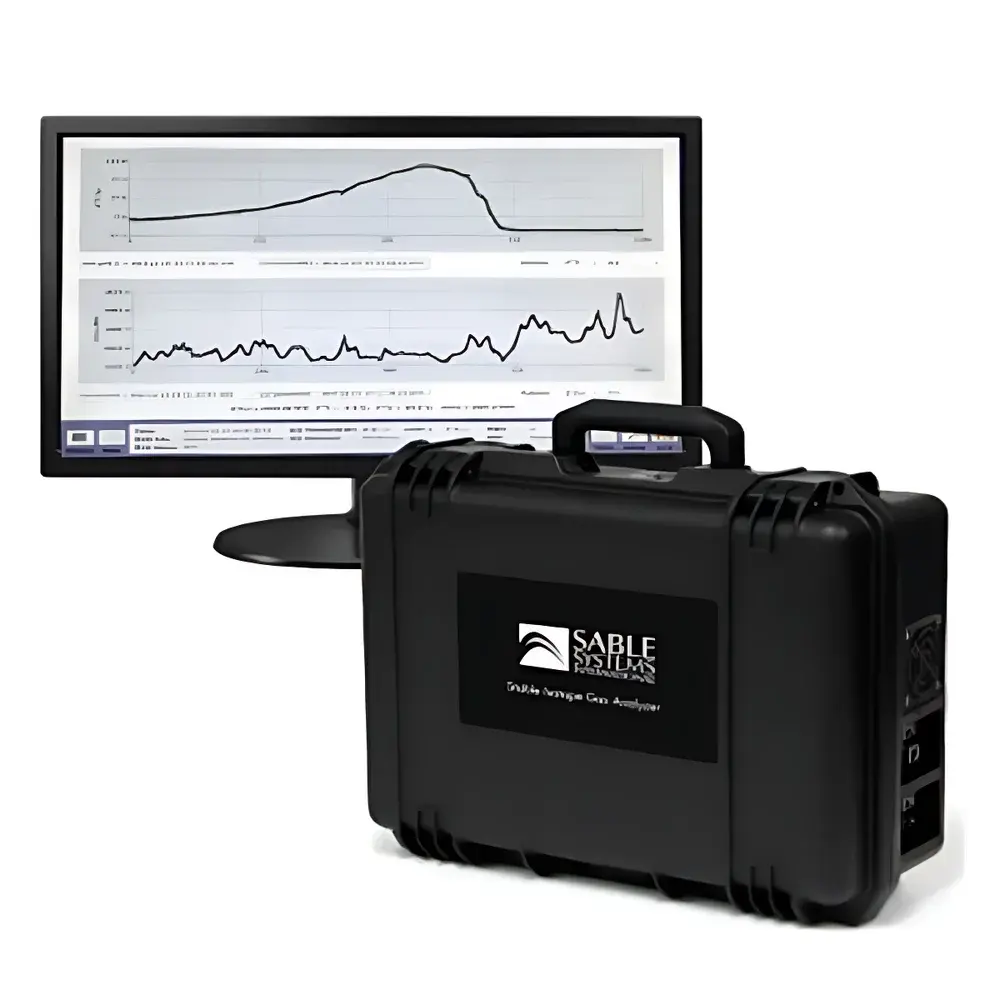
Sable Systems International Isotope Ratio Infrared Spectrometer (IRIS) for Animal Respiration Metabolism Analysis
| Brand | Sable Systems International |
|---|---|
| Origin | USA |
| Model | IRIS-13C/18O |
| Measurement Principle | Off-Axis Integrated Cavity Output Spectroscopy (OA-ICOS) |
| δ¹³C Range | −100‰ to +4000‰ |
| δ¹⁸O Range | −50‰ to +500‰ |
| CO₂ Range | 380–25,000 ppm |
| H₂O Range | 4,000–60,000 ppm |
| Precision (1σ, 1 Hz) | δ¹³C = 0.6‰, δ¹⁸O = 4.0‰, CO₂ = 0.05 ppm, H₂O = 50 ppm |
| Response Time | < 1.5 s (10–90%) |
| Sampling Frequency | 1 Hz |
| Operating Temperature | 5–45 °C |
| Power | 115/230 V AC, 50/60 Hz, 66 W |
| Dimensions (H×W×D) | 18 × 47 × 36 cm |
| Weight | 17 kg |
Overview
The Sable Systems International Isotope Ratio Infrared Spectrometer (IRIS) is a high-sensitivity, real-time stable isotope gas analyzer engineered for quantitative tracking of substrate-specific oxidation in animal respiration metabolism. Unlike conventional open-circuit respirometry systems—which yield only bulk metabolic parameters such as VO₂, VCO₂, and respiratory exchange ratio (RER)—the IRIS enables precise, simultaneous quantification of 13CO₂, 18O-labeled CO₂ (C18O₂), total CO₂, and water vapor (H₂O) in exhaled breath gases. Its core measurement technology employs off-axis integrated cavity output spectroscopy (OA-ICOS), a laser-based absorption technique offering exceptional selectivity for isotopologue-specific rovibrational transitions in the near-infrared region. This allows direct, calibration-free determination of isotopic ratios (δ13C and δ18O) with sub-permil precision—critical for distinguishing endogenous vs. exogenous nutrient oxidation pathways in vivo. The system operates without consumables or external reference gas standards, ensuring long-term stability and minimal operational overhead in longitudinal or high-throughput studies.
Key Features
- Simultaneous real-time detection of δ13C, δ18O, total CO₂, and H₂O at 1 Hz sampling frequency
- High isotopic precision: δ13C ≤ 0.6‰ (1σ, 1 Hz); δ18O ≤ 4.0‰ (1σ, 1 Hz); CO₂ ≤ 0.05 ppm; H₂O ≤ 50 ppm
- Extended dynamic range: δ13C from −100‰ to +4000‰; CO₂ from 380 ppm to 25,000 ppm; H₂O from 4000 ppm to 60,000 ppm
- Modular integration architecture supporting up to eight parallel metabolic chambers via multiplexed gas sampling
- Robust environmental tolerance: non-condensing humidity (0–100% RH), sample temperature range −20 to +50 °C, ambient operation 5–45 °C
- Digital interface suite including RS-232, Ethernet, and USB for seamless synchronization with third-party respirometry controllers (e.g., Sable’s Promethion or Oxymax platforms)
- No consumables, no external calibration gases required—maintains traceable accuracy through internal wavelength stabilization and pressure/temperature compensation algorithms
Sample Compatibility & Compliance
The IRIS is validated for use across diverse biological models—from micro-scale insect preparations and avian hatchlings to large mammals including swine, non-human primates, and human subjects in controlled clinical research settings. Its low-flow, low-power design (<66 W) and compact footprint (17 kg, 18 × 47 × 36 cm) facilitate integration into laminar flow hoods, biosafety cabinets, and mobile field laboratories. Data acquisition and reporting workflows comply with GLP-aligned documentation practices. While not FDA-cleared as a diagnostic device, the system meets ISO/IEC 17025 requirements for analytical instrument validation when deployed under SOP-controlled protocols. Raw spectral data and derived isotopic values are timestamped and stored with full audit trails, supporting 21 CFR Part 11-compliant electronic records when paired with validated LIMS or Sable’s ExpeData software environment.
Software & Data Management
Data acquisition, real-time visualization, and post-hoc isotopic flux modeling are managed through Sable’s ExpeData v6.x platform—a Windows-based application supporting automated peak integration, baseline correction, and dual-isotope kinetic modeling (e.g., two-pool exponential decay fitting for 13C-labeled substrate turnover). Export formats include CSV, HDF5, and MATLAB-compatible .mat files for advanced statistical analysis in R or Python. The software includes built-in tools for calculating fractional oxidation rates, substrate contribution percentages (e.g., % carbohydrate vs. % lipid oxidation), and time-resolved metabolic flexibility indices. All raw spectra and processed outputs are digitally signed and version-stamped to ensure reproducibility and regulatory traceability in peer-reviewed publications and preclinical study reports.
Applications
- Quantifying dynamic shifts in macronutrient utilization during fasting, exercise, cold exposure, or torpor (e.g., arctic ground squirrel studies)
- Evaluating metabolic plasticity in obesity, diabetes, and aging models using 13C-glucose, 13C-palmitate, or 13C-leucine tracers
- Validating mitochondrial substrate switching in transgenic or pharmacologically modulated rodent cohorts
- Assessing dietary protein efficiency and nitrogen partitioning in livestock nutrition trials
- Human clinical research on postprandial fuel selection, insulin resistance biomarkers, and circadian metabolic phenotyping
- Ecological physiology studies linking isotopic breath signatures to foraging behavior, migration energetics, and thermal adaptation
FAQ
Does the IRIS require daily calibration with certified reference gases?
No. The instrument uses internally stabilized laser sources and real-time pressure/temperature correction algorithms to maintain metrological traceability without external standards.
Can it be used with existing Sable or other vendors’ metabolic cages?
Yes. It supports analog and digital input/output synchronization with most commercial open-circuit respirometry systems via TTL triggers, RS-232 handshaking, or Ethernet-based API control.
What is the minimum detectable 13C enrichment for reliable kinetic modeling?
At typical physiological breath CO₂ concentrations (1–5%), the system reliably resolves Δδ13C ≥ 0.3‰ above background—sufficient for single-dose tracer studies using common 13C-acetate, 13C-bicarbonate, or 13C-glucose protocols.
Is the IRIS compatible with humid or particulate-laden air streams?
Yes, provided condensation is prevented upstream. An optional Nafion™ dryer or chilled mirror dew point controller may be integrated for high-humidity applications (e.g., avian or primate studies).
How is data integrity ensured for regulatory submissions?
ExpeData enforces role-based access control, electronic signatures, and immutable audit logs. When configured with networked storage and backup policies, it satisfies ALCOA+ principles (Attributable, Legible, Contemporaneous, Original, Accurate, Complete, Consistent, Enduring, Available) per ICH-GCP and FDA guidance.




