
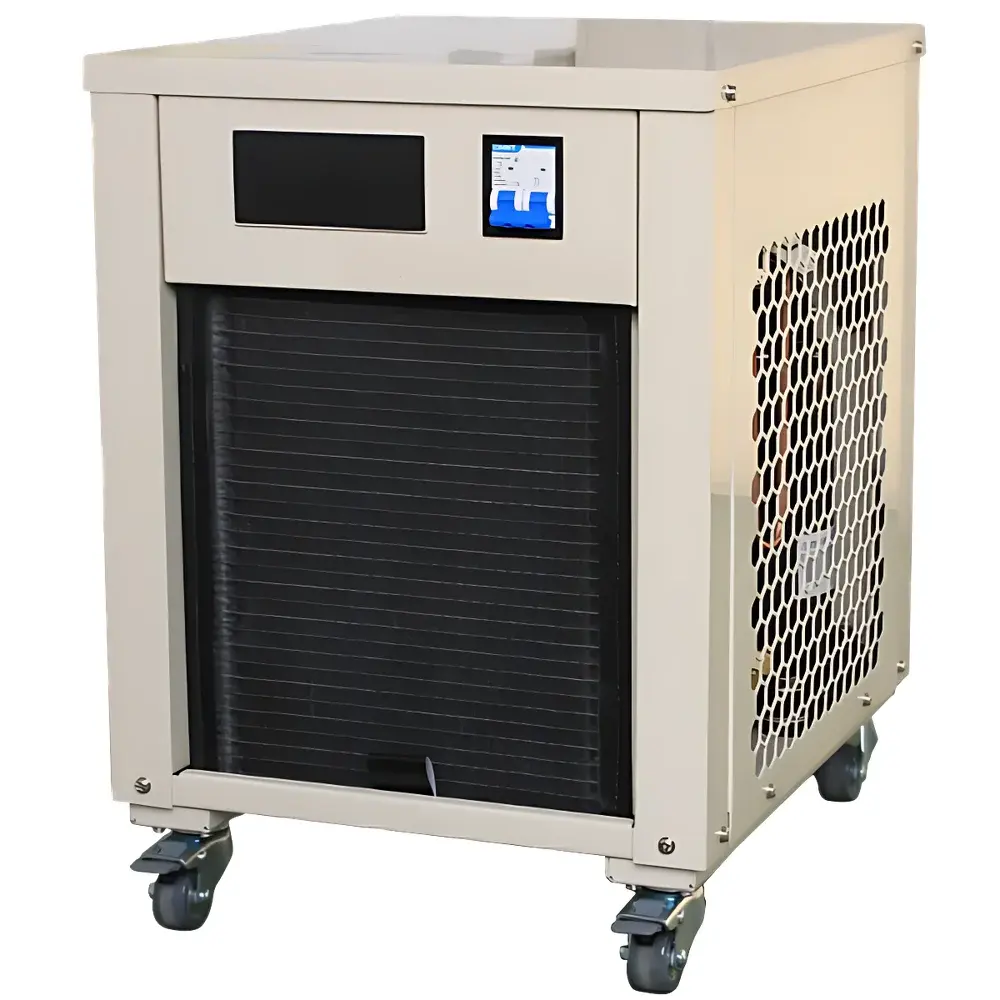
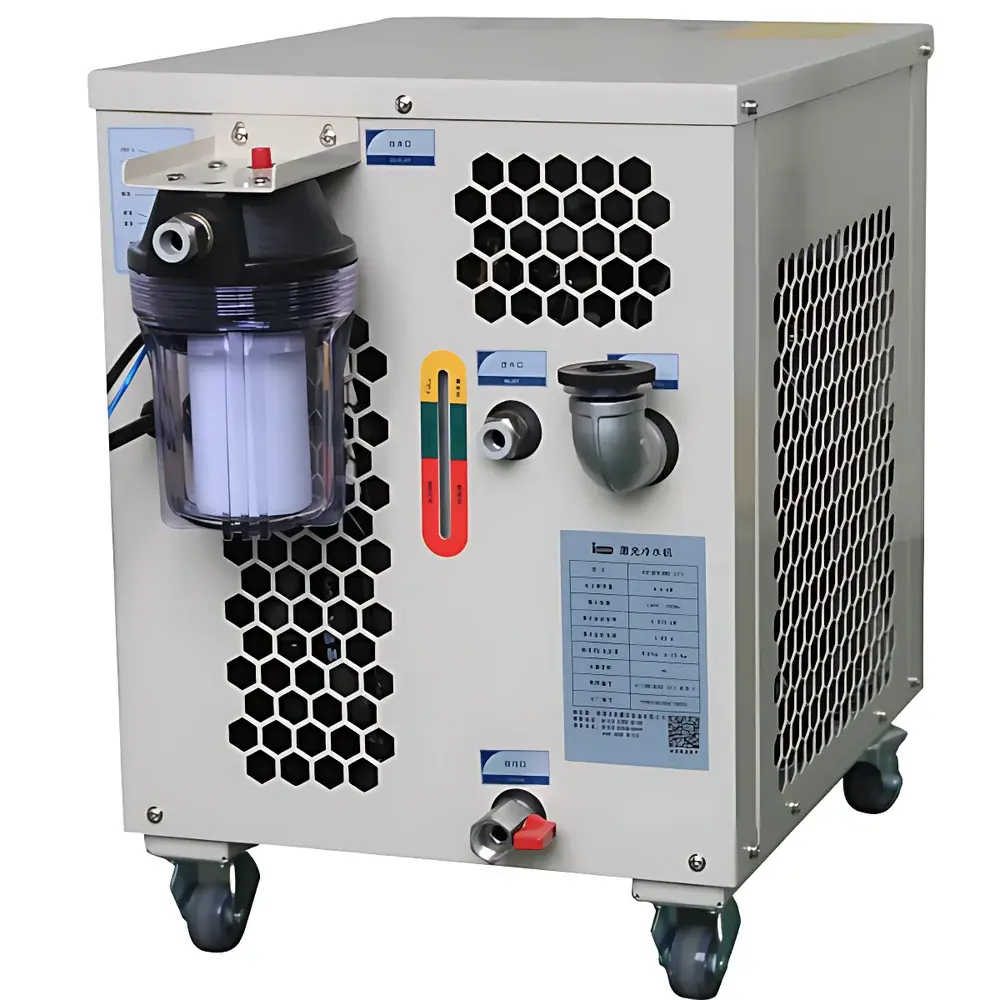
Saintins SY-600S High-Precision Air-Cooled Circulating Chiller
| Brand | Saintins |
|---|---|
| Origin | Jiangsu, China |
| Manufacturer Type | Direct Manufacturer |
| Product Category | Domestic |
| Model | SY-600S |
| Instrument Type | Integrated Unit |
| Cooling Method | Air-Cooled |
| Temperature Stability Range | 8–30 °C |
| Refrigeration Capacity | 600 W |
| Temperature Fluctuation | ±0.1 °C |
| Circulation Pump Pressure | 3 bar |
| Circulation Flow Rate | 12.5 L/min |
| Reservoir Volume | 3 L |
| Operating Mode | Continuous |
| Power Supply | 220 V~, 50 Hz |
| Max. Power Consumption | 830 W |
| Max. Current | 3.7 A |
| Heater Power | 300 W |
| Pump Head | 30 m |
| Inlet/Outlet Port | 4-mm BSP male thread to 12-mm quick-connect |
| Flow Protection Threshold | ≤1.5 L/min |
| Refrigerant | R134a |
| Ambient Operating Temperature Limit | ≤40 °C |
| Coolant Temperature Range | 8–30 °C |
| Filtration | 5-inch purified water filter |
| Net Weight | 25 kg |
| Dimensions (L×W×H) | 360×497×495 mm |
Overview
The Saintins SY-600S is an integrated, air-cooled circulating chiller engineered for high-precision temperature control in laboratory and light industrial applications. It employs a vapor-compression refrigeration cycle using R134a refrigerant to deliver stable, low-temperature coolant—typically deionized water or a water-glycol mixture—to external equipment. The system operates as a closed-loop thermal management unit: chilled fluid is circulated via a pressure-stable pump (3 bar max), absorbs heat from connected instruments, returns to the chiller’s evaporator, and is re-cooled before recirculation. Designed for continuous duty, the SY-600S maintains setpoint temperatures within ±0.1 °C across its operational range of 8–30 °C, enabling reliable thermal regulation for sensitive analytical instrumentation where ambient fluctuations or tap-water variability would otherwise compromise performance or data integrity.
Key Features
- Integrated air-cooled architecture eliminates dependency on facility water supply—reducing installation complexity, operational cost, and risk of contamination or pressure instability.
- Precision temperature control with ±0.1 °C stability over 8–30 °C range, achieved via PID-controlled refrigeration circuit and embedded PT100 sensor feedback loop.
- High-flow, low-pulsation circulation pump delivering 12.5 L/min at up to 30 m head; flow protection triggers automatic shutdown if output drops below 1.5 L/min, safeguarding pump and system integrity.
- 3-liter stainless-steel reservoir with integrated 5-inch purified water filter to minimize particulate ingress and extend coolant service life—critical for protecting precision instrument cooling jackets.
- RS485 serial interface enables remote monitoring and integration into centralized lab infrastructure or SCADA systems for audit-ready temperature logging and alarm reporting.
- Energy-efficient design with 600 W nominal refrigeration capacity and 830 W maximum power draw; includes 300 W electric heater for precise sub-ambient or ambient-temperature stabilization.
Sample Compatibility & Compliance
The SY-600S is compatible with a broad spectrum of laboratory and process equipment requiring stable coolant delivery, including NMR spectrometers, SEM/TEM systems, XRD diffractometers, mass spectrometers, laser sources (CO2, fiber), rotary evaporators, and reaction calorimeters. Its compact footprint (360 × 497 × 495 mm) and 25 kg net weight support benchtop or under-bench deployment in ISO Class 5–7 cleanrooms and GLP-compliant laboratories. While not certified to specific regulatory standards out-of-the-box, the unit’s RS485 interface, real-time temperature logging capability, and hardware-level flow/overheat safeguards align with foundational requirements for FDA 21 CFR Part 11–compatible environmental monitoring when paired with compliant data acquisition software. It meets IEC 61000-6-3 (EMC emission) and IEC 61000-6-2 (immunity) standards for laboratory-grade electrical equipment.
Software & Data Management
The SY-600S supports ASCII-based Modbus RTU protocol over RS485, permitting bidirectional communication with third-party control platforms (e.g., LabVIEW, MATLAB, Delta Tau PMAC, or custom SCADA). Users can read real-time parameters—including actual coolant temperature, setpoint, pump status, compressor run time, and fault codes—and write new setpoints or enable/disable heating/cooling modes. When integrated with validated data acquisition systems, the chiller contributes to ALCOA+ (Attributable, Legible, Contemporaneous, Original, Accurate, Complete, Consistent, Enduring, Available) data integrity frameworks. Optional firmware upgrades may introduce timestamped event logging (e.g., temperature excursions >±0.2 °C lasting >30 s), supporting GxP-aligned deviation tracking without requiring external dataloggers.
Applications
- Analytical Instrument Cooling: Provides stable thermal sink for high-field NMR consoles, electron microscopes, and X-ray sources—preventing thermal drift in detectors and magnet shims that degrade spectral resolution or imaging fidelity.
- Chemical Synthesis & Process Control: Maintains precise bath temperatures during reflux, crystallization, or exothermic reaction monitoring in jacketed reactors and calorimeters.
- Laser System Thermal Management: Stabilizes diode-pumped solid-state (DPSS) and fiber laser heads by maintaining coolant within ±0.1 °C—critical for wavelength consistency and beam pointing stability.
- Pharmaceutical Development: Supports USP and compliant environments by eliminating tap-water use and enabling closed-loop, filtered coolant circulation for lyophilizers and stability chambers.
- Materials Testing: Cools tensile testers, DSC units, and rheometers during extended thermal ramp protocols where ambient temperature shifts would otherwise distort mechanical or viscoelastic measurements.
FAQ
What is the minimum recommended coolant conductivity for optimal performance?
Deionized water with conductivity < 5 µS/cm is recommended; glycol mixtures up to 30% v/v are acceptable but reduce effective refrigeration capacity by ~12% per 10% glycol added.
Can the SY-600S operate continuously at 8 °C ambient temperature?
Yes—the unit is rated for continuous operation at ambient temperatures up to 40 °C; at lower ambient conditions, condenser efficiency improves, enhancing cooling capacity and energy efficiency.
Is the RS485 interface isolated or grounded?
The RS485 port features galvanic isolation (2.5 kV RMS) to prevent ground loops and ensure noise immunity in electrically noisy lab environments.
Does the chiller include built-in alarm relay outputs?
No—alarm states (e.g., high temp, low flow, compressor fault) are accessible only via RS485 register polling; external relay modules must be interfaced through user-defined PLC logic.
What maintenance intervals are recommended for the 5-inch filter and refrigerant charge?
Filter replacement every 6 months under continuous operation; refrigerant integrity is verified during annual preventive maintenance—no scheduled recharge is required unless leak detection confirms loss.



