
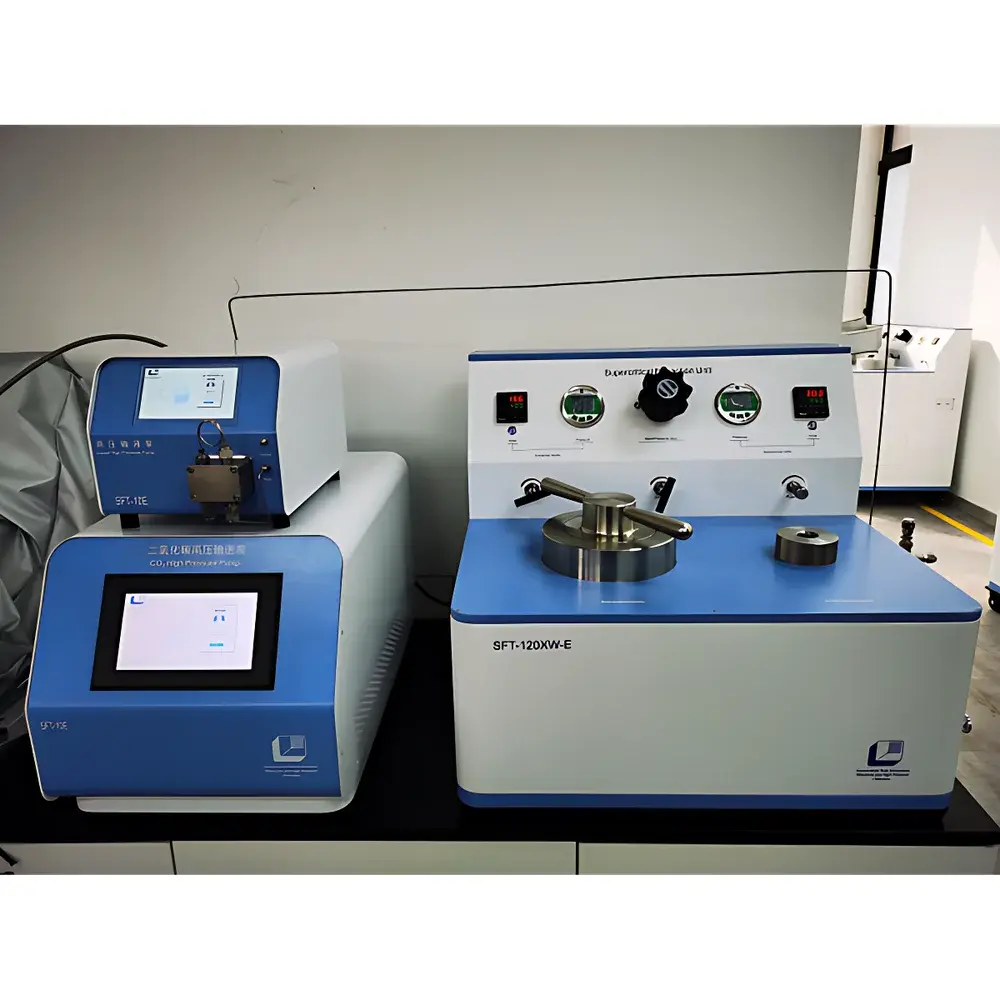
Saitai Technology SFT-120XW-E Supercritical CO₂ Extraction System
| Brand | Saitai Technology (STKJ) |
|---|---|
| Origin | Beijing, China |
| Model | SFT-120XW-E |
| Maximum Temperature | 200 °C (optional up to 300 °C) |
| Maximum Pressure | 48 MPa (7,000 psi) |
| Flow Rate Range | 0–600 mL/min (liquid CO₂) |
| Pressure Control Accuracy | ±0.07–0.14 bar in constant-pressure mode |
| Extractor Vessel Volume Options | 0.1–29 L (100 mL to 29 L standard) |
| Number of Extraction Vessels | 1–5 configurable positions |
| Heating Methods | Electric tape heating, hot air jacket, external thermal oil circulation |
| Cooling | Ambient air cooling or optional embedded electronic refrigeration (pump head < −4 °C) |
| Flow Control Resolution | 0.1 mL/min (liquid CO₂) |
| Flow Accuracy | ±2% of full scale |
| Safety Features | High/low pressure alarms (PAH/PAL), mechanical burst disc (8,500 psi), dual-stage pressure regulation |
Overview
The Saitai Technology SFT-120XW-E Supercritical CO₂ Extraction System is a modular, laboratory-scale platform engineered for precision supercritical fluid extraction (SFE), cleaning, and drying applications. It leverages carbon dioxide in its supercritical state—achieved above its critical point (31.1 °C, 7.38 MPa)—to deliver tunable solvent strength, low toxicity, and facile post-processing due to CO₂’s gaseous recovery at ambient conditions. The system operates across a validated pressure range up to 48 MPa and temperature range up to 200 °C (customizable to 300 °C), enabling thermally sensitive compound isolation (e.g., cannabinoids, essential oils, polyphenols) without degradation. Its architecture follows fundamental principles of supercritical fluid thermodynamics and mass transfer kinetics, with integrated control over density, diffusivity, and solvation power via real-time pressure and temperature modulation.
Key Features
- High-fidelity CO₂ delivery: Nex-10E stainless-steel intensifier pump with alloy pump head, electronic refrigeration (< −4 °C), integrated pressure sensor, and automatic flow compensation to maintain setpoint pressure within ±0.07–0.14 bar.
- Dual-stage flow regulation: Front-end precision metering (0.1 mL/min resolution) via T-type check valve and rear-end fine-tuning using micrometer-calibrated needle valves (up to 200 °C rated).
- Multi-zone thermal management: Independent heating of extraction vessels via electric tape, hot-air jacket, or external thermal oil loop; rapid cooldown via ambient air or internal cooling coils.
- Configurable multi-vessel operation: Supports 1–5 parallel extraction vessels (100 mL to 29 L capacity per vessel), facilitating comparative studies, process optimization, or high-throughput screening.
- Enhanced process fidelity: Pre-heating unit ensures uniform CO₂ inlet temperature; stainless-steel 30-mesh sample baskets and 5 µm nylon extraction bags minimize channeling and particle carryover.
- Robust safety architecture: Dual independent pressure monitoring, programmable high/low pressure alarms (PAH/PAL), and ASME-certified mechanical burst disc rated at 8,500 psi.
Sample Compatibility & Compliance
The SFT-120XW-E accommodates solid, semi-solid, and powdered matrices—including botanicals, foodstuffs, polymers, and pharmaceutical intermediates—without requiring derivatization or harsh solvents. Its design conforms to general laboratory safety standards (ANSI Z9.5, ISO 13857) and supports compliance workflows aligned with GLP and GMP environments. While not pre-certified for FDA 21 CFR Part 11, the system’s microprocessor-based controller logs timestamped pressure, temperature, flow, and alarm events—enabling audit-ready data export for regulatory submissions. Optional mass flow meters (gas-phase) and gravimetric collection modules support ASTM D7675 (supercritical fluid extraction of pesticides) and ISO 14891 (CO₂-based decaffeination) method adaptations.
Software & Data Management
The front-panel interface features chemically resistant LED displays showing real-time pressure (psi/MPa), temperature (°C), and liquid CO₂ flow rate (mL/min). All operational parameters—including pressure setpoints, ramp rates, dwell times, and alarm thresholds—are programmable via tactile membrane buttons. Event-driven logging records pressure excursions, temperature deviations, and valve actuation timestamps. Data export is supported via RS-232 or USB-to-serial interface for integration into LIMS or custom SCADA platforms. No proprietary software license is required; raw ASCII log files are compatible with MATLAB, Python (Pandas), and Excel for statistical process analysis and DOE modeling.
Applications
- Natural product isolation: Selective extraction of terpenes, flavonoids, and alkaloids from plant biomass under mild thermal conditions.
- Pharmaceutical purification: Residual solvent removal from APIs and lipid nanoparticle formulation aids.
- Food & flavor processing: Caffeine-free coffee production, hop oil recovery, and cholesterol reduction in egg yolk powders.
- Materials science: Supercritical drying of aerogels and nanomaterials without capillary collapse.
- Environmental remediation: PCB and PAH removal from contaminated soils and sediments.
- Microelectronics: Precision cleaning of MEMS devices and photomasks without surface oxidation.
FAQ
What CO₂ purity grade is recommended for optimal system performance?
Grade 5.0 (99.999% pure) CO₂ is strongly recommended to prevent pump corrosion and valve clogging. Use cylinders equipped with dip tubes to ensure liquid-phase withdrawal.
Can the system operate continuously for extended periods (e.g., >24 h)?
Yes—the Nex-10E pump and thermal management subsystems are rated for continuous duty cycles. Scheduled maintenance intervals (filter replacement, seal inspection) follow ISO 15360 guidelines and are documented in the operator manual.
Is retrofitting for higher temperature (300 °C) or pressure (60 MPa) possible?
Custom configurations up to 300 °C are available with Inconel 718 vessel liners and upgraded insulation. Pressure upgrades beyond 48 MPa require full ASME Section VIII Div. 3 revalidation and are evaluated on a case-by-case basis.
How is solvent polarity modulated during extraction?
Polarity tuning is achieved via co-solvent (modifier) addition using the optional syringe-type夹带剂 pump, delivering methanol, ethanol, or acetone at controlled volumetric ratios (typically 1–15% v/v) directly into the supercritical stream.
Does the system support automated fraction collection?
While not included as standard, the outlet stream can be interfaced with third-party fraction collectors via TTL-triggered solenoid valves and pressure-synchronized timing logic.



