
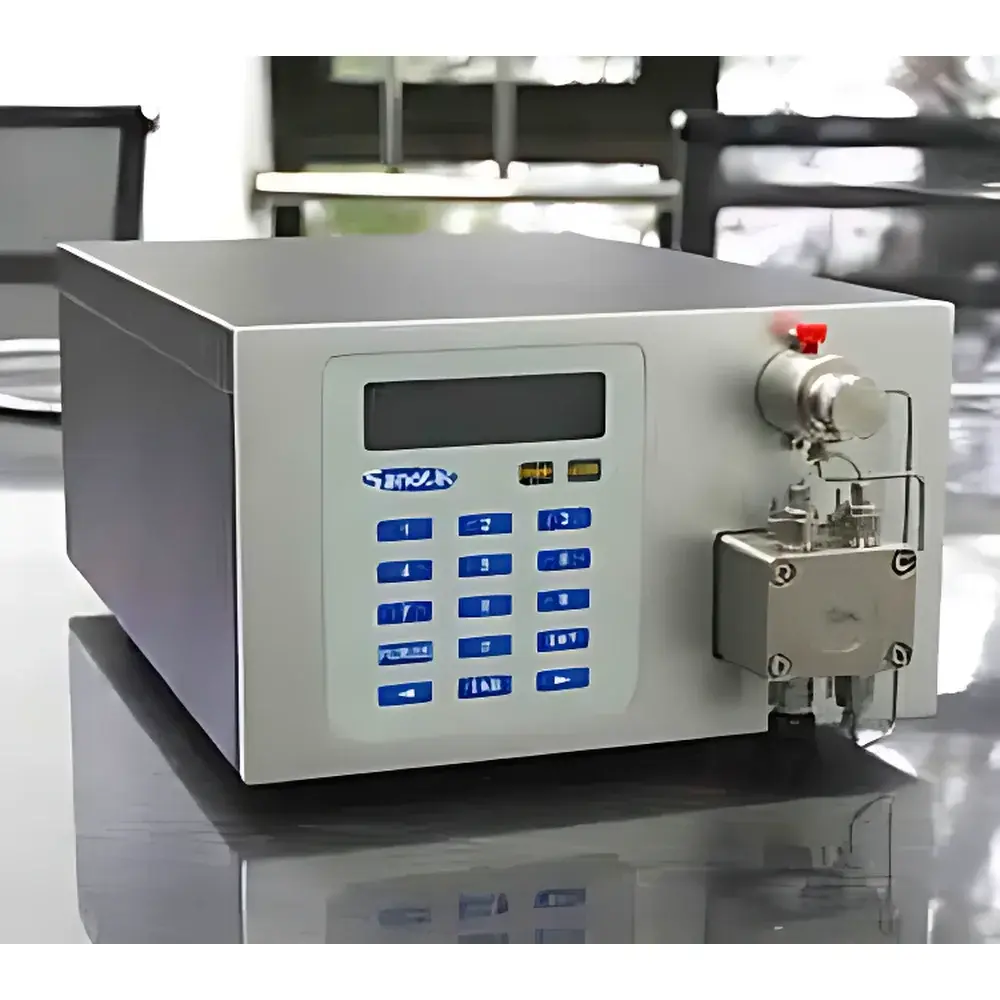
Sanotac AP2010 High-Pressure Constant Flow Pump
| Brand | Sanotac |
|---|---|
| Origin | Shanghai, China |
| Manufacturer Type | OEM Manufacturer |
| Model | AP2010 |
| Flow Rate | 0.001–9.999 mL/min (increment: 0.001 mL/min) |
| Maximum Pressure | 42 MPa |
| Pump Head Material | 316L Stainless Steel (10 mL volume) |
| Flow Accuracy | ±0.1% or ±10 µL |
| Flow RSD | ≤0.1% |
| Pressure Pulsation | ≤0.5 MPa |
| Display | 256×64 dot matrix self-luminous LCD with adjustable backlight |
| Control Interface | Rotary encoder keypad + optional PC remote control via RS232/USB |
| Power Supply | 85–264 VAC, 100 W |
| Tubing Connection | 1/16″ standard stainless steel fittings |
Overview
The Sanotac AP2010 High-Pressure Constant Flow Pump is an engineered solution for precise, stable, and pulse-minimized solvent delivery in analytical and preparative liquid chromatography systems—including HPLC, UHPLC-compatible configurations, and supercritical fluid applications. Built upon a dual-piston serial architecture with floating piston support, the AP2010 eliminates mechanical binding and uneven wear during high-cycle operation, directly enhancing long-term flow stability and seal longevity. Its 10 mL 316L stainless steel pump head ensures full compatibility with aggressive mobile phases (e.g., strong acids, bases, THF, DMSO), while maintaining structural integrity at sustained pressures up to 42 MPa (6,090 psi). Unlike single-piston or low-pressure gradient systems, the AP2010 delivers true constant-flow performance across its full operational range—0.001 to 9.999 mL/min—with resolution down to 1 µL per step. This level of granularity supports method development requiring ultra-low-flow microbore or capillary column operation, as well as robust isocratic and gradient elution protocols in regulated QC laboratories.
Key Features
- Dual-piston serial drive mechanism with dynamically balanced floating piston support—reduces lateral loading on seals and extends service life beyond 10,000 operating hours under typical conditions.
- 316L stainless steel wetted path (including pump head, check valves, and inlet/outlet manifolds) certified for corrosion resistance per ASTM A276 and ISO 8407.
- Flow accuracy of ±0.1% or ±10 µL (whichever is greater) and repeatability (RSD) ≤0.1%—validated per ISO 5725-2:2019 guidelines for precision testing.
- Pressure pulsation <0.5 MPa across all flow rates and viscosity ranges (0.3–5 cP), minimizing baseline noise in UV-Vis and fluorescence detection.
- Self-luminous 256×64 dot-matrix LCD display with uniform brightness and viewing-angle-independent color fidelity—designed for ambient-light flexibility in shared lab environments.
- Rotary encoder-based front-panel interface enabling tactile, drift-free parameter adjustment without touchscreen dependency—critical for gloved operation in GMP cleanrooms.
- Integrated RS232 and USB-B ports supporting bidirectional communication with third-party CDS platforms (e.g., Chromeleon, Empower, OpenLab) and compliance-ready audit trail generation.
Sample Compatibility & Compliance
The AP2010 is validated for use with aqueous, organic, and mixed-phase solvents commonly employed in pharmaceutical, environmental, and polymer analysis—including 0.1% TFA in water/acetonitrile, 1M NaOH for carbohydrate separations, and CO₂/methanol mixtures in SFC. Its 316L construction meets USP requirements for extractables and leachables in Class VI plastic contact applications. The pump complies with IEC 61010-1:2010 for laboratory electrical safety and supports 21 CFR Part 11-compliant electronic records when deployed with validated CDS software. All firmware revisions maintain backward compatibility and are documented in a controlled revision log accessible to qualified users during GLP/GMP audits.
Software & Data Management
Remote operation is enabled via ASCII protocol over RS232 or USB virtual COM port, allowing integration into custom Python, LabVIEW, or MATLAB automation sequences. The pump’s internal memory stores up to 20 user-defined methods with timestamped execution logs. When paired with compliant chromatography data systems, it supports full electronic signature capture, change control tracking, and automatic backup of flow/pressure event histories. Firmware updates are delivered as signed binary packages with SHA-256 checksum verification—ensuring integrity and traceability per ALCOA+ principles.
Applications
- Isocratic and multi-step gradient elution in pharmacopeial assays (USP , EP 2.2.46).
- Preparative-scale purification of monoclonal antibodies using 21.2 mm ID columns at 10–20 mL/min.
- Low-flow nano-LC coupling to mass spectrometers (e.g., 200 nL/min for proteomics).
- Stability-indicating forced degradation studies requiring exact solvent composition control over 72-hour runs.
- Method transfer between research, QC, and manufacturing sites under ICH Q5C guidelines.
FAQ
Does the AP2010 support gradient mixing?
No—the AP2010 is a single-channel constant-flow pump. Gradient formation requires external low-pressure or high-pressure mixing modules (e.g., Sanotac GM-2010) connected upstream.
What maintenance intervals are recommended for the 316L pump head seals?
Under continuous operation at ≤30 MPa and ambient temperature, primary seal replacement is recommended every 6,000 hours; secondary seal inspection is advised every 2,000 hours per preventive maintenance SOP.
Can the AP2010 be operated in parallel mode with another unit for increased flow capacity?
Not natively—the firmware does not support master/slave synchronization. Parallel operation requires external flow-splitting hardware and independent pressure monitoring per ISO/IEC 17025:2017 Annex A.3.
Is firmware update capability available over USB without vendor assistance?
Yes—signed firmware binaries and update utilities are provided with each unit and require no proprietary dongle or cloud authentication.
How is flow calibration traceability maintained?
Each unit ships with a NIST-traceable calibration certificate (ISO/IEC 17025-accredited lab) covering three flow points (0.1, 1.0, and 5.0 mL/min) and two pressure points (10 and 30 MPa).



