
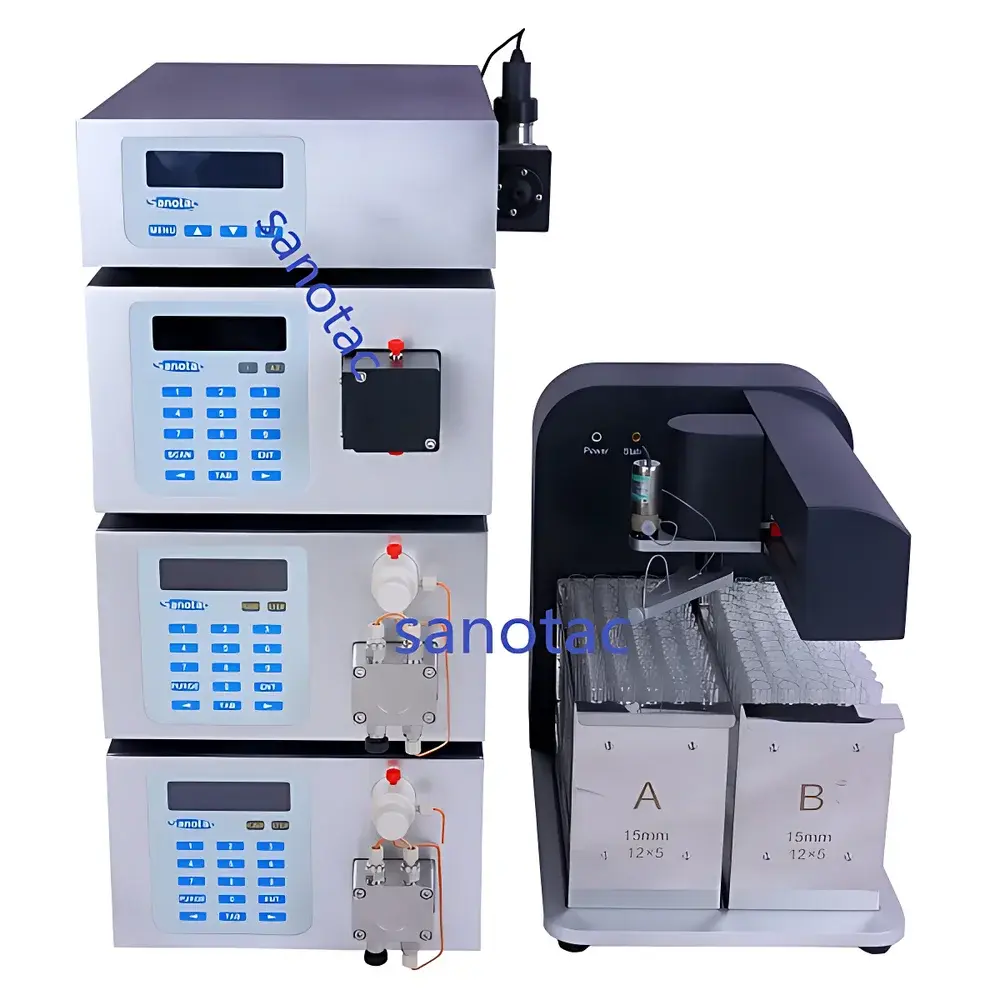
Sanotac Biolot 200 Automated Protein Purification System
| Brand | Sanotac |
|---|---|
| Origin | Shanghai, China |
| Manufacturer Type | OEM Manufacturer |
| Origin Category | Domestic (China) |
| Model | Biolot 200 |
| Purification Principle | Affinity Chromatography (AC) |
| Gradient Types | Step and Linear Gradients (editable in real time) |
| Detectors | UV-Vis (190–800 nm), pH, Conductivity |
| Flow Rate Range | 0.01–200 mL/min |
| Flow Accuracy | ±0.5% |
| Pressure Range | 0–5 MPa |
| Conductivity Range | 0–999.9 mS/cm |
| pH Range | 0–14 |
| UV Absorbance Range | −3 to +3 AU (linear up to 2 AU) |
| Column Material Compatibility | PEEK fluidic path |
| Fraction Collector | 2 × 60-tube rack (15 mm × 150 mm) |
| Software Compliance | FDA 21 CFR Part 11–compliant control software |
Overview
The Sanotac Biolot 200 Automated Protein Purification System is an integrated, benchtop liquid chromatography platform engineered for high-fidelity purification of biomolecules—including recombinant proteins, monoclonal antibodies (mAbs), peptides, polysaccharides, viral vectors, and plasma-derived therapeutics. Built upon a dual-pump high-pressure gradient architecture, the system implements affinity chromatography (AC) as its primary separation mechanism—leveraging immobilized ligands (e.g., Protein A/G, Ni-NTA, GST-tag resins) to achieve selective binding and elution under controlled buffer conditions. Its core design adheres to Good Laboratory Practice (GLP) and early-stage Good Manufacturing Practice (GMP)-aligned workflows, with full traceability, electronic signatures, and audit trail functionality embedded in the native control software. The system operates across a wide dynamic range: flow rates from 0.01 to 200 mL/min, pressure tolerance up to 5 MPa, and simultaneous multi-parameter detection (UV absorbance at two wavelengths, conductivity, and pH), enabling real-time monitoring of mobile phase composition and column elution profiles.
Key Features
- High-precision dual PEEK piston pumps with ≤0.2 MPa pressure pulsation and ±0.5% flow accuracy—optimized for reproducible gradient delivery and low backpressure variability across resin beds.
- Modular detector suite: UV-Vis spectrophotometer with deuterium/tungsten lamp source auto-switching, wavelength scanning from 190–800 nm (±1 nm accuracy), and dual-wavelength simultaneous acquisition; calibrated pH and conductivity sensors with 0–14 pH range and 0–999.9 mS/cm range.
- Fully PEEK-wetted fluidic path ensures biocompatibility, chemical resistance to common buffers (e.g., imidazole, guanidine HCl, low-pH glycine), and minimal metal ion leaching—critical for sensitive protein formulations.
- Automated fraction collector supporting three collection modes: sequential, loop-based recirculation, and event-triggered (e.g., peak threshold, time window, or conductivity step), configurable for 120 tubes (2×60 racks, 15 mm diameter × 150 mm height).
- Integrated pump head self-cleaning protocol minimizes crystallization risk from volatile buffers (e.g., ammonium sulfate) and reduces carryover between runs.
- Standard 1 mL quantitative loop injector with optional variable-loop configurations (0.1–5 mL); manual injection valve included for rapid method scouting.
Sample Compatibility & Compliance
The Biolot 200 supports purification of diverse biomolecular classes: His-tagged and GST-tagged recombinant proteins, IgG-class monoclonal antibodies, synthetic and enzymatically cleaved peptides, plant- and microbial-derived polysaccharides, adeno-associated virus (AAV) capsids, and human serum albumin (HSA) fractions. Its PEEK-based hardware meets ISO 10993–1 biocompatibility guidelines for non-invasive device contact, while the control software conforms to FDA 21 CFR Part 11 requirements—including role-based user access, electronic signatures, immutable audit trails, and data integrity safeguards (ALCOA+ principles). Method files, raw chromatograms, and instrument logs are stored in vendor-neutral formats (e.g., .csv, .pdf, .xml) compatible with LIMS integration and regulatory submissions.
Software & Data Management
Control is executed via Windows-native software (compatible with Windows 7 through Windows 10), communicating over RS-232 or USB. The interface enables full method development: gradient programming (step/linear, editable during run), detector parameter tuning, fraction trigger logic definition, and real-time overlay of UV, conductivity, and pH signals. All methods are saved with metadata (user ID, timestamp, instrument ID) and support version-controlled revision history. Raw data files include embedded calibration coefficients and detector diagnostics. Audit trail records capture every parameter change, start/stop command, and user login/logout event—exportable in PDF/A format for inspection readiness. Software validation documentation (IQ/OQ/PQ templates) is provided to support lab qualification processes.
Applications
- Purification of research-grade recombinant proteins for structural biology (X-ray crystallography, cryo-EM sample prep)
- Downstream processing of therapeutic mAbs—capture (Protein A), intermediate polishing (ion exchange), and final desalting/buffer exchange
- Isolation of bioactive peptides from enzymatic digests or solid-phase synthesis crude mixtures
- Separation of vaccine antigens (e.g., SARS-CoV-2 spike protein trimers) from host cell proteins and nucleic acid contaminants
- Preparative-scale purification of heparin-like glycosaminoglycans and fungal β-glucans for functional assays
- Process development for plasma fractionation—Cohn fractionation optimization and IgM/IgA subclass isolation
FAQ
Does the Biolot 200 support linear gradient formation?
Yes—it generates both step and linear gradients, with real-time editing capability during active runs.
Can the system be validated for GMP environments?
While designed for R&D and preclinical use, its 21 CFR Part 11–compliant software, audit trail, and IQ/OQ documentation package support Stage 1–2 process validation per ICH Q5A/Q5D.
What is the maximum recommended column size?
The system is optimized for analytical to semi-preparative columns (up to 2.6 cm ID × 30 cm length) operating within the 0–5 MPa pressure limit.
Is remote monitoring supported?
No built-in Ethernet or cloud connectivity; however, local PC-based monitoring is fully supported, and third-party SCADA integration is feasible via OPC-UA adapters.
Are maintenance kits and spare parts available internationally?
Yes—Sanotac provides global distributor networks with certified service engineers and standardized consumables (PEEK tubing, pump seals, detector lamps, fraction tubes).



