
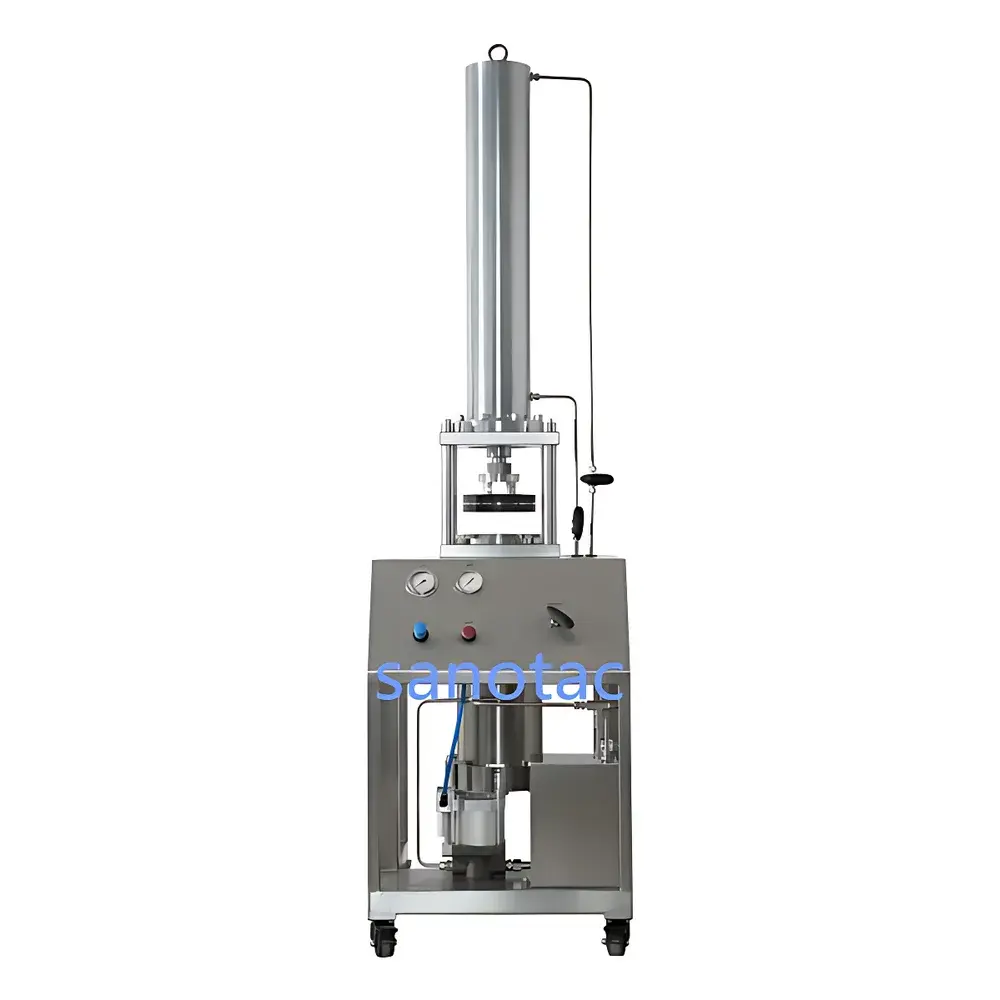
Sanotac DAC-100 Dynamic Axial Compression Chromatography System
| Brand | Sanotac |
|---|---|
| Origin | Shanghai, China |
| Manufacturer Type | Manufacturer |
| Origin Category | Domestic |
| Model | DAC-100 |
| Application Level | Industrial Preparative Scale |
| Instrument Type | High-Pressure Preparative Liquid Chromatograph |
| Flow Rate Range | 0.01–1000.00 mL/min |
| Flow Accuracy | ±1% |
| Flow Precision (RSD) | ≤0.5% |
| Maximum Operating Pressure | 10 MPa |
| Wavelength Range | 190–800 nm |
| Wavelength Accuracy | ±1 nm |
| Wavelength Repeatability | 0.2 nm |
| Baseline Noise | ±0.5 × 10⁻⁵ AU (254 nm, TC = 1 s) |
| Data Acquisition Frequency | 10 Hz |
| Column ID | 100 mm |
| Max Bed Height | 500 mm |
| Column Tube Material | 316L Stainless Steel |
| Wall Roughness (Ra) | ≤0.2 µm |
| Frit Pore Size | 2 µm |
| Frit Material | 316L Stainless Steel |
| Recommended Particle Size | 5–10 µm |
| Pump Max Flow | 600 mL/min |
| Recommended Operational Flow | 200–350 mL/min |
| Gradient Types | Step, Linear, Real-Time Modifiable |
| Minimum Gradient Increment | 1% |
| UV Detector Light Sources | Deuterium + Tungsten Lamps (Imported) |
| Absorbance Range | 0–2 AU |
| Collection Modes | Time-Based, Peak-Triggered, Threshold-Based, Sequential, Recirculating |
| System Dimensions (W×D×H) | 750 × 650 × 2360 mm |
| Net Weight | 240 kg |
Overview
The Sanotac DAC-100 Dynamic Axial Compression Chromatography System is an industrial-scale preparative liquid chromatography platform engineered for high-resolution, high-recovery purification of thermally sensitive and structurally complex molecules. It operates on the principle of dynamic axial compression (DAC), where a hydraulically actuated piston applies uniform, controllable pressure across the entire cross-section of the chromatographic bed during column packing and elution. This eliminates radial density gradients and ensures exceptional bed homogeneity, mechanical stability, and long-term column integrity—critical for reproducible separations over hundreds of runs. Unlike static-packed columns prone to channeling or void formation under high flow or pressure cycling, the DAC-100 maintains consistent bed density (typically >0.95 g/cm³ for silica-based media) and minimizes backpressure drift. Its 10 MPa (100 bar) maximum operating pressure supports both conventional silica (5–10 µm) and rigid polymer-based stationary phases, enabling scalable purification from lab-scale method development (10–50 mm ID columns) to pilot- and production-scale operations (up to 100 mm ID, 500 mm bed height).
Key Features
- Hydraulic piston actuation with nitrogen-sealed interface ensures zero leakage, minimal dead volume, and precise pressure maintenance over extended run durations (±0.5 bar stability for >12 h at 8 MPa).
- Dual-pump architecture configurable as binary or quaternary gradient system, delivering flow rates from 0.01 to 1000 mL/min with RSD ≤0.5% across full range; integrated multi-point flow calibration compensates for viscosity- and pressure-dependent deviations.
- High-sensitivity UV-Vis detector featuring dual deuterium/tungsten lamps, 190–800 nm spectral coverage, real-time dual-wavelength monitoring, and baseline noise <0.5 × 10⁻⁵ AU (254 nm, 1 s time constant).
- Linearly distributed, low-dead-volume flow distributor with ≥92% active screen area utilization and Ra ≤0.2 µm internal surface finish to minimize band broadening and maximize plate count (N > 25,000/m typical for 10 µm particles).
- Intelligent fraction collector with programmable valve sequencing, supporting time-, peak-, threshold-, sequential-, and recirculating collection modes; compatible with standard 15–50 mL tube racks and custom receiver trays.
- Automated pump head rinsing protocol with solvent-switching capability prevents salt crystallization and buffer residue accumulation—essential for long-term operation with phosphate or acetate mobile phases.
- Cam-profile flow pulsation compensation reduces hydraulic ripple to <0.8% peak-to-peak amplitude, directly improving baseline stability and integration accuracy for low-abundance analytes.
Sample Compatibility & Compliance
The DAC-100 accommodates a broad spectrum of sample matrices, including crude plant extracts (e.g., alkaloids, flavonoids, terpenoids), synthetic organic intermediates, peptide fragments, and moderately sized proteins (<50 kDa). Its 316L stainless steel wetted path, 2 µm frits, and chemically resistant fluidic design tolerate pH 1–12 mobile phases and aggressive solvents (e.g., DMSO, DMF, THF). The system meets core regulatory requirements for GMP-compliant manufacturing environments: hardware architecture supports 21 CFR Part 11-compliant electronic signatures, role-based user access control (admin/operator/auditor tiers), immutable audit trails with timestamped event logging (login attempts, method changes, injection records, data exports), and ALCOA+ data integrity principles. All chromatographic methods, raw data files (.cdf), processed results, and instrument configurations are stored in a relational database with project-level metadata tagging—facilitating traceability during FDA, EMA, or NMPA inspections.
Software & Data Management
Sanotac ChromaControl v4.2 is a validated, Windows-based control and analysis suite compliant with CFDA GxP and FDA 21 CFR Part 11 Annex 11 guidelines. It provides centralized management of instrument modules (pumps, detector, collector, column oven), real-time parameter monitoring, and automated method validation workflows (system suitability testing per USP ). Raw chromatograms are acquired at 10 Hz and stored in vendor-neutral .cdf format (ASTM E1947-20 compliant). The software includes quantitative tools for peak integration (tangent skim, valley-to-valley, exponential baseline correction), purity assessment (spectral library matching, peak purity angle analysis), and batch processing with customizable report templates (PDF/Excel export). All user actions—including login/logout, method modification, data deletion, and audit trail review—are digitally signed and archived with hash-verified integrity checks.
Applications
The DAC-100 serves as a primary purification engine in natural product isolation (e.g., paclitaxel analogs from yew extract), chiral resolution of pharmaceutical intermediates (e.g., enantiomeric separation of β-blockers), purification of oligonucleotide synthesis by-products, and recovery of monoclonal antibody fragments from cell culture supernatants. Its robustness supports continuous operation under cGMP conditions for clinical trial material production (Phase I–III), with documented column lifetimes exceeding 300 purification cycles without performance degradation. Method transfer from analytical HPLC (e.g., Waters Acquity) to DAC-100 is facilitated by linear scalability rules (constant L/dp, fixed gradient time/volume ratio), enabling seamless progression from mg- to 100-g batch sizes.
FAQ
What is the minimum particle size supported for optimal performance?
The DAC-100 is optimized for 5–10 µm spherical silica and polymer-based packings; sub-5 µm media are not recommended due to excessive backpressure generation beyond the system’s 10 MPa limit.
Can the system be integrated with third-party mass spectrometers?
Yes—via standard analog/digital I/O ports and optional LC-MS interface module supporting real-time fraction triggering and synchronized data acquisition with Thermo, Sciex, and Waters MS platforms.
Is column re-packing required between batches?
No—dynamic axial compression enables in-place column regeneration using solvent flush sequences; full repacking is only necessary after >500 cycles or upon irreversible fouling (e.g., protein aggregation).
Does the system support temperature-controlled separations?
An optional column oven (ambient to 60°C, ±0.5°C stability) is available for retention time optimization and improved resolution of temperature-sensitive compounds.
How is method validation performed on this platform?
Built-in system suitability tests include precision (n=6 injections), linearity (5-point calibration curve, R² ≥0.999), LOD/LOQ determination, and robustness assessment per ICH Q2(R2); all reports comply with ISO/IEC 17025 documentation standards.






