
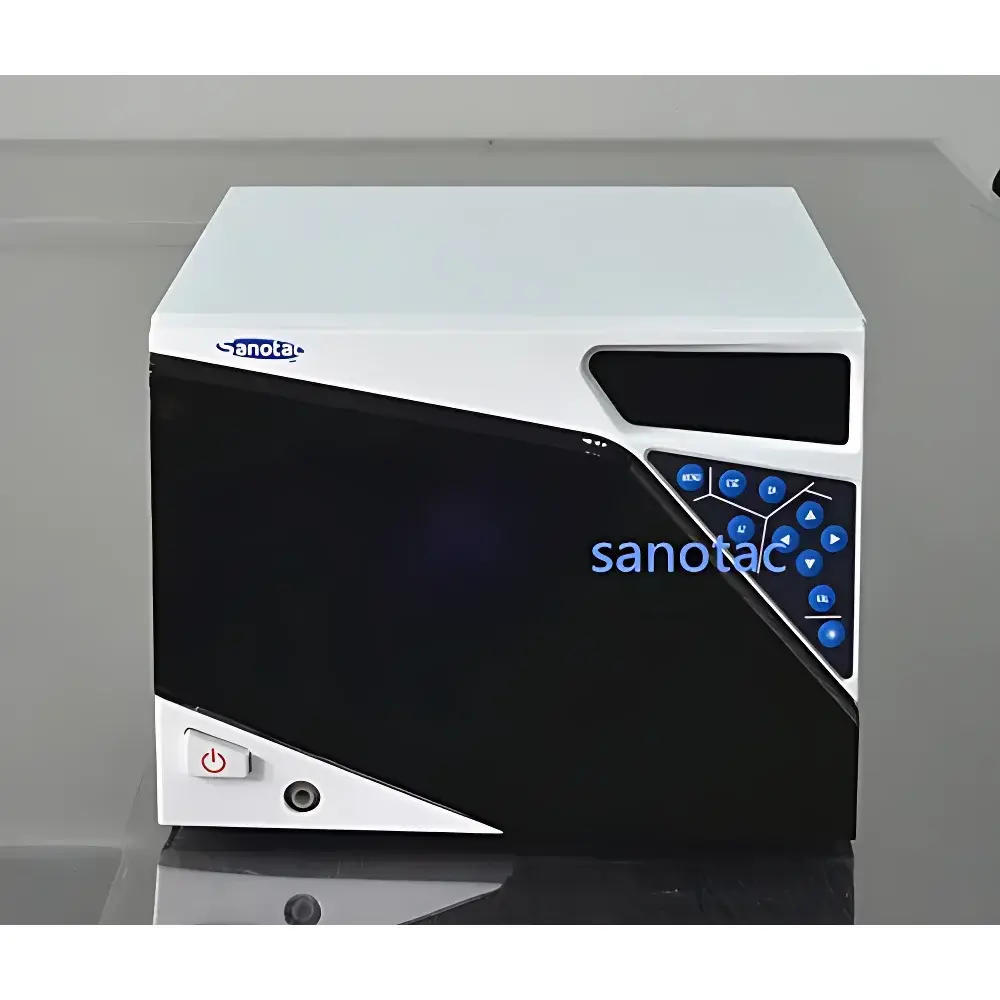
Sanotac ELSD2000 Evaporative Light Scattering Detector
| Brand | Sanotac |
|---|---|
| Origin | Shanghai, China |
| Manufacturer Type | OEM Manufacturer |
| Product Category | Domestic |
| Model | ELSD2000 |
| Instrument Type | Evaporative Light Scattering Detector (ELSD) |
| Wavelength | 650 nm |
| Detection Mode | Low-Temperature Evaporation |
| Light Source | Semiconductor Laser |
Overview
The Sanotac ELSD2000 is a compact, high-performance evaporative light scattering detector engineered for universal detection in liquid chromatography systems. Unlike UV-Vis detectors—which rely on chromophore absorption and are inherently limited to analytes with suitable optical properties—the ELSD2000 operates on the physical principle of nebulization, solvent evaporation, and light scattering from non-volatile analyte particles. This makes it particularly valuable for detecting compounds lacking chromophores, such as carbohydrates, lipids, surfactants, polymers, and natural product extracts. Its design adheres to core analytical requirements for reproducibility, robustness, and compatibility with regulated environments—supporting both routine QC workflows and method development in pharmaceutical, food, and academic laboratories.
Key Features
- Compact footprint (26 × 19 × 46 cm) enabling seamless integration into stacked HPLC or preparative LC configurations
- Low-temperature evaporation mode with precise temperature control (±1 °C accuracy) across both drift tube (room temp–130 °C) and nebulizer (room temp–56 °C) zones
- High-sensitivity detection using a 650 nm semiconductor laser and photomultiplier tube (PMT), achieving baseline noise ≤0.04 mV and drift ≤0.4 mV/30 min
- Adjustable nebulizer angle and heated nozzle for optimized雾化 (atomization) of viscous or oily samples
- Linear gain adjustment (0.3–30×) and analog output range (±1200 mV) for flexible signal scaling and peak height optimization
- Comprehensive self-diagnostic suite: 16 automated system checks covering gas pressure, temperature stability, flow integrity, and laser status
- Real-time monitoring and dual-mode alerting (audible + visual) for critical parameters including gas pressure (0.01 bar resolution), flow rate (1–4 L/min, ±1% or ±0.02 L/min), and temperature deviations
- Energy-efficient standby mode activation via multiple triggers—including idle time, external event signals, or software command
Sample Compatibility & Compliance
The ELSD2000 detects any non-volatile or semi-volatile analyte with volatility lower than the mobile phase, independent of UV absorbance. It is routinely applied to carbohydrates (e.g., mono-/disaccharides, oligosaccharides), lipids (triglycerides, phospholipids), saponins, terpenoids, synthetic polymers, and excipients. Compatible with common reversed-phase, normal-phase, and HILIC mobile phases—including volatile buffers (e.g., ammonium acetate/formate) and low-boiling solvents (e.g., acetonitrile, methanol, chloroform). The instrument meets essential safety and operational standards for laboratory instrumentation: CE marking, IEC 61010-1 compliance, and electrical safety certification. Its integrated software architecture supports audit trail functionality per FDA 21 CFR Part 11 requirements when deployed with validated Clarity® DLL-based acquisition modules.
Software & Data Management
The ELSD2000 is controlled via Sanotac’s proprietary multi-platform chromatography acquisition software, compatible with Windows-based HPLC data systems. It provides structured method management—storing up to 10 methods, each containing 25 configurable parameters (e.g., temperature setpoints, gas flow, gain, sampling rate). Communication interfaces include RS-232, RS-485, USB 2.0, and Ethernet (TCP/IP and HTTP protocols), enabling direct integration with third-party chromatography data systems (CDS) without proprietary hardware dependencies. External event triggering supports synchronized actions such as zeroing, laser shutdown, gas valve actuation, and heater control. All parameter changes, run logs, and alarm events are timestamped and stored locally, forming an immutable record traceable for GLP/GMP audits.
Applications
- Quantitation of sugar alcohols and oligosaccharides in functional foods and infant formula (per AOAC 982.28 and USP <211>)
- Residual solvent and excipient analysis in pharmaceutical formulations where UV-inactive components dominate
- Method transfer from preparative to analytical scale using consistent detection response across flow rates (0.01–3 mL/min)
- Stability-indicating assays for degradation products lacking chromophores
- Quality control of botanical extracts and traditional medicine preparations under Chinese Pharmacopoeia (ChP) and European Pharmacopoeia (Ph. Eur.) guidelines
- Characterization of polymeric drug carriers and lipid nanoparticles in nanomedicine development
FAQ
What types of chromatographic systems is the ELSD2000 compatible with?
It integrates natively with analytical HPLC, semi-preparative and preparative LC systems—including medium-pressure chromatography (MPLC)—via standard analog/digital outputs and protocol-supported communication interfaces.
Does the ELSD2000 support regulatory-compliant data handling?
Yes—when used with validated Clarity® DLL integration and configured audit trail settings, it satisfies FDA 21 CFR Part 11 requirements for electronic records and signatures.
Can the detector operate with nitrogen instead of compressed air?
Yes—both clean, oil-free compressed air and nitrogen (2–5 bar input pressure) are supported; nitrogen is recommended for enhanced baseline stability in sensitive applications.
What is the minimum detectable mass for typical analytes?
The ELSD2000 achieves sub-nanogram detection limits (e.g., <1 ng on-column for sucrose under optimized conditions), with quantitative linearity spanning 0.1–30 μg per injection.
How does the instrument prevent solvent carryover into the detection chamber?
A multi-stage safety architecture includes real-time gas pressure validation, flow-path interlock logic, and automatic shutdown if abnormal backpressure or temperature deviation is detected—preventing condensate ingress and extending PMT lifetime.





