
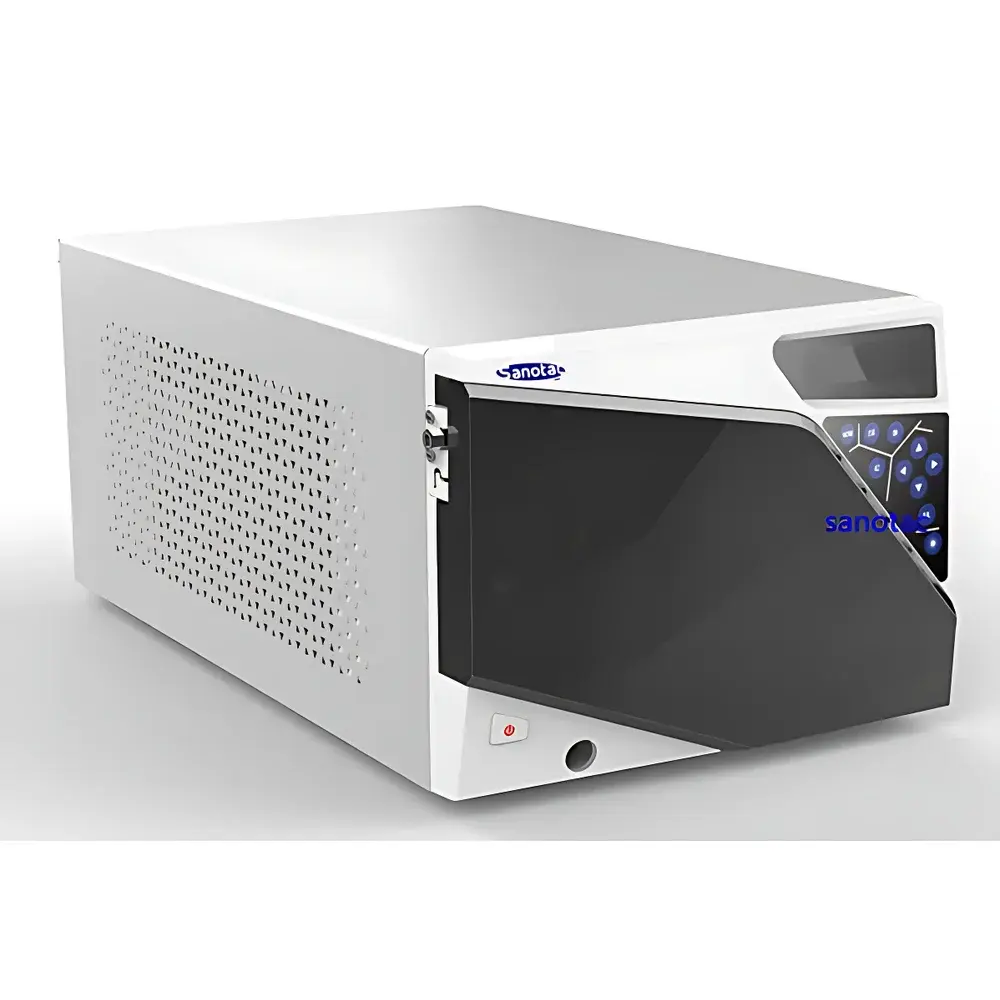
Sanotac ELSD6000 Evaporative Light Scattering Detector
| Brand | Sanotac |
|---|---|
| Origin | Shanghai, China |
| Manufacturer Type | Original Equipment Manufacturer (OEM) |
| Instrument Type | Evaporative Light Scattering Detector (ELSD) |
| Wavelength | 650 nm |
| Detection Mode | Low-Temperature Evaporation |
| Light Source | Semiconductor Laser Diode |
| Dimensions (W×H×D) | 26 × 19 × 46 cm |
| Weight | 10 kg |
| Power Supply | 85–264 VAC, 50 Hz |
| Baseline Noise | ≤ 0.03 mV |
| Baseline Drift | ≤ 0.3 mV / 30 min |
| Minimum Detectable Mass | < 1 ng |
| Quantitative Range | 0.1 µg – 30 µg |
| Precision (RSD) | ≤ 2% |
| Dynamic Range | 10⁴ (fixed gain) |
| Nebulizer Temp Range | RT–56 °C (1 °C increment) |
| Evaporator Temp Range | RT–130 °C (1 °C increment) |
| Temperature Accuracy | ±1 °C |
| Carrier Gas | Clean compressed air or nitrogen |
| Gas Pressure Range | 2–5 bar |
| Pressure Sensing Accuracy | 0.01 bar |
| Gas Flow Range | 1–4 L/min |
| Flow Control Accuracy | ≤1% or 0.02 L/min |
| Mobile Phase Flow Rate Compatibility | 0.01–3 mL/min |
| Analog Output | −1200 to +1200 mV |
| Gain Adjustment | 0.3–30 (continuous) |
| Data Acquisition Rate | 100 Hz (digital), 20 Hz (analog) |
| Communication Interfaces | RS-232, RS-485, USB, LAN (TCP/HTTP) |
| Software Integration | Sanotac-native chromatography software & Clarity® DLL-compatible platform (with Colibrick™ driver support) |
Overview
The Sanotac ELSD6000 is a high-performance evaporative light scattering detector engineered for universal, non-destructive mass-based detection in liquid chromatography systems. Unlike UV-Vis or fluorescence detectors, the ELSD6000 operates on the principle of nebulization, solvent evaporation, and light scattering—making it inherently insensitive to chromophore presence, molecular absorption characteristics, or optical activity. This enables reliable quantification of compounds lacking UV absorbance, including carbohydrates, lipids, surfactants, polymers, glycosides, and non-chromophoric pharmaceutical excipients. The detector employs a 650 nm semiconductor laser as its coherent light source, coupled with a high-sensitivity photomultiplier tube (PMT) for scattered light collection. Its low-temperature evaporation architecture minimizes thermal degradation of labile analytes while maintaining robust baseline stability—critical for gradient elution and long-duration method validation runs.
Key Features
- Compact footprint (26 × 19 × 46 cm) optimized for benchtop integration and stacked HPLC system configurations
- Low baseline noise (≤ 0.03 mV) and drift (≤ 0.3 mV / 30 min), ensuring high signal-to-noise ratio across extended acquisition periods
- Dual-zone precision temperature control: evaporator (RT–130 °C, ±1 °C accuracy) and nebulizer (RT–56 °C, ±1 °C accuracy), both adjustable in 1 °C increments
- Integrated carrier gas management with real-time pressure monitoring (0.01 bar resolution) and flow regulation (1–4 L/min, ≤1% accuracy)
- Automated 16-point self-diagnostic routine at startup and during idle cycles, covering gas integrity, heater status, laser output, and PMT response
- Programmable external event interface supporting TTL-triggered zeroing, laser shutdown, gas valve actuation, and heater disable
- Energy-efficient standby mode reducing power consumption without compromising thermal equilibrium recovery time
- Fast auxiliary cooling system enabling rapid temperature ramp-down between analytical sequences
Sample Compatibility & Compliance
The ELSD6000 is compatible with all common reversed-phase, normal-phase, and HILIC mobile phases—including aqueous buffers, acetonitrile, methanol, THF, chloroform, and ethyl acetate—provided the analyte volatility remains lower than that of the eluent. It complies with key regulatory expectations for analytical instrumentation used in GMP/GLP environments: full audit trail capability via Clarity® software (when configured with Colibrick™ driver), electronic signature support, and 21 CFR Part 11–compliant data handling when deployed with validated workflows. While not certified to ISO/IEC 17025 per se, its performance specifications align with ASTM D7217 (standard test method for ELSD calibration) and USP guidelines for alternative detection strategies in chromatographic assay validation.
Software & Data Management
The ELSD6000 supports dual software pathways: native Sanotac chromatography software for standalone operation and Clarity® DLL integration for seamless coupling with third-party HPLC platforms (e.g., Waters Empower, Agilent OpenLab, Thermo Chromeleon). All instrument parameters—including temperature setpoints, gas flow, gain, offset, and analog output scaling—are programmable and stored in up to 10 user-defined methods (25 parameters each). Real-time digital output at 100 Hz and analog output at 20 Hz allow synchronized data capture with high-speed acquisition systems. Communication protocols include RS-232, RS-485, USB virtual COM port, and Ethernet (TCP/HTTP), enabling remote monitoring and centralized fleet management in multi-instrument laboratories.
Applications
- Quantitative analysis of herbal extracts and TCM formulations where UV-inactive saponins, polysaccharides, and terpenoids dominate
- Characterization of lipid classes (triglycerides, phospholipids, fatty acids) in food and biofluid matrices
- Residual solvent and excipient profiling in generic drug product development
- SEC/GPC analysis of synthetic and natural polymers without chromophores
- Method transfer from UV to mass-independent detection for orthogonal verification in QC release testing
- Stability-indicating assays for photolabile or non-UV-absorbing degradation products
FAQ
What types of mobile phases are compatible with the ELSD6000?
The detector supports volatile organic solvents (e.g., acetonitrile, methanol, THF) and aqueous buffers containing ≤0.1% TFA or formic acid. Non-volatile salts (e.g., phosphate, sulfate) must be avoided to prevent nozzle clogging and detector contamination.
Can the ELSD6000 be used with UHPLC systems?
Yes—its 0.01–3 mL/min flow range and fast response time (100 Hz sampling) accommodate standard and micro-UHPLC configurations; however, backpressure management and post-column dilution may be required for sub-2-µm column applications.
Is the 650 nm laser Class 1 compliant?
Yes—the optical enclosure meets IEC 60825-1:2014 Class 1 safety requirements under normal operating conditions, with interlocked access to the detection chamber.
How does the ELSD6000 handle gradient elution?
Its low-temperature evaporation design and active baseline compensation algorithms minimize gradient-induced signal artifacts; baseline stabilization typically occurs within 2–3 column volumes after gradient initiation.
What maintenance intervals are recommended?
Nebulizer capillary cleaning every 200 injections; evaporator chamber purge weekly if using high-buffer-content mobile phases; annual PMT sensitivity calibration and laser power verification per ISO/IEC 17025-aligned SOPs.






