
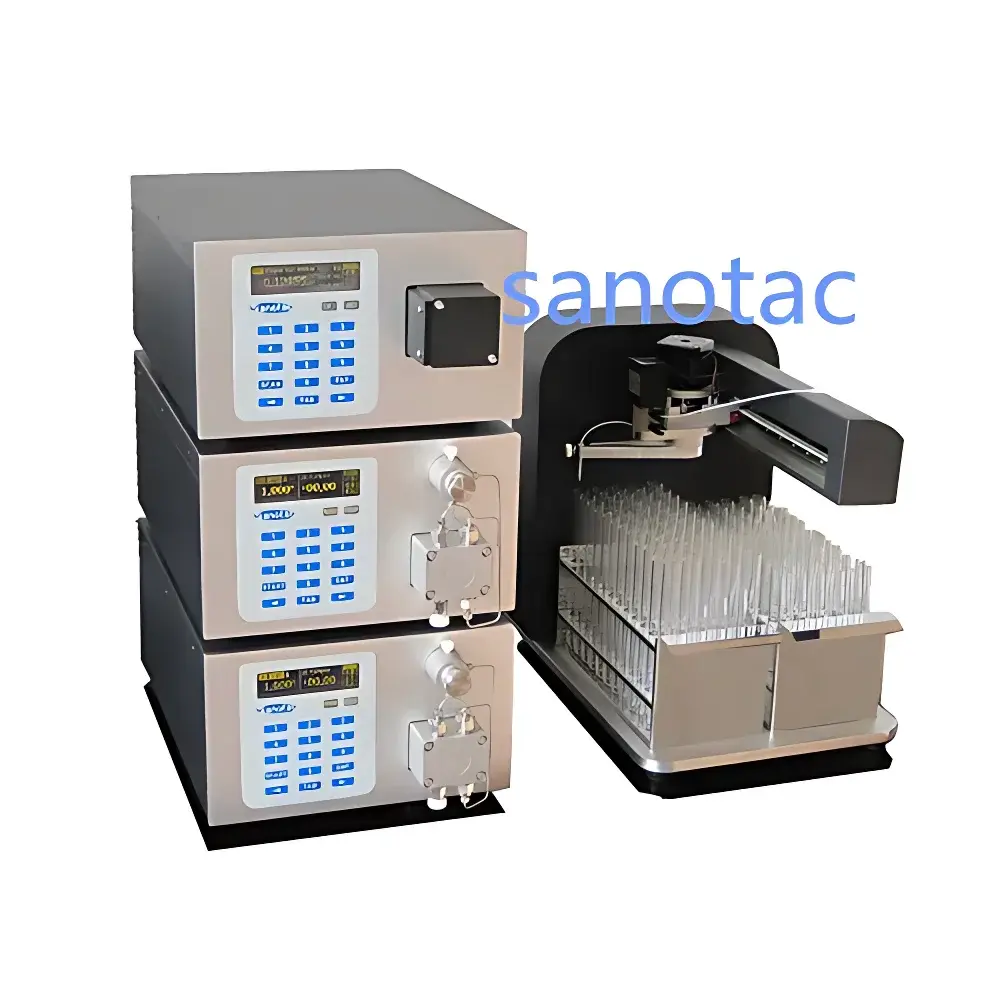
Sanotac Flash 100 Modular Medium-Pressure Preparative Liquid Chromatography System
| Brand | Sanotac |
|---|---|
| Origin | Shanghai, China |
| Manufacturer Type | OEM Manufacturer |
| Regional Classification | Domestic (China) |
| Model | Flash 100 |
| Price Range | USD $14,000–$28,000 (FOB Shanghai) |
| Application Level | Laboratory-Scale Purification |
| Instrument Type | Medium-Pressure Preparative HPLC System |
| Flow Rate Range | 0.01–100.00 mL/min |
| Flow Accuracy | ±1% |
| Flow Precision (RSD) | ≤0.5% |
| Maximum Pressure | 20 MPa |
| Wavelength Range | 190–800 nm |
| Wavelength Accuracy | ±1 nm |
| Wavelength Repeatability | 0.2 nm |
| Baseline Noise | ±0.75×10⁻⁵ AU (254 nm, TC = 1 s) |
| Data Acquisition Rate | 10 Hz |
| Gradient Capability | Up to 4-Solvent Linear/Step Gradients |
| Fraction Collection Modes | Time-, Peak-, Threshold-, and Slope-Triggered |
| Software Compliance | FDA 21 CFR Part 11 & CFDA GxP-Compliant Sanochrom™ Control Software |
Overview
The Sanotac Flash 100 is a modular, medium-pressure preparative liquid chromatography system engineered for high-reproducibility isolation and purification of natural products, synthetic intermediates, and pharmaceutical compounds at laboratory scale. Operating on the principle of gradient elution chromatography under controlled pressure (up to 20 MPa), it bridges the performance gap between low-pressure flash systems and analytical-scale HPLC—delivering robust separation resolution without requiring ultra-high-pressure infrastructure. Designed specifically for applications in phytochemistry, medicinal chemistry, and process development, the Flash 100 employs dual-piston parallel pump architecture with real-time chamber pressure feedback, enabling precise compensation for solvent compressibility and pulse dampening across its full flow range (0.01–100.00 mL/min). Its integrated UV-Vis detector supports simultaneous dual-wavelength monitoring (190–800 nm), while the intelligent lamp-switching mechanism (D₂ + W lamp) ensures optimal signal-to-noise ratio and extended operational uptime.
Key Features
- High-stability dual-piston reciprocating pump with PEEK or 316L stainless steel wetted path options, delivering flow precision ≤0.5% RSD and minimal pulsation (≤0.2 MPa pressure ripple).
- Advanced flow calibration via multi-point linearization curves across the entire dynamic range, ensuring certified accuracy of ±1% from 0.01 mL/min upward.
- UV-Vis detector with ±1 nm wavelength accuracy, 0.2 nm repeatability, and baseline noise as low as ±0.75×10⁻⁵ AU (254 nm, 1 s time constant), optimized for trace-level detection in complex botanical matrices.
- Intelligent fraction collector featuring hybrid linear-rotary motion mechanics, enabling sub-second positioning to any of 120 × 13–15 mm test tubes with zero cross-contamination risk.
- Modular design supports seamless integration with third-party columns—including Biotage®, ISCO®, GE Healthcare AKTA™, Buchi®, and Bio-Rad®—without adapter modifications.
- Floating plunger seal architecture extends pump head service life under sustained 20 MPa operation, reducing maintenance frequency and long-term cost of ownership.
Sample Compatibility & Compliance
The Flash 100 accommodates both solid-phase and liquid-phase sample loading via a standard 10 mL preparative injection valve. It is routinely deployed for the isolation of thermally labile and moderately polar compounds—including saponins, flavonoids, isoflavones, coumarins, chromones, alkaloids, phenolic acids, terpenoids, anthraquinones, and lignans—from crude plant extracts and reaction mixtures. Column compatibility spans standard silica-based, C18, amino, cyano, and diol media (ID 10–50 mm, length up to 500 mm). All hardware and firmware conform to ISO 9001 manufacturing standards. The Sanochrom™ control software implements full audit trail logging, electronic signatures, role-based access control, and data integrity safeguards aligned with FDA 21 CFR Part 11 and China’s CFDA GxP requirements—enabling use in GLP-compliant natural product characterization studies and early-stage API purification workflows.
Software & Data Management
Control and method development are executed through Sanochrom™—a Windows-native (Win 7/8/10/11) chromatography workstation supporting USB 2.0 and RS-232 connectivity. The interface provides real-time graphical monitoring of pressure, flow, UV absorbance (dual-channel), and fraction collection status. Users may define up to 10 stored methods with programmable gradient profiles (linear, step, or custom), variable flow ramping, and wavelength switching schedules. Fraction triggering logic includes time-based, peak-threshold, slope-detection, and combined conditional rules. All raw data files (.snc) are timestamped, digitally signed, and stored in a tamper-evident repository with immutable audit trails. Export options include CSV, PDF reports, and AIA-compliant .cdf format for LIMS integration.
Applications
The Flash 100 is validated for routine use in academic natural product labs, contract research organizations (CROs), and pharmaceutical R&D departments engaged in lead compound isolation, metabolite profiling, and impurity enrichment. Documented application areas include: purification of ginsenosides and astragalosides from *Panax* spp.; isolation of quercetin glycosides and epicatechin derivatives from *Camellia sinensis*; resolution of racemic synthetic intermediates using chiral stationary phases; desalting and buffer exchange of peptide fractions prior to MS analysis; and preparative-scale removal of residual catalysts from Pd-coupling reaction mixtures. Its ability to maintain consistent retention times and peak symmetry across repeated injections supports method transfer to analytical HPLC or LC-MS platforms.
FAQ
Is the Flash 100 compatible with non-Sanotac columns?
Yes—it accepts industry-standard 10–50 mm ID preparative columns from Biotage, ISCO, GE AKTA, Buchi, and Bio-Rad without adapters.
Does the system support method validation per ICH Q2(R2)?
While not an analytical instrument per se, its documented flow/pressure/wavelength performance, software audit trail, and calibration traceability support inclusion in Q2-aligned validation protocols for purification steps.
Can the UV detector perform spectral scanning during a run?
Yes—the detector supports stop-flow spectral acquisition (190–800 nm) and real-time dual-wavelength monitoring with user-defined wavelength programs.
What is the minimum dwell volume for gradient delay compensation?
System dwell volume is <250 µL (configurable in software); users may input column dead volume and tubing dimensions to optimize fraction trigger timing.
Is remote monitoring supported?
Local network monitoring is enabled via TCP/IP; secure remote access requires deployment behind institutional firewall with VPN authentication—no cloud hosting or external telemetry is implemented.





