
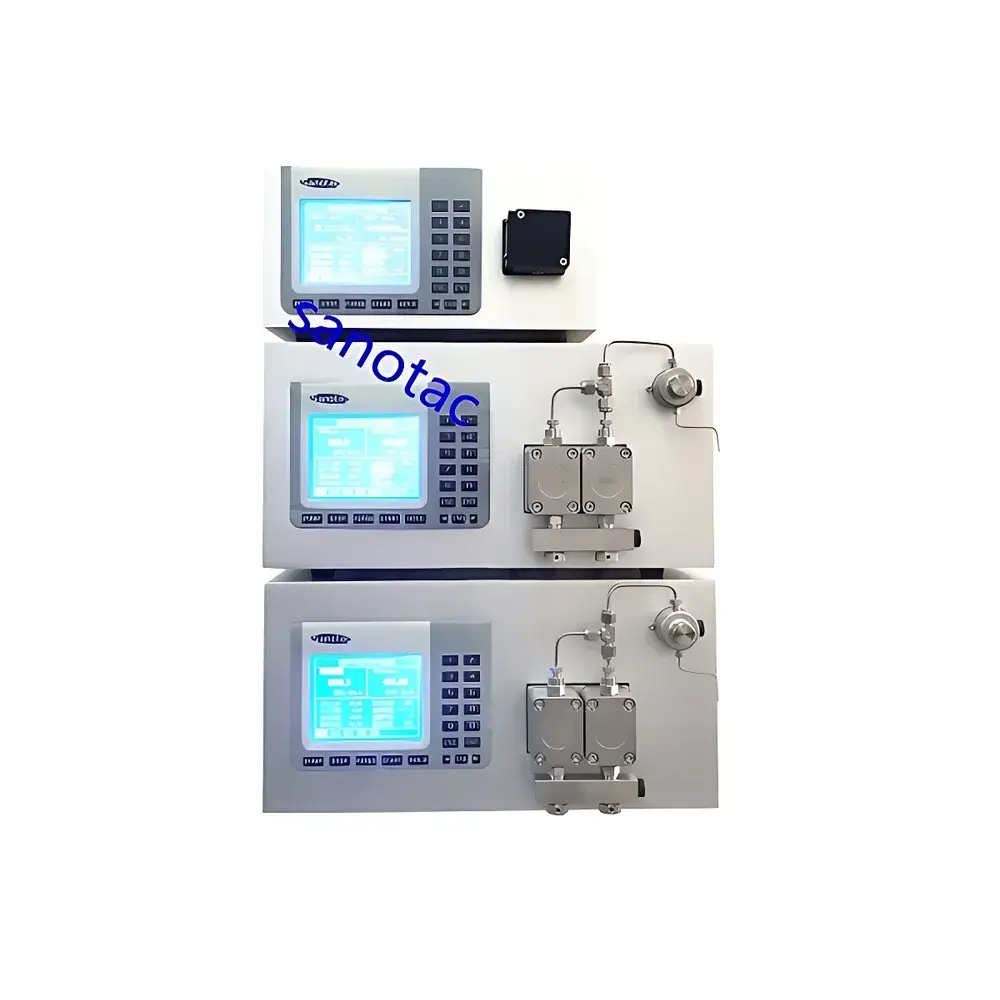
Sanotac Grad600 High-Pressure Gradient Preparative Liquid Chromatography System
| Origin | Shanghai, China |
|---|---|
| Manufacturer Type | Authorized Distributor |
| Regional Origin | Domestic (PRC) |
| Model | Grad600 |
| Price Range | USD 14,000 – 28,500 |
| Application Tier | Industrial-Scale Preparative |
| Instrument Class | Medium-to-Low Pressure Preparative LC System |
| Flow Rate Range | 0.01–600.00 mL/min |
| Flow Accuracy | ±1% |
| Flow Precision (RSD) | ≤0.5% |
| Maximum Operating Pressure | 10 MPa |
| Wavelength Range | 190–800 nm |
| Wavelength Accuracy | ±1 nm |
| Wavelength Repeatability | ±0.2 nm |
| Baseline Noise | ±0.75×10⁻⁵ AU @ 254 nm, TC = 1 s |
| Data Acquisition Rate | 10 Hz |
Overview
The Sanotac Grad600 High-Pressure Gradient Preparative Liquid Chromatography System is a modular, dual-pump preparative HPLC platform engineered for robust performance across laboratory-scale method development and pilot-to-industrial purification workflows. It operates on the principle of gradient elution chromatography—utilizing precisely controlled binary solvent mixing to modulate mobile phase strength over time—enabling high-resolution separation of complex mixtures including natural product extracts, synthetic organic intermediates, peptides, and moderately sized biomolecules. Designed for sustained operation under medium-pressure conditions (up to 10 MPa), the system integrates a high-fidelity flow delivery architecture with dual-wavelength UV-Vis detection and programmable gradient control, supporting scalable purification from milligram to multi-gram quantities per run.
Key Features
- Microprocessor-controlled dual-piston parallel pump system with real-time chamber pressure feedback, compensating for solvent compressibility and refill dynamics to ensure stable flow across the full range (0.01–600.00 mL/min).
- Cam-profile flow pulsation compensation technology minimizes mechanical oscillation, achieving baseline noise as low as ±0.75×10⁻⁵ AU at 254 nm (1 s time constant).
- Multi-point volumetric flow calibration across the entire operating range guarantees ±1% flow accuracy and ≤0.5% RSD repeatability.
- Floating plunger design extends high-pressure seal lifetime under continuous operation at up to 10 MPa.
- Binary gradient capability supports linear, step, or custom-programmed solvent profiles with up to 10 user-defined methods, each configurable for flow rate, gradient slope, hold time, and post-run wash sequences.
- Dual-wavelength UV-Vis detector with deuterium/tungsten lamp auto-switching, wavelength programming, stop-flow spectral scanning, and time-programmable wavelength switching—optimized for simultaneous monitoring of major analytes, by-products, and trace impurities.
- Modular hardware interface accommodates stainless steel and reinforced glass preparative columns (ID 10–30 mm), with semi-preparative flow cell pathlength adjustable from 1 to 5 mm.
Sample Compatibility & Compliance
The Grad600 is validated for use with non-aggressive organic solvents (e.g., acetonitrile, methanol, THF, ethyl acetate) and aqueous buffers within pH 2–8. Its fluidic path employs chemically resistant materials—including PEEK, sapphire, and 316L stainless steel—to maintain integrity during extended exposure to common chromatographic mobile phases. The system supports compliance with GLP and GMP-aligned workflows through audit-trail-capable software logging (method parameters, run timestamps, detector events, pressure/flow deviations). While not pre-certified for FDA 21 CFR Part 11, its software architecture permits integration with validated electronic lab notebook (ELN) and LIMS environments via standard CSV/ASCII export and timestamped raw data files.
Software & Data Management
The included chromatography workstation software provides intuitive method building, real-time chromatogram visualization, peak integration with customizable baselines and threshold logic, and batch report generation in PDF or Excel format. All acquisition parameters—including flow program, gradient table, wavelength schedule, and detector time constants—are stored with metadata (operator ID, instrument serial, date/time stamp). Raw data files are saved in vendor-neutral ASCII format, ensuring long-term readability and third-party processing compatibility (e.g., with OpenChrom or Chromeleon). Automatic zeroing, dynamic range scaling, and digital filtering options enhance signal fidelity without hardware modification.
Applications
- Purification of natural product isolates (alkaloids, flavonoids, terpenoids) from plant extracts using reversed-phase C18 or silica-based columns.
- Isolation of reaction intermediates and final products in multistep organic synthesis, especially where thermal lability precludes distillation or crystallization.
- Desalting and buffer exchange of synthetic peptides prior to lyophilization or biological assay.
- Removal of residual catalysts (e.g., Pd, Ru) and unreacted starting materials from cross-coupling reactions.
- Preparative chiral separations using immobilized polysaccharide-based columns (e.g., Chiralpak AD-H, AS-H) at sub-10 MPa backpressure.
- Process development support for downstream purification trains in early-stage biopharmaceutical manufacturing.
FAQ
What column formats are compatible with the Grad600?
Standard semi-preparative stainless steel columns (ID 10–30 mm) and high-pressure borosilicate glass columns with Swagelok-compatible end fittings are supported. Custom column oven integration is possible via external temperature controller I/O ports.
Does the system support automated fraction collection?
The Grad600 does not include an integrated fraction collector; however, it provides TTL-level trigger outputs synchronized to UV peak maxima or user-defined retention windows, enabling seamless interfacing with third-party timed or peak-triggered collectors.
Can the UV detector perform spectral scanning during a run?
Yes—the detector supports stop-flow spectral acquisition at user-specified retention times, delivering full 190–800 nm spectra for peak identity confirmation and purity assessment.
Is method transfer from analytical to preparative scale feasible?
Linear velocity and gradient time normalization tools are embedded in the software to facilitate scalable method translation, preserving selectivity while adjusting for column dimensions and flow rates.
What maintenance intervals are recommended for routine operation?
Pump seals should be inspected every 500 hours of operation; UV lamp replacement is advised every 1,000–1,500 hours based on intensity decay monitoring; flow cell cleaning with 10% nitric acid is recommended after every 200 injections of viscous or particulate-laden samples.




