
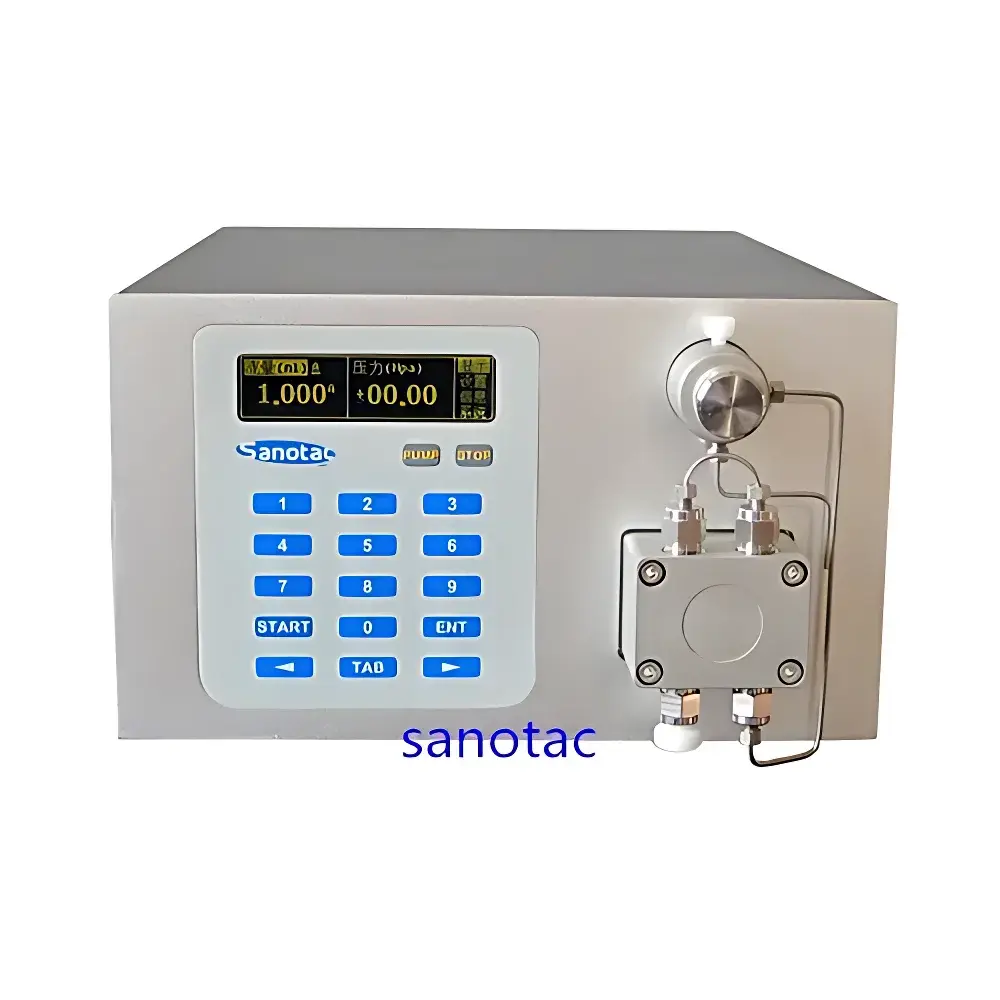
Sanotac GT1020 High-Pressure Constant Flow Pump for High-Throughput Reaction Systems
| Brand | Sanotac |
|---|---|
| Origin | Shanghai, China |
| Manufacturer Type | OEM/ODM Producer |
| Country of Origin | China |
| Model | GT1020 |
| Price Range | USD 1,400 – 2,800 |
| Flow Range | 0.01–100.00 mL/min |
| Increment | 0.01 mL/min |
| Flow Accuracy | ±0.5% |
| Flow Precision (RSD) | ≤0.1% |
| Max Pressure | 20 MPa |
| Pressure Pulsation | ≤0.2 MPa |
| Pump Head Volume | 100 mL |
| Pump Mechanism | Dual Parallel Plunger with Floating Plunger Design |
| Wetted Materials | 316L Stainless Steel, Sapphire, PTFE, Ceramic |
| Tubing Connection | 1/16″ Standard Fittings |
| Display | 256×64 Dot Matrix Backlit LCD |
| Control Interface | Front Panel Keypad + RS232/USB Computer Reverse Control (Open Protocol) |
| Power Supply | 85–264 VAC, 50 Hz |
| Dimensions (W×D×H) | 370×240×152 mm |
Overview
The Sanotac GT1020 is a high-precision, high-pressure constant flow pump engineered specifically for integration into high-throughput reaction systems, catalytic evaluation rigs, and continuous-flow chemistry platforms. It operates on a dual parallel plunger architecture with floating plunger mechanics—designed to minimize seal wear under sustained high-pressure conditions while maintaining exceptional volumetric accuracy across its full dynamic range (0.01–100.00 mL/min). The pump employs microprocessor-based flow control with solvent compressibility compensation and multi-point flow calibration curves, enabling stable delivery even with low-compressibility solvents (e.g., water, acetonitrile) or highly compressible media (e.g., CO₂-expanded liquids, supercritical fluids). Its maximum pressure rating of 20 MPa (2900 psi) supports demanding applications in hydrothermal synthesis, hydrogenation, oxidation, and supercritical fluid processing. Unlike conventional peristaltic or single-plunger pumps, the GT1020 delivers true constant-flow performance—not merely pressure-regulated output—making it suitable for stoichiometric reagent dosing, residence time-controlled reactions, and automated process analytical technology (PAT) workflows.
Key Features
- Dual parallel plunger design with floating plunger mechanism reduces mechanical stress on seals and extends service life under continuous 20 MPa operation.
- Low-pressure pulsation (<0.2 MPa) achieved via cam-profile optimization and real-time electronic pulse suppression—critical for sensitive inline sensors (e.g., UV-Vis, FTIR, Raman) and microreactor stability.
- Multi-segment gradient capability: combines isocratic, linear, and step gradients to generate custom elution profiles—enabling method development for complex reaction mixtures and kinetic profiling.
- Wetted path constructed from chemically inert, high-strength materials: 316L stainless steel body, sapphire check valves, ceramic plungers, and PTFE seals—compatible with aggressive solvents (HF,浓H₂SO₄, Cl₂-saturated media), oxidizers, and halogenated compounds.
- Open communication protocol (RS232/USB) allows seamless integration with third-party laboratory automation software (e.g., LabVIEW, MATLAB, Python-based control suites) and chromatography data systems (CDS) compliant with ASTM E1318 and ISO/IEC 17025 requirements.
- Front-panel interface with backlit 256×64 dot-matrix display supports up to 10 user-defined methods with programmable flow rates, gradient ramps, hold times, and start/stop triggers.
Sample Compatibility & Compliance
The GT1020 accommodates a broad spectrum of process fluids—from aqueous buffers and organic solvents to corrosive inorganic acids (e.g., HCl, HNO₃), halogenated reagents, and high-viscosity polymer solutions (up to 500 cP at 25°C). Its 316L/PTFE/sapphire fluidic path meets USP Class VI biocompatibility standards and resists pitting corrosion per ASTM A262 Practice E. For regulated environments, the pump supports audit-trail-enabled operation when paired with validated CDS software adhering to FDA 21 CFR Part 11 requirements—including electronic signatures, change history logging, and role-based access control. It is routinely deployed in GLP-compliant catalyst screening labs and GMP-aligned process development units serving pharmaceutical, fine chemical, and energy storage material synthesis.
Software & Data Management
The GT1020 features an open reverse-control protocol documented in IEEE 11073-10201 format, enabling bidirectional command exchange and real-time status reporting (flow rate, pressure, error codes, temperature). Data logs are timestamped and exportable in CSV/JSON formats for traceability. When integrated into larger automation frameworks (e.g., ChemSpeed, Unchained Labs, or custom PLC-driven systems), the pump supports synchronized triggering with reactor temperature ramps, sampling valves, and inline spectrometers—facilitating closed-loop feedback control based on real-time reaction progress monitoring. Firmware updates are delivered via USB stick with cryptographic signature verification to ensure integrity and compliance with IEC 62443-3-3 security guidelines.
Applications
- Catalytic testing: Precise co-feeding of gaseous (H₂, CO, O₂) and liquid reagents into fixed-bed or slurry-phase reactors for turnover frequency (TOF) quantification.
- Continuous-flow photochemistry and electrochemistry: Stable reagent delivery under irradiation or electrode potential control without flow-induced artifacts.
- High-throughput reaction screening: Automated parallel synthesis across 48–96 microreactor channels using synchronized multi-pump manifolds.
- Supercritical fluid processing: Delivery of CO₂-modified solvents at subcritical and supercritical states (T > 31.1°C, P > 7.38 MPa) with minimal thermal drift.
- Material synthesis: Controlled addition of precursors in sol-gel, MOF, and perovskite nanocrystal formation protocols where nucleation kinetics depend critically on reagent concentration gradients.
FAQ
Is the GT1020 compatible with aggressive halogenated solvents such as sulfuryl chloride or phosphorus oxychloride?
Yes—the wetted path uses sapphire check valves and PTFE/316L construction, rated for continuous exposure to Class 3A halogenated media per NACE MR0175/ISO 15156 standards.
Can the pump be operated in pressure-control mode, or is it strictly flow-controlled?
The GT1020 is fundamentally a constant-flow device; however, optional external pressure transducers (e.g., Keller PA-23Y) can be interfaced via analog input to implement hybrid flow/pressure cascade control loops.
Does the pump support remote firmware updates and diagnostic self-tests?
Yes—firmware updates are performed via USB with SHA-256 signature validation; built-in diagnostics include plunger position verification, valve timing calibration, and seal integrity assessment.
What is the mean time between failures (MTBF) under continuous 20 MPa operation?
Based on accelerated life testing per ISO 13849-1, MTBF exceeds 12,000 hours at 15 MPa and 25°C ambient, with seal replacement recommended every 6,000 hours at full 20 MPa load.
Is the communication protocol truly open, and are driver libraries available for Python or LabVIEW?
Yes—Sanotac provides documented ASCII command sets, Python SDK (PyGT1020), and LabVIEW VIs under MIT License; no proprietary middleware or dongles required.
Related Products



