
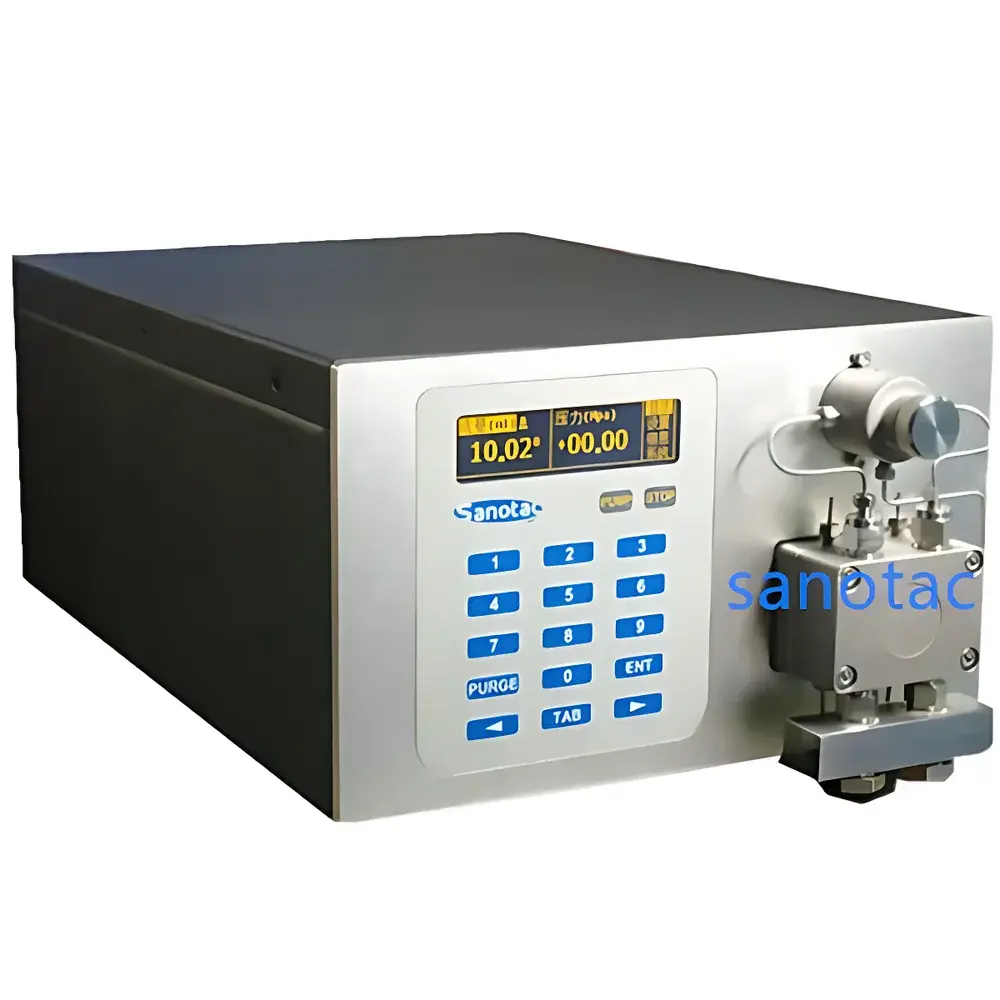
Sanotac J1040 High-Pressure Metering Pump for Reactor Integration
| Brand | Sanotac |
|---|---|
| Model | J1040 |
| Drive Type | Electric |
| Flow Range | 0–100 mL/min |
| Max Pressure | 40 MPa (6000 psi) |
| Flow Accuracy | ±0.5% |
| Flow Repeatability | ≤0.1% |
| Pressure Pulsation | ≤0.1 MPa |
| Wetted Materials | 316L Stainless Steel, Sapphire, PTFE, Ceramic |
| Communication Interfaces | USB, RS232, RS485/422 (optional), Modbus RTU/ASCII |
| Power Supply | 85–264 VAC, 50 Hz |
| Power Consumption | 75 W |
| Dimensions | 370 × 240 × 152 mm |
| Weight | 8 kg |
Overview
The Sanotac J1040 High-Pressure Metering Pump is an engineered solution designed specifically for precise fluid delivery in demanding reactor-based laboratory and pilot-scale applications. Operating on positive displacement principle with a dual-cam-driven reciprocating plunger mechanism, the J1040 delivers stable, pulse-minimized flow across its full 0–100 mL/min range while maintaining rated pressure up to 40 MPa (6000 psi). Its architecture integrates mechanical pulse suppression—via optimized cam profile—and active electronic flow compensation to ensure minimal pressure deviation (<0.1 MPa) under dynamic load conditions. This makes it suitable for continuous operation in high-integrity chemical synthesis loops, catalytic evaluation systems, supercritical fluid processing, and microreactor feed control where flow stability, long-term repeatability, and material compatibility are critical.
Key Features
- Multi-point flow calibration across the entire operating range ensures traceable accuracy of ±0.5% and repeatability ≤0.1%, validated per ISO 5725-2 guidelines for precision measurement.
- Integrated plunger rear-wash function reduces seal wear by flushing residual particulates or precipitates from the packing interface—extending maintenance intervals and supporting extended unattended operation.
- Compressive compensation algorithm dynamically adjusts stroke volume in response to fluid compressibility at elevated pressures, enabling accurate volumetric delivery even with low-compressibility solvents (e.g., water, glycerol) or near-critical CO₂.
- Dual-stage pressure protection includes programmable upper-limit cutoff and zero-offset correction to mitigate thermal drift and ambient pressure fluctuations.
- Modular communication architecture supports native RS232/USB for local configuration and optional RS485/422 for industrial fieldbus integration; protocol stack includes Modbus RTU/ASCII as standard, with Modbus TCP, Profibus DP, and PROFINET available via firmware upgrade.
- Front-panel HMI and remote software enable real-time monitoring of flow rate vs. pressure curves, program execution progress, and event-triggered data logging with timestamped CSV export.
Sample Compatibility & Compliance
The J1040 accommodates a broad spectrum of process fluids—including corrosive reagents (e.g., HCl, HF solutions), high-viscosity polymer melts (up to 50,000 cP), supercritical CO₂, and abrasive catalyst slurries—through selectable wetted-path configurations: standard 316L stainless steel, Hastelloy C-276 (upon request), PTFE-lined heads, and PEEK-composite variants. All fluidic components comply with ASTM F2136 for elastomer compatibility and ISO 8536-4 for pharmaceutical-grade tubing interfaces. The pump meets CE marking requirements (2014/30/EU EMC Directive, 2014/35/EU LVD), and its control firmware supports audit-trail-enabled operation aligned with FDA 21 CFR Part 11 when deployed with validated SCADA or DCS integration.
Software & Data Management
The optional Sanotac FlowControl Suite provides method-based workflow management: users define multi-segment programs (constant, linear ramp, gradient profiles) with independent pressure/flow setpoints per segment. Real-time plotting displays synchronized flow rate and system backpressure traces with adjustable sampling intervals (100 ms–5 s). All operational parameters—including motor current, temperature diagnostics, and error codes—are logged with millisecond timestamps and exportable in ISO-standard CSV or MATLAB-compatible MAT formats. Calibration records, user access logs, and parameter change histories are stored locally with SHA-256 hashing for integrity verification. Remote operation is supported via Ethernet (wired or Wi-Fi bridge) with TLS 1.2 encryption and role-based authentication.
Applications
- Catalytic reaction evaluation: Precise co-feeding of liquid reactants and gaseous precursors into fixed-bed or slurry-phase reactors under controlled residence time.
- Supercritical fluid chromatography (SFC) and extraction: Stable delivery of CO₂-modifier mixtures at pressures >30 MPa without cavitation or phase separation.
- Microfluidic synthesis platforms: Synchronized multi-pump feeding for multi-step continuous-flow chemistry with sub-milliliter residence volumes.
- Electrochemical energy research: Controlled electrolyte injection into high-pressure fuel cell test stations or battery cycling rigs.
- Pharmaceutical process development: GMP-aligned dosing of API solutions into crystallization vessels with documented flow traceability.
- Polymer processing R&D: Metered introduction of initiators or chain-transfer agents into extrusion or foaming lines at elevated melt pressures.
FAQ
What is the maximum allowable viscosity for continuous operation at 40 MPa?
The J1040 maintains rated performance up to 50,000 cP at 25°C and 40 MPa when equipped with the high-torque motor option and ceramic-plunger configuration.
Does the pump support automatic density compensation for mass-based dosing?
Yes—when paired with an external density sensor (e.g., Coriolis or vibrating-tube type), the FlowControl Suite accepts real-time density input to convert volumetric flow commands into mass flow equivalents.
Can the J1040 be integrated into a Siemens S7-1500 PLC environment?
Fully supported via PROFINET interface module (order code: J1040-PN-01) with preconfigured GSDML files and cyclic I/O mapping for pressure, flow, status, and fault bits.
Is column cleaning functionality available for HPLC-grade applications?
While not a dedicated HPLC pump, the rear-plunger wash feature and PTFE/PEEK fluid path options meet USP requirements for low-metal leaching and are routinely deployed in preparative SFC and reaction-monitoring LC systems.
How often is recalibration required under GLP conditions?
Annual calibration is recommended; however, built-in self-diagnostic routines and user-executable two-point flow verification (using certified volumetric flasks) allow in-house verification between formal calibrations per ISO/IEC 17025 Clause 7.7.



