
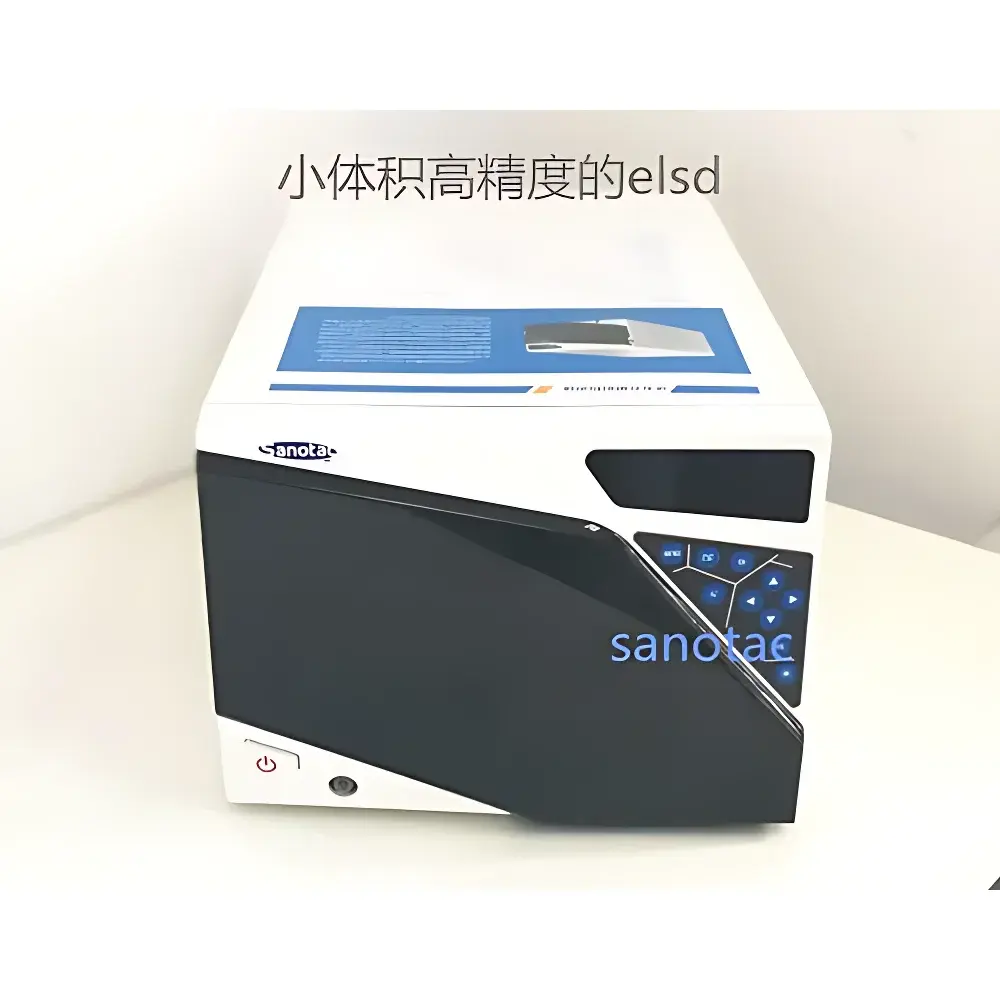
Sanotac K6000 Evaporative Light Scattering Detector (ELSD) for Pharmacopeial Antibiotic Quality Control
| Brand | Sanotac |
|---|---|
| Origin | Shanghai, China |
| Manufacturer Type | OEM Manufacturer |
| Product Category | Domestic |
| Model | K6000 |
| Instrument Type | Evaporative Light Scattering Detector (ELSD) |
| Wavelength | 650 nm |
| Detection Mode | Low-Temperature Evaporation |
| Light Source | Semiconductor Laser |
Overview
The Sanotac K6000 Evaporative Light Scattering Detector (ELSD) is a compact, high-reliability detection system engineered for quantitative analysis of non-chromophoric compounds in pharmaceutical quality control workflows—particularly for pharmacopeial-compliant testing of aminoglycoside antibiotics and other low-UV-absorbing analytes. Unlike UV-Vis detectors, which rely on electronic transitions and are insensitive to compounds lacking conjugated systems or chromophores, the K6000 operates on the principle of nebulization, solvent evaporation, and light scattering from dried analyte particles. This universal detection mechanism enables consistent response across structurally diverse molecules—including kanamycin, gentamicin C1a, tobramycin, amikacin, netilmicin, etimicin, ribostamycin, streptomycin, neomycin, paromomycin, sisomicin, and cholesterol—regardless of optical absorbance properties. Designed for integration with HPLC, preparative LC, and medium-pressure chromatography systems, the K6000 delivers trace-level sensitivity and robust baseline stability under regulated laboratory conditions.
Key Features
- Compact horizontal architecture with optimized thermal field design—minimizes footprint (260 × 190 × 460 mm) while ensuring mechanical stability and operator safety
- Dual-stage temperature control: drift tube (up to 130 °C, ±1 °C accuracy) and nebulizer (up to 56 °C), both adjustable in 1 °C increments for method reproducibility
- Low-noise photomultiplier tube (PMT) detector paired with a 30 mW, 650 nm semiconductor laser source—optimized for high signal-to-noise ratio (baseline noise ≤ 0.03 mV)
- Integrated mass flow controller for carrier gas (N₂ or clean air): 1–4 L/min range, accuracy ≤ ±1% or ±0.02 L/min; pressure monitoring resolution 0.01 bar
- Automated self-diagnostic suite (16 internal checks) including gas valve integrity, heater status, laser activation, and flow path blockage detection
- Intelligent standby mode reduces nitrogen consumption by >50% and lowers power draw during idle periods—activatable via front-panel timer, remote command, or software trigger
- Front-accessible nebulizer capillary simplifies routine maintenance and visual inspection—critical for GMP-aligned operation
Sample Compatibility & Compliance
The K6000 is validated for detection of volatile-below-mobile-phase analytes across USP , EP 2.2.46, and ChP IV general chapters governing ELSD use in antibiotic assay and impurity profiling. It supports gradient and isocratic elution methods with mobile phase flow rates from 0.01 to 3 mL/min—compatible with reversed-phase, HILIC, and normal-phase separations. Its universal response eliminates compound-specific calibration bias inherent in UV detection, making it suitable for relative quantitation of multi-component antibiotic mixtures (e.g., gentamicin complex profiling) where reference standards for all components are unavailable. The instrument meets GLP/GMP environmental requirements per ISO/IEC 17025:2017 Annex A and supports audit-ready documentation through built-in event logging.
Software & Data Management
The Sanotac Chromatography Data System (CDS) provides full FDA 21 CFR Part 11 compliance, including electronic signatures, role-based access control, immutable audit trails, and automatic session logging. Method parameters—including temperature setpoints, gas flow, gain, offset, and auto-zero timing—are stored in 10 user-configurable method templates (25 parameters each). Digital output at 20 Hz and analog output (–1000 to +1000 mV) support synchronization with third-party acquisition platforms. Communication interfaces include RS-232, USB 2.0, and Ethernet (TCP/HTTP), enabling centralized instrument monitoring in networked QC laboratories. External event programming allows hardware-triggered actions such as laser shutdown, gas valve closure, or baseline reset.
Applications
- Quantitative determination of aminoglycosides per USP monographs (e.g., Gentamicin Sulfate, Tobramycin, Amikacin)
- Stability-indicating assays for degradation product profiling without UV chromophores
- Excipient quantification in lyophilized formulations (e.g., trehalose, mannitol)
- Analysis of lipids, carbohydrates, surfactants, and polymers in pharmaceutical excipients
- Method transfer between analytical and preparative LC systems using identical detection principles
- Supporting ICH Q5C and Q5D guidelines for characterization of biotechnological products with non-UV-active moieties
FAQ
Does the K6000 require UV-absorbing derivatization for antibiotic analysis?
No. ELSD detection is independent of molecular absorbance—derivatization is unnecessary for aminoglycosides, glycopeptides, or other non-chromophoric antibiotics.
Can the K6000 be used with gradient elution methods?
Yes. Its low thermal inertia and rapid drift-tube cooling enable stable baseline performance across solvent composition changes typical in RP-HPLC gradients.
What carrier gas specifications are recommended for optimal sensitivity?
High-purity nitrogen (≥99.999%) at 3.0–3.5 bar inlet pressure and 2.5 L/min flow rate is recommended to minimize background scatter and maximize signal reproducibility.
How does the K6000 ensure data integrity in regulated environments?
Through embedded 21 CFR Part 11-compliant CDS with time-stamped audit trails, electronic signature enforcement, and tamper-evident method storage—all validated per GAMP 5 guidance.
Is the K6000 compatible with third-party HPLC systems?
Yes. Analog and digital outputs, along with standard RS-232/USB/Ethernet protocols, enable seamless integration with Agilent, Waters, Shimadzu, and Thermo Fisher chromatography platforms.
Related Products






