
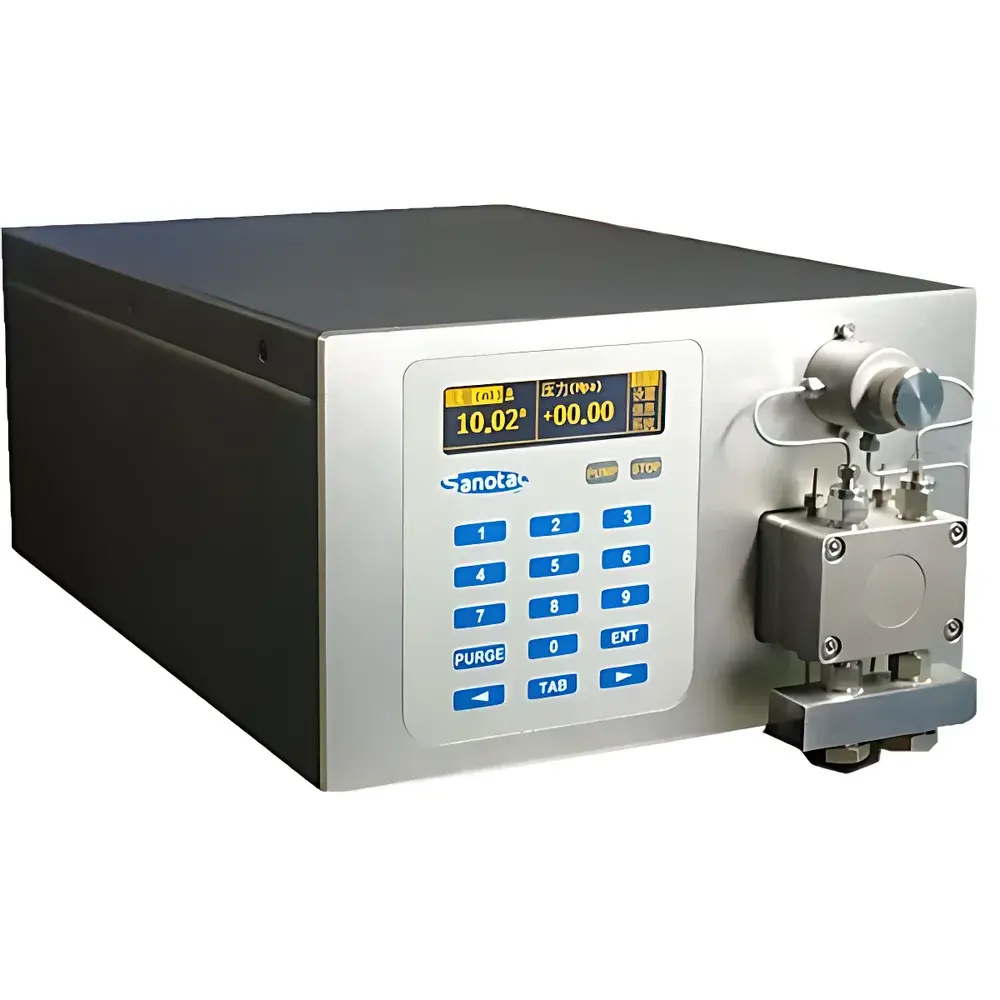
Sanotac KAP0010 High-Pressure Binary HPLC Pump
| Brand | Sanotac |
|---|---|
| Origin | Shanghai, China |
| Manufacturer Type | Original Equipment Manufacturer (OEM) |
| Product Category | Domestic |
| Model | KAP0010 |
| Instrument Type | Binary High-Pressure Solvent Delivery Pump |
| Maximum Pressure | 42 MPa |
| Flow Rate Range | 0.001–10 mL/min (standard configuration with 10 mL pump head) |
| Pump Head Material Options | Stainless Steel, Titanium, PTFE, PCTFE, Hastelloy C-276, PEEK |
| Control Interface | RS-232/RS-485, Open Protocol for External Workstation Integration |
| Gradient Capability | Isocratic, Linear, Step, and Custom Composite Gradients |
| Flow Accuracy | ≤ ±0.1% RSD at ≥1 mL/min |
| Pressure Ripple | < 0.1% (measured at 1 mL/min, 10 MPa, methanol/water 80:20) |
| Seal Life | Enhanced via Floating Plunger Design & Precision Cam Drive |
| Compliance | Designed to support GLP/GMP workflows |
Overview
The Sanotac KAP0010 is a high-precision binary high-pressure liquid chromatography (HPLC) pump engineered for analytical and preparative-scale chromatographic applications requiring stable, reproducible solvent delivery under elevated backpressure. Operating on the principle of dual-syringe or dual-plunger positive displacement, the KAP0010 employs a parallel dual-pump-head architecture driven by synchronized microprocessor-controlled stepper motors. This design enables real-time solvent composition blending upstream of the mixing chamber—eliminating post-mixing dwell volume effects common in low-pressure gradient systems. With a maximum operating pressure of 42 MPa (6090 psi) and a standard 10 mL stainless steel pump head, the system delivers flow rates from 0.001 to 10 mL/min with ≤ ±0.1% relative standard deviation (RSD) across its dynamic range. Its mechanical architecture integrates cam-profile compensation and electronic flow pulsation suppression to maintain pressure ripple below 0.1%—a critical specification for baseline stability in UV, fluorescence, and mass spectrometric detection.
Key Features
- Dual independent pump heads with synchronized microstepping control for true high-pressure gradient formation
- Floating plunger mechanism reducing radial load on high-pressure seals, extending seal service life by up to 3× versus fixed-plunger designs
- Multi-point flow calibration algorithm compensating for solvent compressibility across viscosity and temperature gradients
- Open communication protocol (RS-232/RS-485) supporting bidirectional remote control and parameter logging from third-party chromatography data systems (CDS)
- Onboard programmable method storage: 10 user-defined methods with editable flow profiles, gradient tables, and pressure limits
- Modular wetted-path construction: interchangeable pump heads and check valves available in stainless steel, titanium, PTFE, PCTFE, Hastelloy C-276, and PEEK to accommodate aggressive solvents (e.g., HF,浓H₂SO₄, anhydrous amines) and supercritical CO₂
Sample Compatibility & Compliance
The KAP0010 supports a broad spectrum of mobile phase chemistries—from aqueous buffers and acetonitrile/water mixtures to halogenated solvents, ionic liquids, and supercritical fluids—without degradation of flow integrity. Its material options meet ASTM F2136 (for PTFE components), ISO 15195 (for reference material traceability in calibration), and USP requirements for HPLC system suitability testing. When integrated into a full chromatography platform compliant with 21 CFR Part 11, the pump’s audit-trail-capable firmware (via external CDS) supports electronic signatures, user access controls, and immutable method parameter logs—fulfilling core GLP and GMP documentation mandates for pharmaceutical QC, contract research organizations (CROs), and regulatory submissions.
Software & Data Management
The KAP0010 does not include proprietary acquisition software but provides deterministic ASCII-based command-response protocol documentation (freely available upon request). It interoperates natively with industry-standard platforms including Chromeleon (Thermo Fisher), Empower (Waters), and OpenLab CDS (Agilent) via serial or USB-to-serial adapters. All gradient programs, flow setpoints, and pressure thresholds are timestamped and logged during operation—enabling retrospective analysis of system performance drift. Firmware updates preserve backward compatibility and include enhanced error diagnostics (e.g., cavitation detection, check valve stall identification) accessible through diagnostic mode.
Applications
- Analytical reversed-phase and hydrophilic interaction liquid chromatography (HILIC) method development
- Preparative purification of peptides, oligonucleotides, and small-molecule APIs under cGMP conditions
- Catalytic reaction monitoring in continuous-flow reactors with inline UV/Vis detection
- Supercritical fluid chromatography (SFC) using CO₂/methanol gradients at pressures up to 42 MPa
- High-temperature HPLC for polymer characterization and thermal stability assessment
- Electrochemical LC-MS coupling where ultra-low pulsation minimizes ion suppression artifacts
FAQ
What gradient accuracy can be achieved with the KAP0010’s composite gradient capability?
Gradient composition accuracy is ±0.2% absolute for binary mixing, verified per ISO 11607-2 Annex D protocols using conductivity-based solvent ratio validation.
Is the KAP0010 suitable for use with corrosive mobile phases such as hydrofluoric acid?
Yes—when configured with Hastelloy C-276 pump heads and PCTFE check valves, the system maintains structural integrity and flow linearity in 0.5% HF/water solutions at 25°C and 20 MPa.
Does the pump support automatic leak detection and shutdown?
It includes pressure-rise rate monitoring and sustained overpressure cutoff (configurable threshold: 35–42 MPa), but does not feature optical or acoustic leak sensing—external pressure transducers are recommended for closed-loop safety interlocks.
Can I integrate the KAP0010 into a multi-pump SFC system with backpressure regulation?
Yes—the open protocol allows synchronization with ABPR (active backpressure regulator) controllers via TTL triggers or analog voltage inputs, enabling dynamic backpressure modulation during gradient elution.
What is the typical maintenance interval for the floating plunger assembly?
Under continuous operation at 30 MPa and 2 mL/min with methanol/water (70:30), scheduled inspection is recommended every 1,500 operational hours; seal replacement intervals exceed 3,000 hours in non-aggressive solvent environments.




