
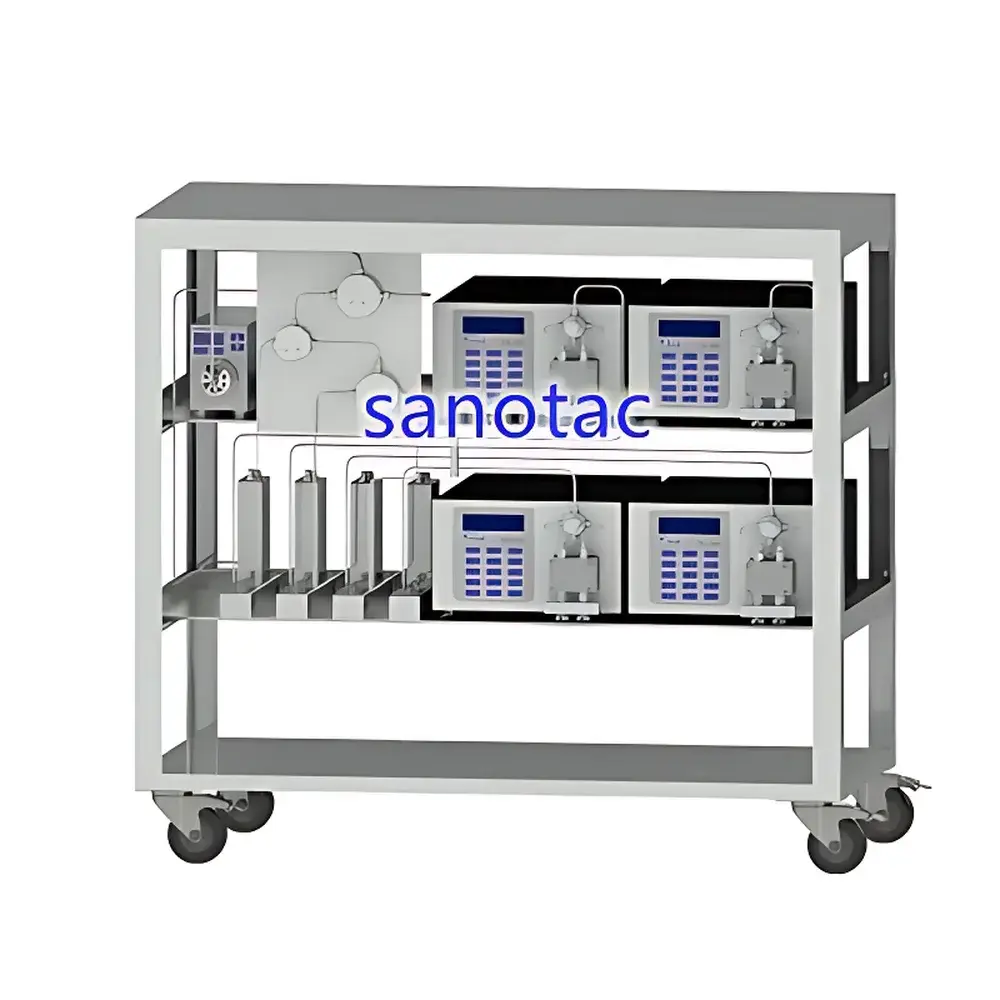
Sanotac NX-600 Microfluidic Lipid Nanoparticle (LNP) Production System for mRNA and DNA Therapeutics
| Key | Brand: Sanotac |
|---|---|
| Origin | Shanghai, China |
| Manufacturer Type | Manufacturer |
| Product Category | Domestic |
| Model | NX-600 |
| Carrier Type | Lipid Nanoparticle (LNP) |
| Flow Rate Range | 200 mL/min and 1000 mL/min |
| Flow Rate Reproducibility Error | ±0.5% |
| Maximum Operating Pressure | 20 MPa |
Overview
The Sanotac NX-600 Microfluidic Lipid Nanoparticle (LNP) Production System is an engineered platform for the scalable, reproducible synthesis of lipid-based nanocarriers used in nucleic acid therapeutics. It operates on the principle of hydrodynamic focusing via impinging jet mixing—where precisely controlled streams of lipid solution and aqueous nucleic acid (e.g., mRNA, siRNA, circRNA, ASO, or DNA) converge at high velocity within a geometrically optimized mixing chamber. This rapid, turbulent mixing induces spontaneous self-assembly of lipids around the nucleic acid payload, forming monodisperse, encapsulated LNP structures with controlled size (typically 50–120 nm), polydispersity index (PDI 90%). The system is designed for process development, clinical-grade batch production, and seamless scale-up—supporting both preclinical formulation screening and GMP-aligned manufacturing workflows.
Key Features
- Modular dual-pump architecture: Two high-precision 316L stainless steel high-pressure syringe pumps deliver lipid and nucleic acid solutions independently, enabling precise stoichiometric control over LNP composition.
- Dual-stage mixing configuration: Includes one primary impinging jet mixer (rated for up to 20 MPa) plus two auxiliary mixers for inline pre-dilution and post-mixing quenching—ensuring thermal and pH stability during nanoparticle formation.
- Real-time flow monitoring: Four integrated mass flow meters provide closed-loop feedback for flow rate verification, drift compensation, and fault detection across all fluid paths.
- Scalable design: Supports parallel unit operation (multi-NX-600 clustering) or single-unit throughput expansion via pump/mixer reconfiguration—validated from lab-scale (1 mL/min) to clinical manufacturing (1000 mL/min).
- Industrial-grade connectivity: Equipped with RS232/485, USB, and Ethernet ports; supports Modbus RTU, Profibus DP, and Profinet protocols for integration into SCADA, DCS, and PLC environments.
- Material compatibility: Fluidic pathways constructed from 316L stainless steel, PEEK, ruby, and chemically resistant fluoropolymers—suitable for organic solvents (e.g., ethanol, isopropanol), acidic buffers, and biologically active payloads.
Sample Compatibility & Compliance
The NX-600 accommodates a broad spectrum of nucleic acid modalities, including but not limited to: messenger RNA (mRNA), small interfering RNA (siRNA), antisense oligonucleotides (ASOs), circular RNA (circRNA), self-amplifying RNA (saRNA), and plasmid DNA (pDNA). It supports common LNP formulations using ionizable lipids (e.g., DLin-MC3-DMA, ALC-0315), phospholipids (DSPC), cholesterol, and PEGylated lipids. All wetted components comply with USP Class VI and ISO 10993-5 biocompatibility standards. The system’s mechanical design adheres to ISO 13485:2016 principles for medical device manufacturing infrastructure. Software functionality conforms to FDA 21 CFR Part 11 requirements—including role-based access control, electronic signatures, audit trails, and immutable data logging—enabling use in GLP and GMP-regulated environments.
Software & Data Management
The NanoFlu Nanoparticle Fluidics Workstation serves as the central control interface for the NX-600. It provides programmable fluid delivery profiles—including constant, linear ramp, gradient, and user-defined mathematical functions—with resolution down to 0.01 mL/min. Real-time pressure and flow telemetry are visualized as synchronized time-series plots, with automatic event tagging for critical transitions (e.g., start-of-mixing, quench initiation). All operational parameters and sensor outputs are timestamped, encrypted, and stored in compliant .csv and .xlsx formats. Calibration routines support multi-point volumetric correction under application-specific conditions. External instrumentation—including dynamic light scattering (DLS) analyzers, UV-Vis spectrophotometers, and microfluidic particle counters—can be synchronized via TTL triggers or TCP/IP APIs. Audit logs record every operator action, parameter change, and system alarm with hash-verified integrity.
Applications
- Preclinical formulation development: Rapid screening of lipid ratios, N:P ratios, buffer compositions, and mixing kinetics to optimize encapsulation efficiency and colloidal stability.
- Clinical batch production: Consistent generation of LNP batches meeting ICH Q5A and Q5B quality attributes for Phase I–III trials.
- Process characterization studies: DOE-driven evaluation of critical process parameters (CPPs) including flow rate ratio, total flow rate, temperature, and mixing chamber geometry.
- Technology transfer: Reproducible replication of lab-scale processes in pilot or commercial facilities via standardized method templates and validated communication protocols.
- Platform extension: Integration with downstream purification (TFF, SEC), analytics (cryo-TEM, HPLC-SEC), and fill-finish modules for end-to-end mRNA-LNP manufacturing lines.
FAQ
What nucleic acid types are compatible with the NX-600 system?
mRNA, siRNA, ASO, circRNA, saRNA, and plasmid DNA—provided they are formulated in aqueous buffers compatible with the system’s solvent tolerance profile.
Can the NX-600 be integrated into an existing automated manufacturing line?
Yes. Its native support for Modbus RTU, Profibus DP, and Profinet—alongside configurable digital I/O and analog signal interfaces—enables direct integration with PLCs, MES, and supervisory control systems.
Is the NanoFlu software qualified for regulated environments?
Yes. NanoFlu Standard and Multi-Station editions include full 21 CFR Part 11 compliance features: electronic signatures, audit trail export, user permission tiers, and data immutability safeguards.
How does the system ensure batch-to-batch reproducibility?
Through real-time flow meter feedback, pressure-compensated pump control, geometrically invariant mixer design, and automated calibration traceability—all documented in IQ/OQ protocols available upon request.
What validation documentation is provided with the NX-600?
Factory acceptance testing (FAT) reports, installation qualification (IQ), operational qualification (OQ), and risk assessments per ISO 14971 are included. Custom PQ support and URS alignment services are available under contract.



