
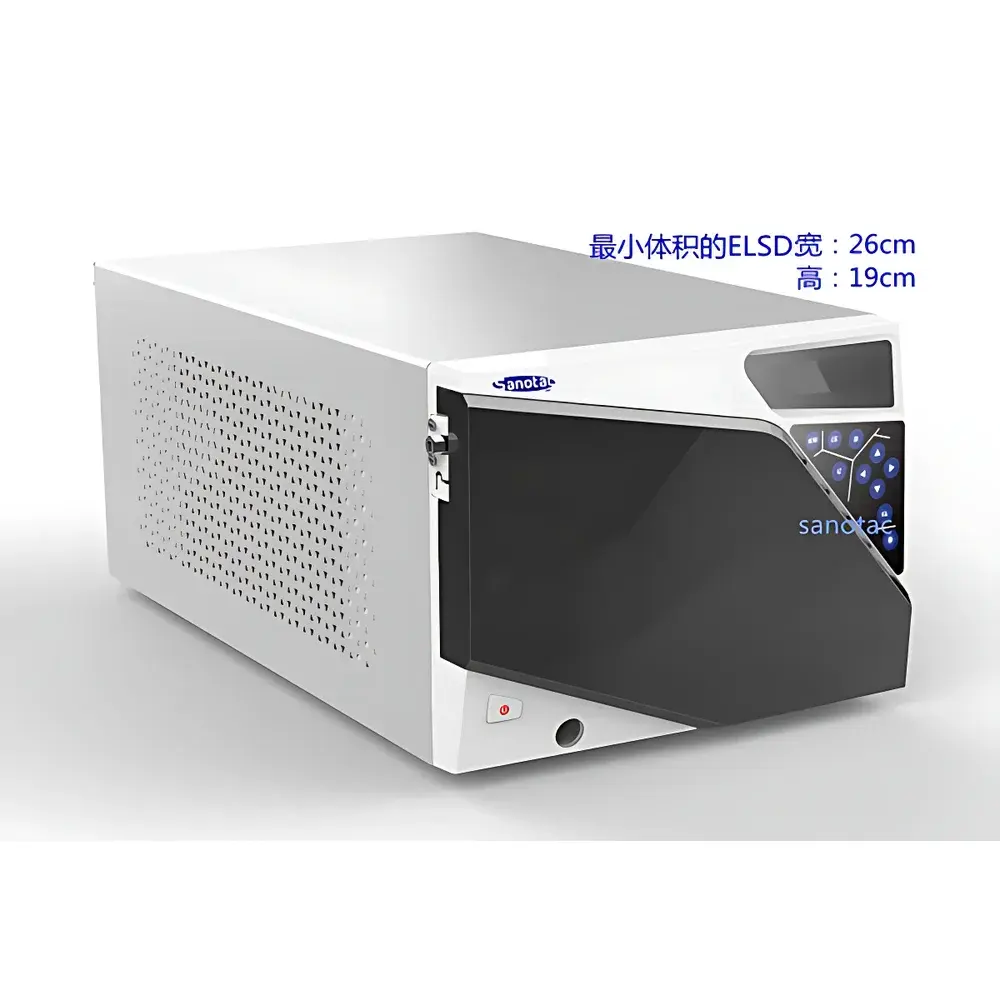
Sanotac Omnitor ELSD 7000 Evaporative Light Scattering Detector
| Brand | Sanotac |
|---|---|
| Origin | Shanghai, China |
| Manufacturer Type | Manufacturer |
| Product Category | Domestic |
| Model | ELSD 7000 |
| Instrument Type | Evaporative Light Scattering Detector (ELSD) |
| Wavelength | 650 nm |
| Detection Mode | Low-Temperature Evaporation |
| Light Source | Semiconductor Laser |
Overview
The Sanotac Omnitor ELSD 7000 is a high-performance evaporative light scattering detector engineered for universal, non-destructive mass-based detection in liquid chromatography systems. Unlike UV-Vis or refractive index detectors, the ELSD 7000 operates on the principle of nebulization, controlled evaporation, and light scattering—detecting analytes based on their relative volatility and mass concentration rather than optical absorbance or refractive index change. This enables reliable quantification of non-chromophoric compounds—including carbohydrates, lipids, polymers, saponins, fatty acids, amino acids, and natural product glycosides—that lack UV activity or exhibit weak absorption at conventional wavelengths. Its low-temperature evaporation mode minimizes thermal degradation of labile compounds while maintaining robust signal reproducibility across diverse mobile phase compositions, including gradients with volatile and semi-volatile solvents (e.g., acetonitrile, methanol, water, and ammonium acetate buffers).
Key Features
- Compact optical architecture (26 × 19 × 46 cm) optimized for stackable integration with HPLC and UHPLC systems
- Low-noise photomultiplier tube (PMT) detection system with baseline noise ≤ 0.03 mV and drift ≤ 0.3 mV/30 min
- Precision temperature control: evaporation chamber (room temperature to 130 °C, ±1 °C accuracy, 1 °C increment); nebulizer zone (room temperature to 56 °C, same resolution)
- Integrated gas management: digitally regulated clean air or nitrogen supply (2–5 bar input pressure, ±0.01 bar monitoring; flow range 1–4 L/min, ≤1% or ±0.02 L/min accuracy)
- Automated 16-point self-diagnostic routine covering gas pressure, heater status, laser activation, valve sequencing, and PMT gain stability
- Programmable external event interface supporting TTL-triggered zeroing, laser shutdown, gas valve actuation, and heater deactivation
- Energy-efficient standby mode reducing power draw during idle periods without compromising thermal equilibration time
Sample Compatibility & Compliance
The ELSD 7000 supports flow rates from 0.01 to 3 mL/min, making it compatible with analytical, microbore, and semi-preparative LC configurations. It is routinely employed in QC laboratories adhering to GLP and GMP frameworks for herbal medicine standardization (e.g., Chinese Pharmacopoeia monographs), lipidomics profiling (ASTM D6584), polymer molecular weight distribution analysis (ISO 16014), and excipient characterization per ICH Q5C guidelines. While not inherently compliant with FDA 21 CFR Part 11, its Clarity™-enabled data acquisition supports audit-trail-capable operation when deployed with validated software environments meeting ALCOA+ principles. All hardware components meet CE electromagnetic compatibility (EMC) and low-voltage directive requirements.
Software & Data Management
The detector is fully controllable via Sanotac’s native chromatography software suite and integrates natively with Clarity® v8.x and later through dynamic-link library (DLL) support. Communication protocols include RS-232, USB, and TCP/IP (HTTP-based API), enabling remote configuration, real-time parameter adjustment, and synchronized method recall. Up to 10 user-defined methods—each containing 25 configurable parameters (evap temp, nebulizer temp, gas flow, gain, offset, sampling rate, etc.)—can be stored onboard and recalled automatically during sequence execution. Digital output at 100 Hz (or 20 Hz for high-stability applications) ensures precise peak integration, while analog output (–1200 to +1200 mV) maintains backward compatibility with legacy integrators and chart recorders.
Applications
- Quantitative analysis of non-UV-absorbing natural products in traditional Chinese medicine extracts (e.g., ginsenosides, astragalosides, polysaccharides)
- Fatty acid methyl ester (FAME) profiling in biodiesel and food oil matrices
- Residual solvent and excipient monitoring in pharmaceutical formulations (per USP )
- Carbohydrate mapping in glycoprotein biologics and vaccine adjuvants
- Quality control of surfactants, emulsifiers, and polymeric excipients (e.g., PEGs, poloxamers)
- Method development for gradient-elution HILIC and reversed-phase separations where UV detection fails
FAQ
What types of mobile phases are compatible with the ELSD 7000?
Compatible solvents include volatile organic modifiers (acetonitrile, methanol, ethanol, THF) and aqueous buffers containing volatile salts (e.g., ammonium acetate, ammonium formate). Non-volatile additives (e.g., phosphates, sulfates, ion-pair reagents) must be avoided.
Can the ELSD 7000 be used with UHPLC systems?
Yes—its low internal volume design and fast response time (100 Hz sampling) support sub-2-µm particle column applications when paired with appropriate flow-splitting or microflow-compatible nebulizers.
Is post-run cleaning required after high-salt mobile phases?
While the low-temperature evaporation mode reduces salt deposition risk, routine rinsing with 100% organic solvent (e.g., isopropanol) for 10 minutes between runs is recommended when using >10 mM volatile buffer concentrations.
Does the detector support multi-wavelength or spectral acquisition?
No—the ELSD 7000 uses a fixed 650 nm semiconductor laser source optimized for Mie scattering efficiency; it does not provide spectral resolution or tunable wavelength capability.
How is calibration performed for quantitative analysis?
Calibration is conducted using external standards of known mass concentration. Response is logarithmic over a dynamic range of 10⁴ (at constant gain), requiring linearization via log-log regression in post-processing software.
Related Products



