
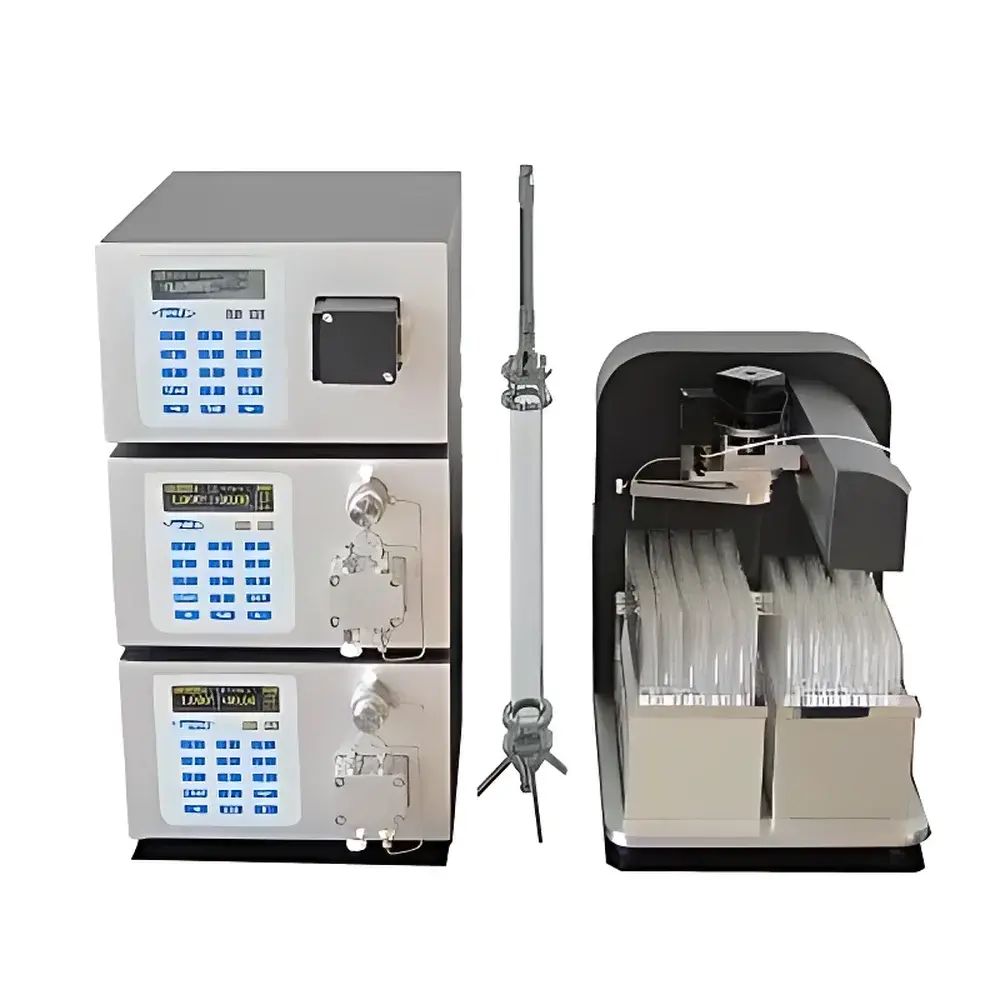
Sanotac Pilot-300 Preparative Liquid Chromatography System
| Brand | Sanotac |
|---|---|
| Origin | Shanghai, China |
| Manufacturer Type | Manufacturer |
| Origin Category | Domestic |
| Model | Pilot-300 |
| Application Level | Laboratory Grade |
| Instrument Type | High-Pressure Preparative Liquid Chromatograph |
| Flow Rate Range | 0.01–300.00 mL/min |
| Maximum Pressure | 15 MPa |
| Flow Accuracy | ±1% |
| Flow Precision (RSD) | ≤0.5% |
| Pressure Pulsation | ≤0.5 MPa |
| Wavelength Range (UV-Vis Detector) | 190–700 nm |
| Wavelength Accuracy | ±1 nm |
| Wavelength Repeatability | ±0.2 nm |
| Flow Cell Path Length | Adjustable (1–5 mm) |
| Baseline Noise | ±0.5×10⁻⁵ AU (254 nm, TC=1 s) |
| Baseline Drift | 1.5×10⁻⁴ AU (254 nm) |
| Linear Range | ≥3 AU |
| Time Constant Options | 0.1/0.2/0.5/1.0/2.0/5.0/10.0 s |
| Detection Modes | Dual-Wavelength Monitoring, Wavelength-Time Programming, Stop-Flow Scanning |
| Gradient & Flow Programming | 10 User-Defined Methods |
| Column ID Compatibility | 10–30 mm I.D. |
Overview
The Sanotac Pilot-300 Preparative Liquid Chromatography System is a high-pressure, laboratory-grade preparative HPLC platform engineered for reproducible, scalable purification of organic compounds, pharmaceutical intermediates, natural products, and synthetic peptides. Based on classical liquid chromatographic separation principles—utilizing differential partitioning of analytes between a mobile phase (eluent) and stationary phase (packed column)—the Pilot-300 operates within a pressure range up to 15 MPa, supporting both flash chromatography (medium-pressure) and high-resolution preparative separations. Its dual-pump architecture employs real-time cavity pressure feedback and solvent compressibility compensation, enabling precise flow delivery across the full dynamic range (0.01–300.00 mL/min). Designed for method translation from analytical to preparative scale, the system maintains retention time fidelity and peak shape integrity under variable load conditions—critical for process development in compliance-driven environments such as pharmaceutical R&D and contract manufacturing organizations (CMOs).
Key Features
- High-stability dual-servo piston pump with floating plunger design, extending seal lifetime under sustained high-pressure operation (up to 15 MPa).
- Advanced flow pulsation suppression via cam-profile compensation, achieving baseline noise ≤ ±0.5×10⁻⁵ AU at 254 nm (1 s time constant), essential for low-abundance fraction detection.
- Multi-point volumetric flow calibration across the entire operating range ensures traceable flow accuracy (±1%) and exceptional repeatability (RSD ≤ 0.5%).
- Dual-lamp UV-Vis detector with automatic D₂/W lamp switching, wavelength programming, and stop-flow scanning—enabling simultaneous monitoring of main components, by-products, and impurities with extended linear dynamic range (≥3 AU).
- Modular hardware architecture: compatible with customizable preparative columns (10–30 mm I.D.), Rheodyne-style 6-port/2-position injection valves, and adjustable-path-length flow cells (1–5 mm).
- Embedded control firmware supporting 10 user-defined gradient and flow programs, including step, linear, and multi-segment gradients with real-time solvent composition tracking.
Sample Compatibility & Compliance
The Pilot-300 accommodates a broad spectrum of sample matrices—including polar/nonpolar small molecules, peptides, oligonucleotides, and labile natural product extracts—when paired with appropriate stationary phases (e.g., C18, silica, amino, cyano, or specialized chiral media). Its solvent handling system supports common HPLC-grade eluents (acetonitrile, methanol, water, THF, ethyl acetate, hexane) and is compatible with corrosive modifiers (e.g., TFA, formic acid) when configured with chemically resistant wetted materials (316L stainless steel, PEEK, sapphire). The system meets core functional requirements for GLP-compliant purification workflows: electronic logbooks, audit-trail-enabled method storage, and detector signal timestamping align with FDA 21 CFR Part 11 data integrity expectations. While not pre-certified, its architecture supports integration into ISO 17025-accredited laboratories and satisfies ASTM E2656 (Standard Guide for Preparative Liquid Chromatography) operational benchmarks.
Software & Data Management
The proprietary Sanotac PrepControl software provides intuitive method setup, real-time chromatogram visualization, automated fraction collection triggering (based on UV threshold, time window, or peak apex), and post-run purity analysis. All acquisition parameters—including pump flow profiles, gradient tables, detector wavelength programs, and valve actuation timing—are stored as encrypted binary files with embedded metadata (operator ID, timestamp, instrument serial number). Raw data export is supported in ASCII-compatible formats (.csv, .txt) for third-party processing (e.g., Empower, Chromeleon, OpenChrom). Software updates are delivered via secure HTTPS channel; no cloud synchronization or remote telemetry is enabled by default—ensuring local data sovereignty per institutional IT policies.
Applications
- Purification of synthetic APIs and intermediates during route scouting and early-phase process development.
- Isolation of bioactive constituents from plant extracts or fermentation broths for structure elucidation (NMR, MS).
- Preparative-scale chiral separations using immobilized polysaccharide-based columns (e.g., Chiralpak AD-H, AS-H).
- Generation of certified reference standards compliant with USP Analytical Instrument Qualification guidelines.
- Desalting and buffer exchange of peptide fractions prior to lyophilization or formulation studies.
- Parallel purification of compound libraries (up to 96 fractions per run) using timed or UV-triggered fraction collectors.
FAQ
What column dimensions are supported?
The Pilot-300 is optimized for preparative columns with internal diameters ranging from 10 mm to 30 mm and lengths up to 250 mm. Custom-packed columns with stainless steel or PEEK housings are fully compatible.
Can the system perform gradient elution with four solvents?
Yes—the integrated quaternary low-dead-volume mixing module supports precise proportioning of up to four solvents with active degassing and real-time composition verification via pressure sensor feedback.
Is the UV detector compliant with pharmacopeial requirements for system suitability testing?
The detector meets sensitivity, linearity, and noise specifications outlined in USP and EP 2.2.46 for preparative UV detection; full system suitability protocols (e.g., resolution, tailing factor, plate count) can be executed using standard test mixtures.
How is maintenance access designed for routine service?
All critical modules—including lamp housing, flow cell, pump seals, and purge valves—are tool-free accessible with front-panel service doors. Lamp replacement requires <60 seconds; flow cell cleaning is performed without disassembly via backflush mode.
Does the system support 21 CFR Part 11-compliant electronic signatures?
While the base firmware does not include digital signature enforcement, the audit trail logs (method changes, run starts/stops, parameter edits) are tamper-evident and exportable for integration into validated LIMS or ELN platforms meeting Part 11 requirements.





