
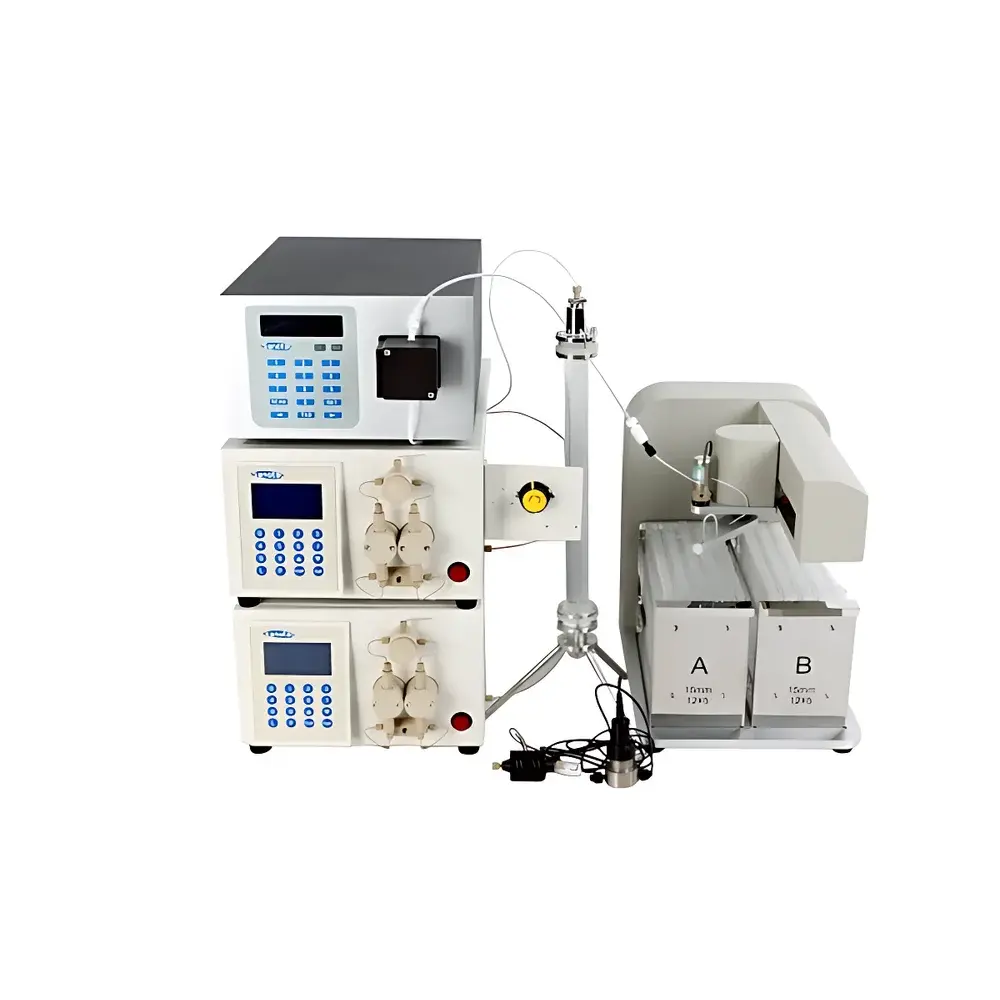
Sanotac Pilot Series Protein Purification System
| Brand | Sanotac |
|---|---|
| Model | Pilot Series |
| Type | Medium-Pressure & Low-Pressure Protein Purification System |
| Purification Principle | Affinity Chromatography (AC) |
| Detector | Conductivity Detector |
| Conductivity Range | 0–999.9 mS/cm |
| Pump Material | PEEK |
| Flow Rate Range | 0.01–200 mL/min (model-dependent) |
| Pressure Range | 0–30 MPa (max) |
| UV Detection | 190–800 nm, Dual-Lamp (Deuterium + Tungsten), ±1 nm wavelength accuracy |
| Absorbance Range | 0–2 AU |
| Fraction Collector | 2 × 60-tube rack (15 mm × 150 mm) |
| Gradient Types | Linear and Isocratic, Online Editable |
| Gradient Resolution | 1% minimum step |
| pH Detection Range | 0–14 |
| Power Supply | 220 V ±10%, 50 Hz |
| Control Interface | RS-232 / USB, Windows XP/7-compatible workstation software |
Overview
The Sanotac Pilot Series Protein Purification System is an engineered platform for scalable, reproducible chromatographic purification of proteins and other biomolecules under medium-pressure (up to 30 MPa) and low-pressure operational regimes. Designed around core principles of affinity chromatography (AC), the system supports ligand-based capture—such as His-tag, GST, or antibody-mediated isolation—by integrating high-precision binary or quaternary gradient pumping, real-time multi-parameter monitoring (UV absorbance, conductivity, pH), and programmable fraction collection. Its modular architecture accommodates both analytical-scale optimization and preparative-scale processing (from milligram to multi-gram yields), making it suitable for upstream process development in biopharmaceutical R&D, academic structural biology labs, and QC/QA environments requiring traceable, GLP-aligned workflows.
Key Features
- PEEK pump heads with pulse-dampened flow delivery: ensures ≤±1% flow accuracy across dynamic ranges (0.01–200 mL/min), critical for maintaining column integrity and binding kinetics during AC elution.
- Dual-lamp UV-Vis detector (deuterium + tungsten): enables simultaneous monitoring at multiple wavelengths (190–800 nm) with ±1 nm wavelength accuracy and 0–2 AU linear absorbance response—ideal for detecting aromatic residues (e.g., Trp, Tyr) and co-eluting contaminants.
- Integrated conductivity and pH sensors: provide real-time buffer composition feedback during gradient formation and wash/elution steps; conductivity detection spans 0.001–999.9 mS/cm, supporting both low-ionic-strength binding and high-salt elution conditions.
- Automated fraction collector with dual 60-position racks: accepts standard 15 mm × 150 mm tubes; supports sequential, cyclic, and peak-triggered collection modes synchronized with UV/conductivity thresholds.
- Manual injection valve with configurable定量 loops (10 mL standard, optional 20 mL): facilitates precise loading of clarified lysates, supernatants, or purified fractions without inline dilution artifacts.
- Windows-based control software: compliant with FDA 21 CFR Part 11 requirements for electronic records and signatures when configured with audit trail, user access levels, and data encryption—supporting GMP/GLP documentation needs.
Sample Compatibility & Compliance
The Pilot Series is validated for use with common chromatographic media including Ni-NTA, Protein A/G/L resins, ion-exchange matrices (e.g., Q Sepharose, SP Sepharose), and size-exclusion columns (e.g., Superdex, Sephacryl). It supports sample viscosities up to 10 cP and particulate loadings consistent with clarified E. coli or mammalian cell culture supernatants (post-centrifugation/filtration ≤0.45 µm). System hardware meets IEC 61010-1 safety standards for laboratory equipment. Software workflows align with ISO/IEC 17025 method validation guidelines and support ASTM E2500-18 (good practice in analytical method development) and USP (analytical instrument qualification).
Software & Data Management
Control and data acquisition are managed via a dedicated Windows workstation application communicating over RS-232 or USB. The interface provides real-time chromatogram overlays (UV, conductivity, pH), gradient programming with editable dwell volume compensation, and automated method sequencing. All raw data—including timestamps, detector signals, pump parameters, and collection events—are stored in vendor-neutral .csv and .chm formats. Audit trails log user actions, method changes, and calibration events with tamper-proof timestamps. Optional add-ons include LIMS integration modules (via HL7 or OPC UA) and PDF report generation with embedded chromatograms and metadata compliant with ALCOA+ principles.
Applications
- Process development of monoclonal antibodies (mAbs), Fc-fusion proteins, and recombinant enzymes under GMP-relevant conditions.
- Tagged-protein purification from bacterial, yeast, insect, or CHO expression systems using immobilized metal affinity chromatography (IMAC) or immunoaffinity resins.
- Buffer exchange and desalting via inline size-exclusion or dialysis modules (externally coupled).
- Method scouting and robustness testing per ICH Q5A and Q5B guidelines for biologics characterization.
- Teaching laboratories conducting hands-on instruction in chromatographic theory, binding isotherms, and column efficiency calculations (e.g., HETP, N, Rs).
FAQ
What pressure ratings are supported across Pilot Series models?
The series includes variants rated for 5 MPa (low-pressure), 6–10 MPa (medium-pressure), and up to 30 MPa (high-resolution AC), enabling compatibility with rigid-bead resins (e.g., POROS, Cytiva Capto) and monolithic columns.
Can the system perform pH gradient elution?
Yes—when paired with an external pH-controlled buffer delivery module or pre-mixed pH-staged buffers, the system supports pH-mediated elution for ion-exchange or hydrophobic interaction chromatography (HIC), though on-board pH gradient generation requires optional peristaltic pump integration.
Is method transfer possible between Pilot Series and analytical HPLC systems?
Method parameters (flow rate, gradient slope, column dimensions) are scalable using retention time normalization and linear velocity equivalence; however, column packing density and extra-column volume differences necessitate empirical re-optimization for quantitative transfer.
Does the software support 21 CFR Part 11 compliance out-of-the-box?
Full compliance requires configuration of role-based authentication, electronic signatures, and enabled audit trail logging—features available in the licensed Professional Edition of the workstation software.
What maintenance intervals are recommended for pump seals and UV lamp replacement?
PEEK pump seals are rated for ≥5,000 hours of continuous operation under typical AC conditions; deuterium lamps require replacement every 1,000–1,500 hours of active use, as indicated by reduced intensity at 254 nm or increased noise in baseline signal.






