
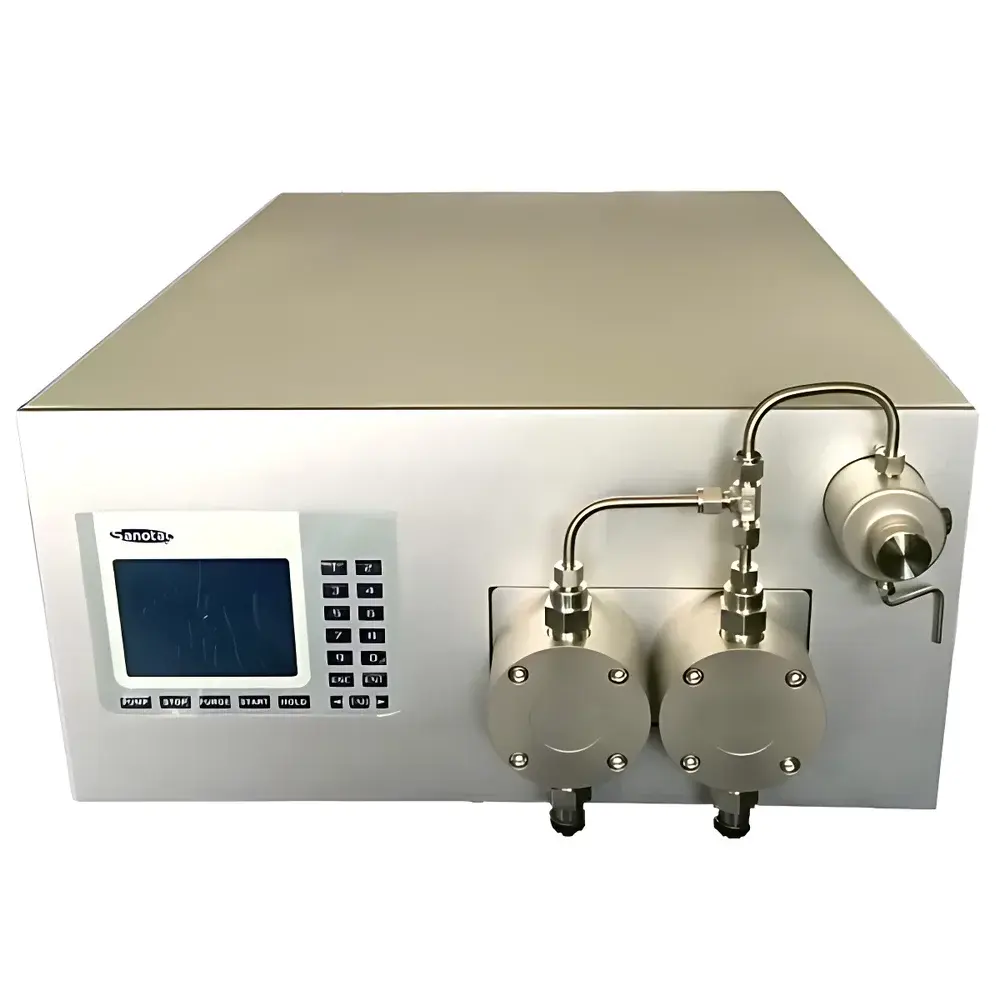
Sanotac ZX100 High-Pressure Plunger Pump for Homogeneous Reactor Systems
| Brand | Sanotac |
|---|---|
| Origin | Shanghai, China |
| Manufacturer Type | OEM Manufacturer |
| Country of Origin | China |
| Model | ZX100 |
| Price Range | USD 1,400 – 2,800 |
Overview
The Sanotac ZX100 High-Pressure Plunger Pump is an engineered constant-flow solution designed specifically for integration into pressurized continuous-flow chemical systems—including homogeneous reactors, microchannel reactors, fixed-bed catalytic evaluation units, hydrogenation rigs, tubular flow reactors, and high-pressure synthesis platforms. Operating on positive displacement principles via dual parallel plunger architecture with floating piston design, the ZX100 delivers stable, pulse-dampened fluid delivery across a wide dynamic range. Its core engineering addresses critical challenges in high-pressure liquid handling: solvent compressibility effects, mechanical pulsation transmission, and long-term seal integrity under sustained pressure loads. The pump is not a standalone analytical instrument but a precision fluidic actuator—intended for system-level deployment where reproducible mass transfer, residence time control, and stoichiometric consistency are prerequisites for kinetic studies, catalyst screening, or process intensification.
Key Features
- Dual parallel plunger mechanism with floating piston design minimizes radial load on seals, extending service life of high-pressure sealing components and reducing maintenance frequency.
- Microprocessor-controlled flow regulation with real-time solvent compressibility compensation ensures accuracy across variable temperature and solvent density conditions.
- Electronic flow pulse suppression combined with cam profile optimization reduces pressure ripple to ≤ 0.2 MPa (typ.), critical for avoiding flow-induced vibration in sensitive reactor manifolds or inline sensors.
- Multi-point flow calibration curve correction enables consistent accuracy from 0.01 mL/min to 100.00 mL/min—covering both trace reagent addition and bulk feed applications.
- Open communication protocol supports bidirectional computer control (RS-232/USB), enabling seamless integration with third-party chromatography data systems (CDS), SCADA platforms, or custom LabVIEW-based automation frameworks.
- Front-panel interface features a 256×64 backlit LCD display and stores up to 10 user-defined flow/gradient programs—supporting rapid method recall without external software dependency.
- Wetted path constructed from 316L stainless steel, sapphire check valves, PTFE seals, and ceramic components ensures compatibility with aggressive solvents, acids, bases, and halogenated media.
Sample Compatibility & Compliance
The ZX100 is compatible with a broad spectrum of process liquids—including aqueous buffers, organic solvents (e.g., THF, DMF, acetonitrile), supercritical CO₂ co-solvents, and low-viscosity ionic liquids—provided operating parameters remain within specified limits (≤ 20 MPa, ≤ 100 mL/min). Its wetted materials meet ASTM F2136 requirements for metallic components in high-pressure fluid systems and conform to ISO 8536-4 for glass container compatibility in pharmaceutical process validation contexts. While not certified for intrinsically safe environments, explosion-proof variants (e.g., Sanotac EP series) are available upon request for Class I Div 1 hazardous area deployments. The pump’s mechanical design adheres to ISO 5170 and EN 13480-3 standards for pressure equipment structural integrity.
Software & Data Management
The ZX100 supports ASCII-based serial command sets compliant with ANSI X3.27-1988, allowing interoperability with LIMS, ELN, and process historians. Computer-controlled operation includes full audit trail logging of flow setpoints, pressure readings, runtime duration, and error codes—enabling compliance with FDA 21 CFR Part 11 when deployed within validated GxP workflows. Optional firmware upgrades provide timestamped event logging with SHA-256 hash integrity verification for GLP/GMP traceability. No proprietary software installation is required; standard terminal emulators or Python-based PySerial scripts suffice for remote configuration and monitoring.
Applications
- Catalyst performance evaluation under controlled residence time and partial pressure conditions in fixed-bed or trickle-bed reactors.
- Continuous-flow hydrogenation using integrated H₂ mass flow controllers and back-pressure regulators.
- High-temperature/pressure hydrothermal synthesis where precise stoichiometric feeding prevents localized thermal runaway.
- Automated reaction screening platforms requiring synchronized multi-pump gradient delivery (e.g., combinatorial ligand testing).
- In-line FTIR or UV-Vis spectroscopic monitoring setups demanding ultra-low pulsation to avoid signal noise artifacts.
- Preparative supercritical fluid chromatography (SFC) feed systems where CO₂–co-solvent ratio stability dictates separation resolution.
FAQ
What is the maximum allowable inlet pressure for the ZX100?
The ZX100 is designed for ambient-pressure inlet conditions only. Positive inlet pressure exceeding 0.1 MPa may compromise check valve function and void warranty.
Can the ZX100 be used with viscous fluids above 50 cP?
Viscosity > 30 cP requires derating of maximum operating pressure and flow rate per Sanotac Application Note AN-ZX100-03; consult technical support prior to deployment.
Is gradient mixing performed internally or externally?
The ZX100 itself does not perform mixing; it delivers pre-mixed streams or individual solvent lines to external T-mixers or static mixers—gradient formation occurs downstream.
Does the pump include built-in leak detection or dry-run protection?
No. External flow sensors or pressure transducers must be integrated into the system architecture for such safety interlocks.
What maintenance intervals are recommended for routine operation at 15 MPa?
Seal replacement every 1,200 hours of cumulative operation; cam and drive train inspection every 3,000 hours—per Sanotac Maintenance Schedule MS-ZX100 Rev. 4.2.



