
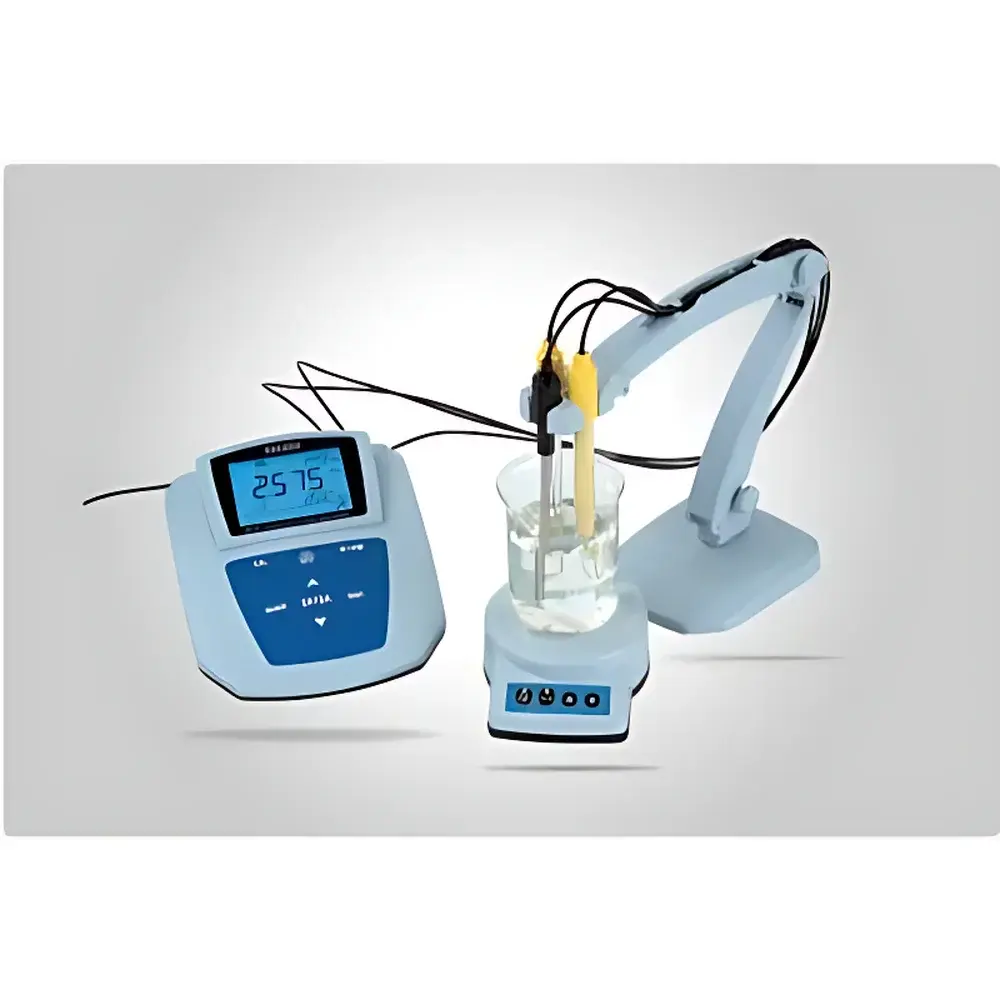
Sanxin MP523-02 Low-Level Sodium Ion Analyzer
| Brand | Sanxin |
|---|---|
| Origin | Shanghai, China |
| Manufacturer Type | Manufacturer |
| Model | MP523-02 |
| Ion Type | Sodium |
| Measurement Range (pNa) | 0.00–9.00 pNa (electrometer) |
| Detection Limit | ≥0.2 ppb (dynamic mode), ≥2 ppb (static mode) |
| Accuracy | ±0.01 pNa |
| Temperature Compensation | 0–50 °C |
| Data Storage | 600 sets |
| Interface | RS232 |
| Power Supply | DC 9 V / 300 mA |
| Dimensions | 160 × 190 × 70 mm |
| Weight | 880 g |
| IP Rating | IP54 |
| Compliance | GLP-compliant architecture, supports audit-ready data logging |
Overview
The Sanxin MP523-02 Low-Level Sodium Ion Analyzer is a benchtop potentiometric ion analyzer engineered for trace-level sodium quantification in ultrapure water systems, power plant condensate and feedwater streams, semiconductor rinse water, and pharmaceutical process water. It operates on the principle of selective ion detection using a solid-state sodium-selective electrode (SSE) paired with a double-junction reference electrode, enabling Nernstian response to Na⁺ activity across six orders of magnitude. The instrument integrates pH, mV, and temperature measurement capabilities—making it a multifunctional platform for ionic impurity monitoring where sodium serves as a critical contamination indicator. Its design prioritizes stability in low-conductivity matrices (<1 µS/cm), where conventional conductivity-based methods lack specificity and sensitivity. With a dynamic detection limit of 0.2 ppb (equivalent to 8.7 × 10⁻¹² mol/L), the MP523-02 meets stringent operational requirements defined in ASTM D4582 (Standard Practice for Detecting Sodium in High-Purity Water) and aligns with IAPWS Technical Guidance for Steam Cycle Chemistry in fossil and nuclear power generation.
Key Features
- Trace-sensitivity sodium measurement with dual-mode operation: static mode (≥2 ppb LOD) and dynamic flow-through mode (≥0.2 ppb LOD) optimized for continuous sampling in high-purity water loops.
- Four selectable concentration units—pNa, mol/L, mg/L, and ppm—with seamless real-time conversion during calibration and sample analysis.
- Two-point calibration protocol using certified Na⁺ standard solutions (e.g., pNa 1.00 and pNa 4.00), eliminating interpolation errors and supporting direct concentration readout without manual calculation.
- Integrated intelligent magnetic stirrer (Model 901) with programmable, constant-speed agitation—ensuring reproducible diffusion layer thickness and minimizing boundary potential drift during low-level measurements.
- Auto-temperature compensation (0–50 °C) via integrated Pt1000 thermistor (MP500 temperature probe), correcting for thermal effects on electrode potential per the Nernst equation.
- GLP-compliant data architecture: time-stamped measurements, user ID tagging, calibration history logging, and RS232 output compatible with LIMS integration and 21 CFR Part 11–enabled software (MP517).
- IP54-rated enclosure with silicone-sealed electrode ports and ruggedized housing for laboratory and controlled industrial environments.
Sample Compatibility & Compliance
The MP523-02 is validated for aqueous samples with conductivity <5 µS/cm and total dissolved solids <10 ppb. It accommodates high-purity water matrices including boiler feedwater, turbine condensate, deionized water, and WFI (Water for Injection) per USP . Electrode configuration—using the 7801 sodium-selective electrode and 6212-M double-junction reference—minimizes liquid junction potential drift and eliminates KCl leaching interference in low-ionic-strength media. The system complies with ISO/IEC 17025 documentation requirements for calibration traceability and supports GMP/GLP audit trails through encrypted data export and immutable session logs. All firmware and calibration routines adhere to IEC 61508 functional safety principles for analytical instrumentation in critical infrastructure applications.
Software & Data Management
The MP517 PC communication software enables bidirectional data exchange via RS232, supporting automated report generation (PDF/CSV), calibration certificate printing, and trend visualization over time-series datasets. Each stored record includes measurement timestamp, electrode status, temperature, slope (%Nernst), offset (mV), and user-defined sample ID. Audit trail functionality records all parameter changes, calibration events, and firmware updates with operator attribution and time/date stamps—meeting FDA 21 CFR Part 11 electronic record integrity criteria when deployed with validated computer systems. Data retention spans 600 full measurement entries with overflow protection and manual archive export capability.
Applications
- Real-time sodium monitoring in thermal power plant steam-water cycles to prevent stress corrosion cracking (SCC) of austenitic stainless steel components.
- Validation of mixed-bed ion exchange resin exhaustion in ultrapure water distribution systems.
- Leachate testing of pharmaceutical primary packaging materials (e.g., borosilicate glass vials) per EP 3.2.1.
- Process water qualification for semiconductor wafer cleaning baths (SEMI F57-0218).
- Environmental compliance testing of low-sodium effluents from desalination brine polishing stages.
FAQ
What is the recommended electrode maintenance procedure for long-term pNa accuracy?
Rinse the 7801 sodium electrode with deionized water after each use; store immersed in 0.1 mol/L NaCl solution. Regenerate the sensing membrane annually via controlled etching with dilute HNO₃ (0.01 M, 30 s), followed by thorough rinsing and reconditioning in pNa 2.00 standard.
Can the MP523-02 measure sodium in seawater or high-salinity samples?
No—it is designed exclusively for trace sodium analysis in low-ionic-strength matrices. For seawater or brine, use a dedicated high-range ion meter with robust junction design and salinity compensation algorithms.
Does the instrument support automatic calibration verification (ACV) or built-in standard checking?
It does not perform ACV autonomously, but includes a “Calibration Check” function that compares current electrode slope and offset against prior calibration records to flag drift exceeding ±3% deviation from theoretical Nernst response.
Is the RS232 interface optically isolated?
No—RS232 is electrically isolated via internal DC-DC converters, providing noise immunity up to 1 kV transient surge per IEC 61000-4-5, suitable for industrial lab environments with variable ground potentials.
How is temperature compensation applied during pNa measurement?
The MP500 temperature probe continuously feeds real-time temperature to the microprocessor, which applies the extended Nernst equation: E = E⁰ − (RT/F)·ln(10)·pNa + kT, where kT is empirically derived from multi-point calibration across 5–50 °C.







