
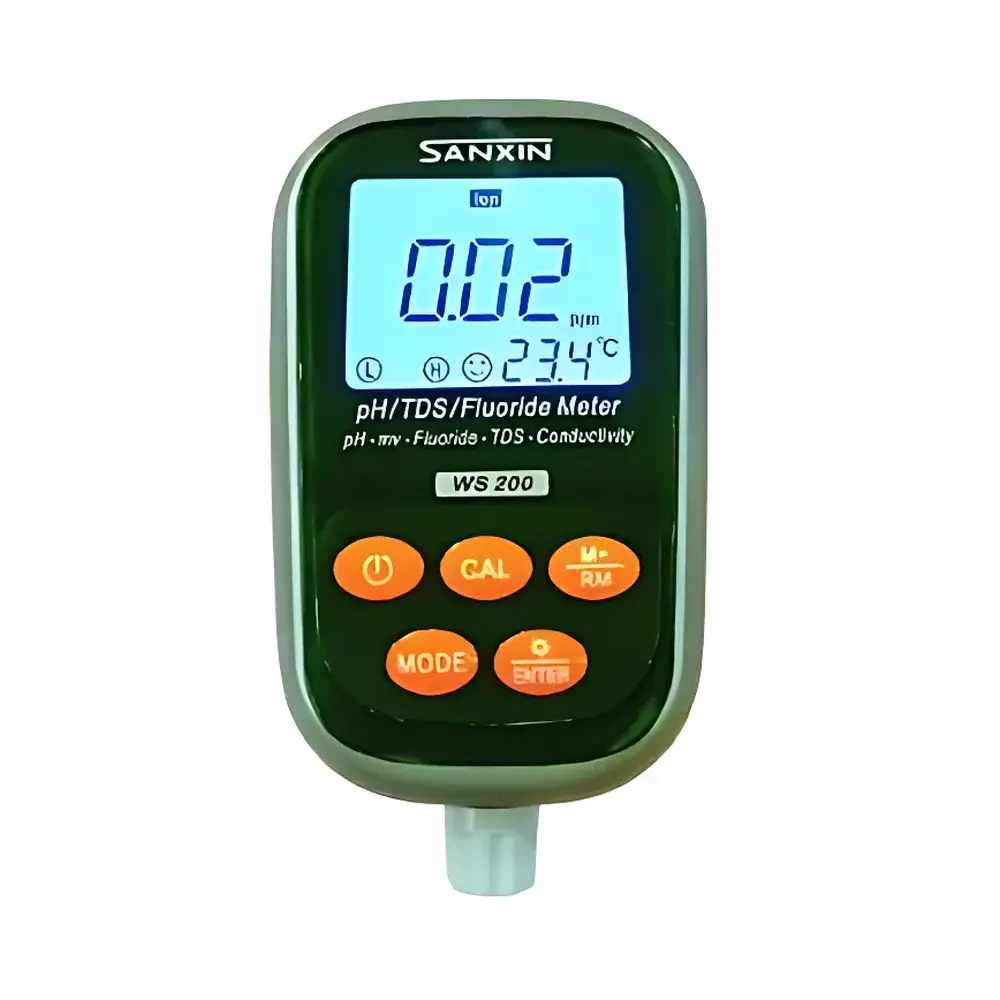
Sanxin PX200 Portable pH / Fluoride Ion / TDS / Temperature Meter
| Brand | Sanxin Peirui |
|---|---|
| Origin | Shanghai, China |
| Manufacturer Type | Direct Manufacturer |
| Instrument Category | Domestic |
| Model | WS200 |
| Instrument Type | Portable |
| Fluoride Ion Measurement Range | 1.00–6.00 pF |
| Detection Limit | 1.00–6.00 pF |
| Response Time | 5 s |
| Fluoride Accuracy | ±0.01 pF |
| Temperature Range | 0–80 °C |
| pH Range | 0.00–14.00 |
| pH Accuracy | ±0.01 pH |
| ORP Range | ±1999 mV |
| ORP Accuracy | ±0.1% FS |
| Conductivity Range | 0–199.9 mS/cm |
| TDS Range | 0–100 g/L |
| Salinity Range | 0–100 ppt |
| Resistivity Range | 0–100 MΩ·cm |
| Conductivity Accuracy | ±1.0% of reading |
| Temperature Compensation | Automatic (0–80 °C for F⁻ |
| Electrode Constants | 0.1 / 1.0 / 10 cm⁻¹ |
| Reference Temperatures | 18 °C, 20 °C, 25 °C |
| Data Storage | 200 sets (ID, value, unit, temperature) |
| Power | 2 × AA batteries (1.5 V each) |
| Dimensions (meter) | 65 × 120 × 31 mm |
| Weight (meter) | 186 g |
| Carrying Case | 255 × 210 × 50 mm / 1.7 kg |
| Ingress Protection | IP57 |
Overview
The Sanxin PX200 Portable pH / Fluoride Ion / TDS / Temperature Meter is a field-deployable, multi-parameter electrochemical analyzer engineered for rigorous water quality assessment in environmental monitoring, municipal water supply verification, and regulatory compliance workflows. It operates on potentiometric measurement principles: fluoride ion activity is quantified via a solid-state lanthanum fluoride (LaF₃)-based ion-selective electrode (ISE), while pH and ORP rely on glass and noble-metal reference electrodes respectively; conductivity, TDS, salinity, and resistivity are derived from four-electrode or two-electrode AC conductance measurements with automatic cell constant compensation. All electrochemical readings are thermally compensated in real time using an integrated NTC thermistor, ensuring traceable accuracy across dynamic field conditions—from cold groundwater sources to warm effluent streams.
Key Features
- Triple-composite fluoride ISE probe with integrated reference and temperature sensors—eliminates junction potential drift and enables single-point immersion without external calibration buffers or stirring.
- Auto-calibration routines compliant with ISO 7888 (conductivity), ASTM D1125 (pH), and EPA Method 300.0 (fluoride)—supports up to three-point pH calibration and two-point F⁻ calibration using standard solutions traceable to NIST SRM 1692.
- Intelligent microprocessor architecture with self-diagnostic diagnostics, low-battery indication, auto-power-off after 10 minutes of inactivity, and non-volatile memory retaining calibration coefficients and last-used settings.
- Rugged IP57-rated housing—fully protected against dust ingress and immersion in 1 m of water for up to 30 minutes—validated per IEC 60529 for field durability.
- Unit-switching capability across concentration formats: pF, mg/L (as F⁻), and ppm—with stoichiometric conversion based on atomic mass (19.00 g/mol) and charge equivalence.
Sample Compatibility & Compliance
The PX200 is validated for use with natural waters (surface, groundwater, drinking water), wastewater effluents, and treated distribution system samples. It meets essential performance criteria outlined in ISO 10523 (pH), ISO 10304-1 (ion chromatography correlation for F⁻), and WHO Guidelines for Drinking-water Quality (fluoride limit: 1.5 mg/L). The instrument supports GLP-aligned data integrity through timestamped storage of 200 measurement records—including sample ID, measured parameter, unit, temperature, and operator-defined annotation. While not FDA 21 CFR Part 11 certified out-of-the-box, audit trails can be exported manually for inclusion in regulated laboratory documentation systems.
Software & Data Management
No proprietary software or USB interface is included; data retrieval is manual via on-device LCD review and numeric export. Each stored record contains a unique index number, measured value, selected unit (e.g., pF or mg/L), and concurrent temperature reading—enabling post-acquisition correction using published temperature coefficient tables (e.g., −0.002 pF/°C for LaF₃ electrodes). For laboratories requiring electronic data capture, the PX200’s RS-232 output (optional adapter required) permits integration with LIMS platforms supporting ASCII-based serial protocols. Calibration history is retained separately and accessible via diagnostic mode.
Applications
- Field verification of fluoride levels in community water fluoridation programs—ensuring compliance with national standards (e.g., US EPA MCL = 4.0 mg/L; EU Directive 2020/2184 = 1.5 mg/L).
- Rapid screening of industrial discharge points for fluoride contamination from semiconductor etching, aluminum smelting, or phosphate fertilizer production.
- Multi-parameter profiling of source water during emergency response—simultaneously evaluating acidity (pH), oxidizing capacity (ORP), ionic strength (conductivity/TDS), and toxic anion burden (F⁻).
- Educational use in environmental science curricula—demonstrating ion-selective electrode theory, Nernst equation application, and temperature-dependent activity corrections.
FAQ
What is the recommended calibration frequency for fluoride measurements?
For routine field use, calibrate before each sampling session using two standard solutions bracketing the expected pF range (e.g., 2.00 pF and 4.00 pF). In high-precision applications, verify calibration every 2 hours or after measuring >10 samples.
Can the PX200 measure fluoride in seawater or high-salinity brines?
No. Ionic strength above 0.1 mol/L (≈5 g/L TDS) induces significant activity coefficient deviation and junction potential error. Use only for freshwater matrices with TDS < 2,000 mg/L.
Is the triple-composite electrode replaceable as a single unit?
Yes—the integrated F⁻/Ref/Temp probe (Sanxin model F-01T) is field-replaceable without recalibrating the meter body. Electrode lifetime averages 12–18 months under proper storage (wet-capped in 1 mM NaF solution).
Does the instrument support differential pH measurement (e.g., between two wells)?
No. It provides absolute electrode potential readings only. Differential analysis requires paired instruments or external data logging with synchronized timestamps.
How does temperature compensation differ across parameters?
Fluoride uses a fixed −0.002 pF/°C slope; pH applies the Nernstian −0.198 mV/°C shift at 25 °C; conductivity applies linear α-coefficient (2.0%/°C default, adjustable) per ISO 7888 Annex B.
Related Products







