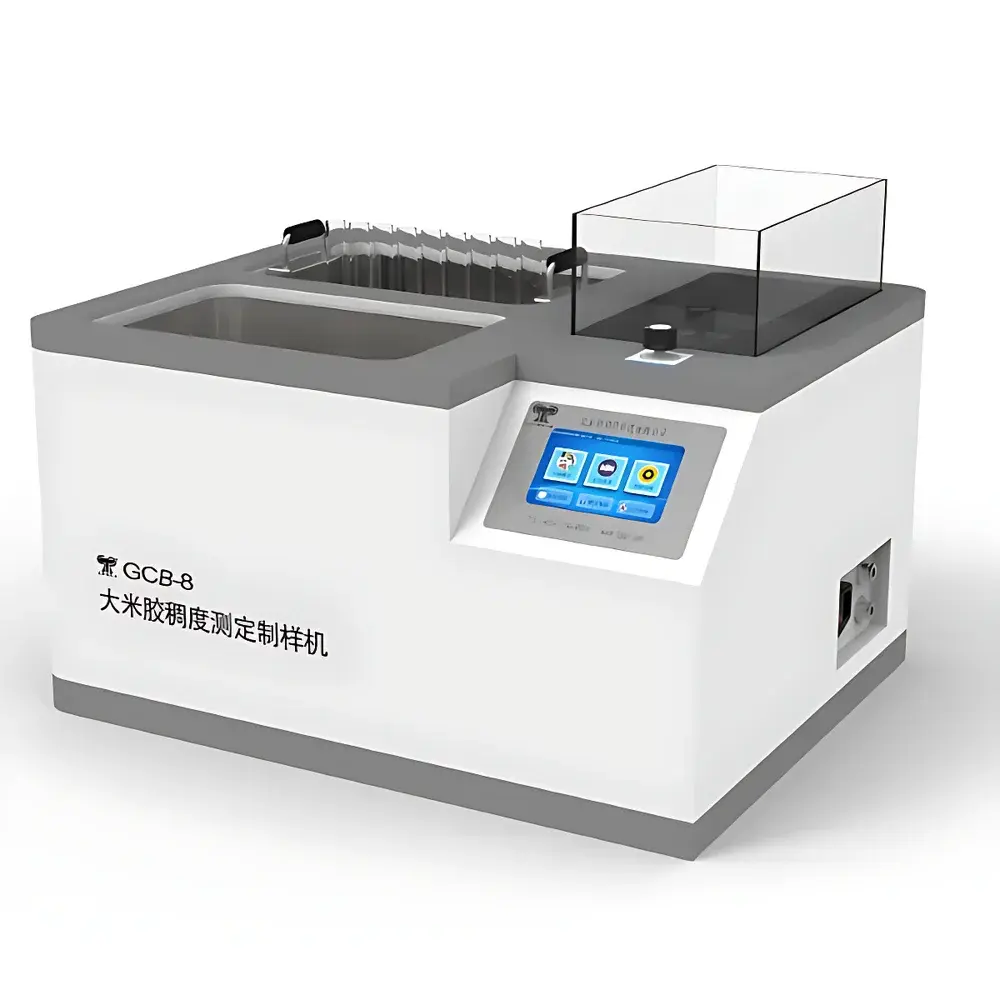

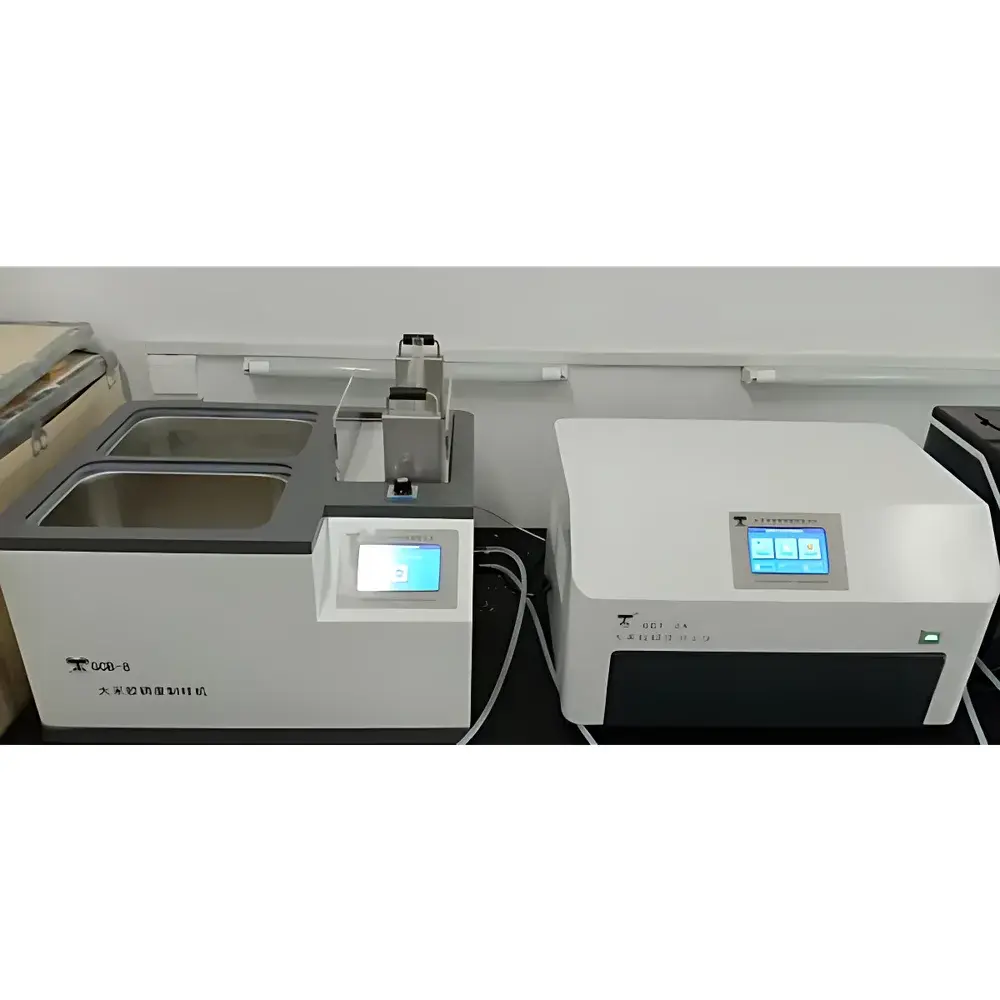
Saprete GCB-28 Rice Gel Consistency Sample Preparation System
| Brand | Saprete |
|---|---|
| Origin | Beijing, China |
| Manufacturer Type | Direct Manufacturer |
| Country of Origin | China |
| Model | GCB-28 |
| Power Supply | 220 V AC |
| Sample Capacity | 28 positions |
| Temperature Control Accuracy | ±0.1 °C |
Overview
The Saprete GCB-28 Rice Gel Consistency Sample Preparation System is a dedicated benchtop instrument engineered for standardized, reproducible sample conditioning in accordance with GB/T 17891–2018 (Rice – Specifications), GB/T 20569–2006 (Determination of Gel Consistency of Rice), and ISO 6647-1:2022 (Rice – Determination of gelatinization properties – Part 1: Method using the amylograph). It automates the critical pre-analytical phase of rice gel consistency testing—specifically the controlled gelatinization of milled rice flour slurries followed by immediate transfer into an ice-water bath to halt starch retrogradation. Unlike manual water-bath setups prone to inter-operator variability, the GCB-28 implements closed-loop thermal regulation, real-time water-level monitoring, and synchronized timing logic to ensure uniform slurry heating (to precise boiling point), consistent hold duration, and rapid post-boil quenching—all within a single integrated platform. Its architecture aligns with GLP-compliant laboratory workflows where traceability, repeatability, and operator-independent execution are prerequisites for regulatory-grade grain quality assessment.
Key Features
- 28-position parallel sample processing capacity—enabling high-throughput batch preparation for routine quality control labs handling multiple rice cultivars or harvest lots.
- Stepless heating power adjustment via calibrated rotary controller—provides granular thermal input modulation to prevent localized overheating or bumping during slurry gelatinization.
- ±0.1 °C temperature control accuracy across the full operational range (ambient to 100 °C), verified against NIST-traceable reference thermometers.
- Automated water-level sensing with fail-safe shutdown—prevents dry-heating events and ensures consistent thermal mass for reproducible heat transfer kinetics.
- Integrated automatic fill-and-drain cycle—eliminates manual water handling, reduces contamination risk, and supports unattended operation between batches.
- Boiling point auto-detection algorithm—dynamically identifies onset of nucleate boiling for each individual vessel, compensating for altitude- or atmospheric-pressure-induced variations in boiling temperature.
- Backlit capacitive touchscreen interface—supports multi-language UI (English default), timestamped operation logs, and parameter lockout for SOP enforcement.
Sample Compatibility & Compliance
The GCB-28 accommodates standard 18 mm × 150 mm glass test tubes (as specified in GB/T 20569) containing 0.1 g milled rice flour + 1.0 mL 0.2 mol/L KOH solution. Tube racks are CNC-machined from corrosion-resistant anodized aluminum to maintain dimensional stability under repeated thermal cycling. The system complies with IEC 61010-1:2010 safety standards for electrical equipment for measurement, control, and laboratory use. Its operational protocol satisfies audit requirements under ISO/IEC 17025:2017 (General requirements for the competence of testing and calibration laboratories) when paired with documented method validation data. No modifications to core assay chemistry or endpoint measurement (e.g., cold gel length measurement on ruler scale) are required—only the upstream conditioning step is automated.
Software & Data Management
The embedded firmware records per-run metadata—including start time, target temperature, actual achieved temperature profile, water-fill volume, boil-onset timestamp, hold duration, and drain completion time—for each of the 28 positions. All logs are exportable via USB 2.0 port in CSV format, retaining ISO 8601 timestamps and operator ID fields. Audit trail functionality meets FDA 21 CFR Part 11 foundational requirements: all parameter changes are time-stamped, user-identified, and non-erasable within the device’s internal memory (retention ≥ 3 years). Optional PC-based configuration utility (Windows 10/11 compatible) enables batch parameter templates, electronic signature capture, and integration with LIMS via HL7 v2.5 message mapping.
Applications
- Routine grading of paddy and milled rice in national grain inspection centers and commodity trading laboratories.
- Varietal screening programs evaluating amylose–amylopectin interaction effects on cooked rice texture.
- Research on starch modification (e.g., hydrothermal treatment, enzymatic debranching) where gel consistency serves as a proxy for molecular weight distribution shifts.
- Quality assurance in parboiled rice manufacturing, where gel consistency correlates with breakage resistance during milling.
- Method validation studies supporting accreditation under CNAS (China National Accreditation Service) or equivalent international bodies.
FAQ
Does the GCB-28 perform the final gel length measurement?
No—the GCB-28 executes only the standardized gelatinization and quenching steps. Final cold gel length evaluation remains a manual visual measurement per GB/T 20569–2006 Section 6.3.
Can it be used for non-rice cereal flours?
It is calibrated and validated exclusively for rice flour per GB/T 20569. Use with wheat, barley, or sorghum requires full re-validation of thermal profiles and hold times.
Is external cooling water required for the ice-water bath function?
No—the system uses ambient air-cooled stainless steel chill plates and timed immersion in pre-chilled water reservoirs; no recirculating chiller is needed.
What maintenance intervals are recommended?
Quarterly verification of temperature sensor calibration and annual inspection of solenoid valves and water-level probes are advised per the maintenance logbook included with shipment.
Is remote monitoring supported?
Local Ethernet connectivity is not provided; however, USB-log exports enable offline trend analysis in statistical process control (SPC) software such as Minitab or JMP.