
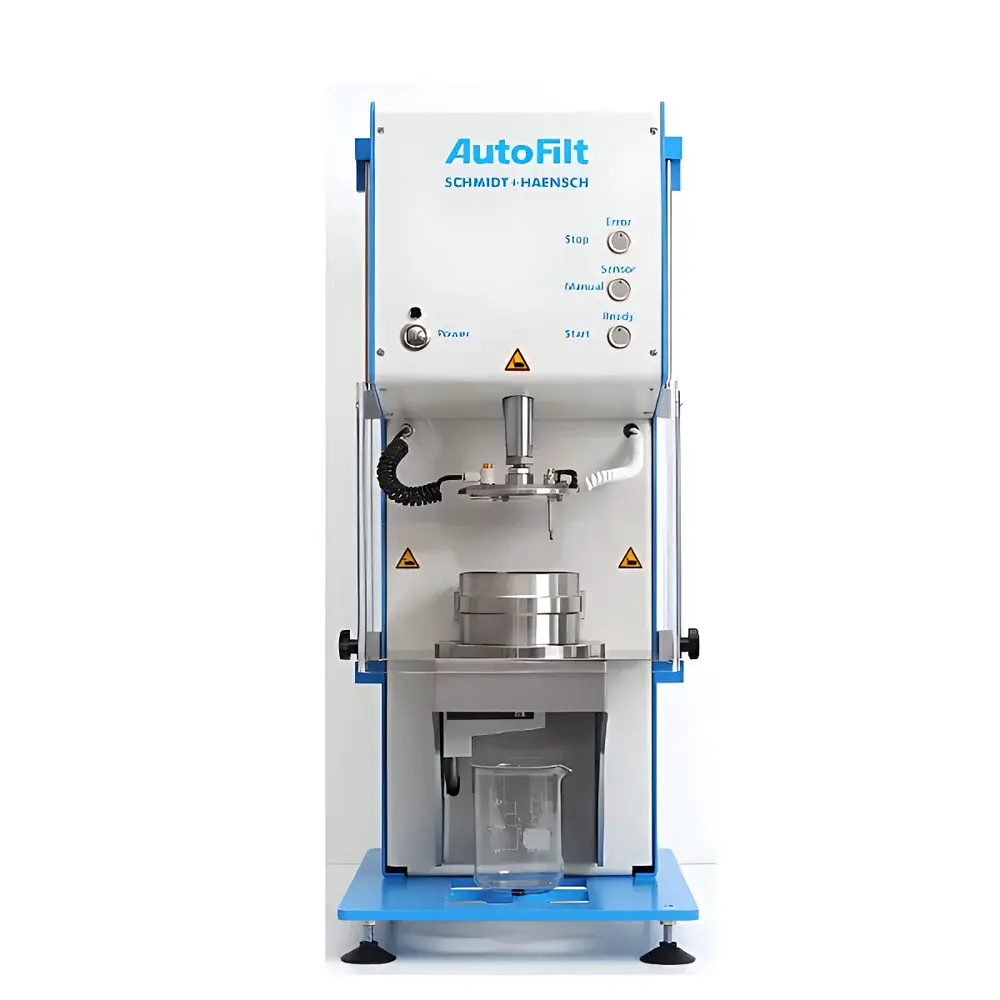
Schmidt + Haensch AutoFilt Z Lead-Free Automatic Filtration System
| Brand | Schmidt + Haensch (S+H) |
|---|---|
| Origin | Germany |
| Manufacturer Type | Authorized Distributor |
| Origin Category | Imported |
| Model | AutoFilt Z |
| Pricing | Upon Request |
| Max. Filtration Pressure | 5 bar (0.5 MPa) |
| Typical Filtration Volume | ~250 mL |
| Measured Sample Volume | 50 mL |
| Operating Temperature Range | +10 °C to +40 °C |
| Power Supply | 100–240 VAC, 47–63 Hz, 40 W |
| Compressed Air Requirement | ≤10 bar (1.0 MPa), oil-free, Ø outer diameter 6 mm |
| Waste Tube | Ø inner diameter 16 mm |
Overview
The Schmidt + Haensch AutoFilt Z Lead-Free Automatic Filtration System is an engineered solution for rapid, reproducible clarification of highly colored, solid-laden liquid samples—particularly in sugar analysis laboratories. Designed as a dedicated companion to S+H’s NIR polarimeters and spectrophotometers, the AutoFilt Z replaces legacy chemical clarification methods that rely on toxic lead-based reagents (e.g., lead acetate). Its core principle is pressure-driven, sensor-regulated microfiltration under programmable pneumatic control. By eliminating dependence on hazardous precipitants, the system supports modern laboratory compliance with REACH, RoHS, and GLP-aligned sample preparation workflows. The Z-configuration enables sequential pre-filtration discard and precision volume retention—ensuring only representative, particle-free filtrate enters downstream optical measurement cells.
Key Features
- Lead-free operation: Fully compliant with EU Directive 2011/65/EU (RoHS) and German Ordinance on Hazardous Substances (GefStoffV), eliminating need for lead acetate or similar toxic clarifying agents.
- Programmable filtration pressure: Adjustable up to 5 bar (0.5 MPa) via integrated pressure regulator—optimized for viscous beet juice, cane syrup, and molasses without membrane rupture or channeling.
- Conductivity-controlled volume retention: Real-time conductivity sensing maintains exact 50 mL measurement volume post-filtration; deviations trigger automatic air purge or hold cycle termination.
- Dual-stage sample handling: Automatically discards initial and terminal filtrate fractions (“pre-rinse” and “end-of-run” segments), minimizing carryover and improving repeatability across high-throughput sugar QC batches.
- Robust pneumatic architecture: Requires only oil-free compressed air (≤10 bar); integrated flow regulators ensure stable transmembrane pressure regardless of line fluctuations.
- LED status interface: Visual indication of operational state (standby, pressurizing, filtering, rinsing, error)—no software dependency for basic function monitoring.
- Modular filter support: Compatible with standard 47 mm diameter membranes (cellulose acetate, polyethersulfone, nylon) and diatomaceous earth (DE) or perlite filter aids per ISO 21528-1 and ICUMSA Method GS7-12.
Sample Compatibility & Compliance
The AutoFilt Z is validated for use with raw and intermediate sugar process streams—including unclarified beet juice, cane juice, diffusion juice, and molasses—where suspended solids exceed 2 g/L and turbidity exceeds 400 NTU. It meets the mechanical and procedural requirements of ICUMSA Method GS7-12 (Clarification of Sugar Solutions for Polarimetric Analysis) and aligns with ASTM D1209 (Standard Test Method for Color of Clear Liquids) sample prep specifications. All wetted parts are constructed from FDA-compliant PTFE, PP, and borosilicate glass; no leachable metals are introduced during operation. The system supports audit-ready documentation when paired with S+H’s optional LabControl Suite, enabling full traceability per 21 CFR Part 11 (electronic records and signatures) and ISO/IEC 17025 calibration management protocols.
Software & Data Management
While the AutoFilt Z operates autonomously via embedded microcontroller logic, it integrates seamlessly with Schmidt + Haensch’s LabControl software suite (v4.2+) for centralized method storage, run logging, and instrument diagnostics. Each filtration cycle generates a timestamped metadata record—including inlet pressure profile, conductivity drift, total elapsed time, and air consumption—exportable as CSV or XML for LIMS ingestion. Optional RS-232 or Ethernet connectivity enables remote start/stop and real-time status polling within automated lab networks. All firmware updates comply with IEC 62304 Class B medical device software standards, ensuring deterministic response timing and fail-safe pressure cutoff.
Applications
- Sugar industry QC labs: Preparation of clarified beet and cane juice for polarimetric sucrose determination (ICUMSA Method GS1-10) and NIR quantification of purity, Brix, and invert sugar.
- Biorefinery R&D: Clarification of fermentation broths and hydrolysates prior to HPLC or enzymatic assay—reducing column fouling and extending resin lifetime.
- Food safety testing: Removal of particulates from fruit juice, wine, and vinegar samples prior to heavy metal analysis (ICP-MS) or mycotoxin ELISA.
- Pharmaceutical excipient development: Filtration of starch, dextrin, or cellulose suspensions used in tablet formulation studies where residual turbidity affects dissolution kinetics.
- Academic carbohydrate research: Standardized sample prep for kinetic studies of enzymatic hydrolysis or Maillard reaction modeling under controlled clarity conditions.
FAQ
Does the AutoFilt Z require calibration before first use?
No routine calibration is required—the system relies on fixed mechanical geometry and factory-trimmed pressure sensors. However, annual verification against NIST-traceable pressure and conductivity standards is recommended per ISO/IEC 17025.
Can it be used with aggressive solvents such as acetone or ethanol?
Only with chemically resistant membrane types (e.g., PTFE or PVDF) and confirmed compatibility of O-rings (Viton® or Kalrez®). Standard configuration uses PP/PTFE assemblies rated for aqueous and mild organic media only.
Is filter aid dosing automated?
No—filter aid addition (e.g., diatomaceous earth) is performed manually prior to loading the sample cup, per ICUMSA-recommended slurry ratios. The system detects optimal cake formation via conductivity stabilization.
What maintenance intervals apply to the pneumatic components?
Air filters should be inspected every 200 operating hours; the main pressure regulator requires recalibration every 12 months or after 500 cycles, whichever occurs first.
How does the AutoFilt Z ensure compliance with GLP documentation requirements?
When operated with LabControl software and configured for electronic signature, all filtration events generate immutable audit trails—including operator ID, method version, environmental logs, and digital signatures—fully satisfying OECD GLP Principles Section 5.2.2.



