
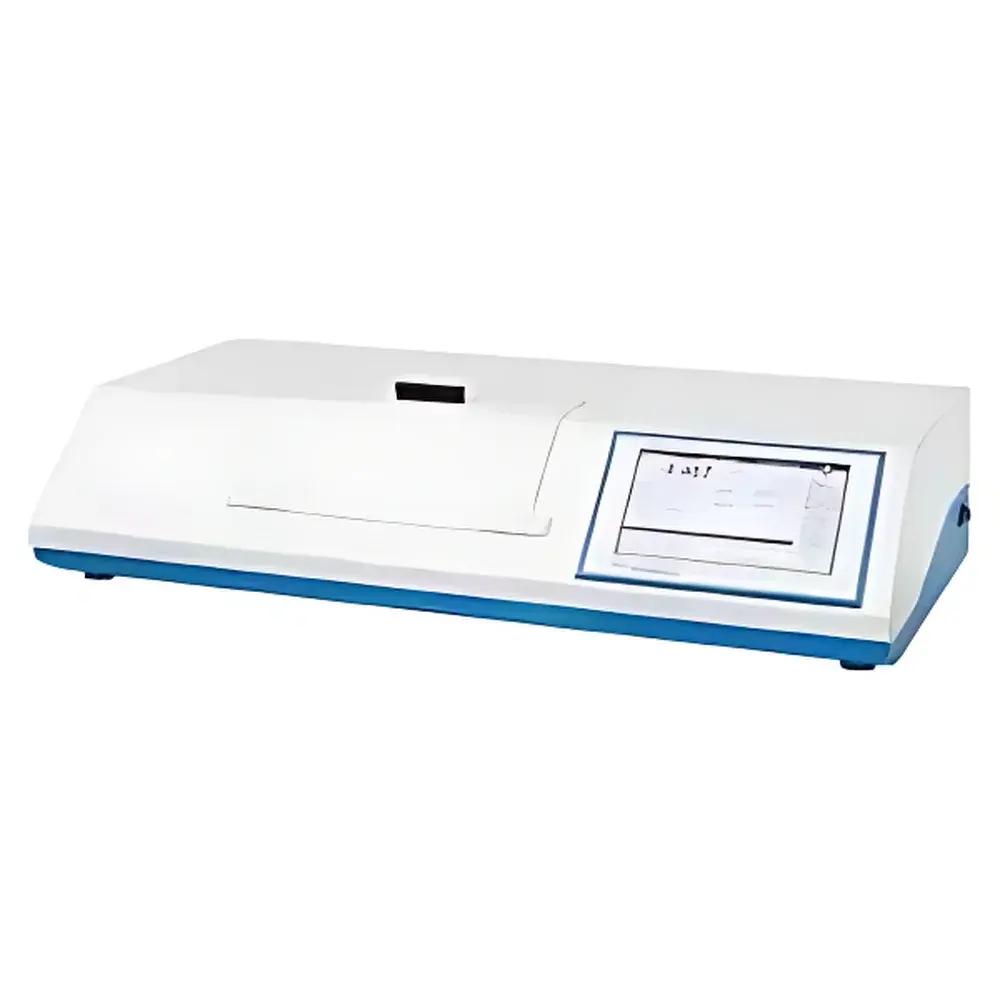
Schmidt+Haensch Saccharomat® Quartz Wedge Saccharimeter
| Brand | Schmidt+Haensch (S+H) |
|---|---|
| Country of Origin | Germany |
| Model | Saccharomat® |
| Measurement Range | –35°Z to +105°Z |
| Resolution | 0.01°Z |
| Accuracy | ±0.02°Z |
| Repeatability | ±0.01°Z |
| Optical Density Limit | OD 5 (Transmittance down to 1×10⁻⁵%) |
| Measurement Time | <4 s |
| Cell Length Options | 50 mm, 100 mm, 200 mm |
| Light Source | LED |
| Wavelengths | 587 nm and/or 882 nm |
| Compensation Principle | Quartz wedge-based optical nulling |
| Calibration | Factory-calibrated |
Overview
The Schmidt+Haensch Saccharomat® is a high-precision, quartz wedge–compensated saccharimeter engineered for absolute stability and long-term metrological reliability in industrial sugar analysis. Unlike conventional polarimeters that rely on angular encoder-based rotation of half-shade or Lippich prisms, the Saccharomat® employs a fixed, optically aligned quartz wedge positioned at a precise oblique angle within the light path. Paired with crossed polarizers (polarizer and analyzer oriented at 90°), the instrument achieves optical nulling by laterally translating the quartz wedge—whose inherent optical rotatory dispersion (ORD) matches that of sucrose across the operational wavelength range. This physical isomorphism between quartz and sucrose eliminates wavelength-dependent systematic error, rendering the system inherently insensitive to minor spectral shifts in the LED source (587 nm and/or 882 nm). As a result, the Saccharomat® delivers traceable, drift-free measurements over decades without periodic recalibration—a critical advantage in continuous QC environments such as beet and cane sugar refineries where regulatory compliance and measurement continuity are mandated under ISO 22000, ICUMSA Method GS4/3-11, and GMP-aligned laboratory practices.
Key Features
- Quartz wedge compensation architecture ensuring intrinsic match to sucrose ORD—eliminates need for wavelength-specific calibration and suppresses thermal and aging-induced drift
- Optical density tolerance up to OD 5 (transmittance = 1×10⁻⁵%), enabled by AutoFilt Z dynamic attenuation—supports direct analysis of highly colored, turbid, or caramelized syrups without NIR modeling or dilution
- Linear displacement encoder system (not angular) for wedge positioning—provides superior linearity, hysteresis-free response, and resolution of 0.01°Z with repeatability of ±0.01°Z
- Dual-wavelength capability (587 nm and 882 nm) compliant with ICUMSA standard measurement protocols for purity assessment and correction of mutarotation effects
- Modular integration interface for co-location with S+H refractometer heads (e.g., Abbemat series), enabling real-time calculation of sugar purity (°Z / °Brix ratio) without manual data transfer
- Robust mechanical design with temperature-stabilized optical bench and sealed LED illumination—rated for 24/7 operation in humid, high-dust industrial labs
Sample Compatibility & Compliance
The Saccharomat® accommodates standard sample cells of 50 mm, 100 mm, and 200 mm path lengths—compatible with ICUMSA-specified cell geometries and ASTM D1092 reference configurations. Its OD 5 performance enables unmodified measurement of dark molasses, inverted syrup, and clarified juice samples directly from production lines. The instrument meets essential regulatory requirements for food-grade analytics: it supports audit-ready data integrity per FDA 21 CFR Part 11 when paired with S+H’s optional LabSoft™ software (with electronic signatures, change control, and full ALCOA+ traceability). All optical components are manufactured to DIN EN ISO 17025–accredited processes at the Berlin facility, and the device is certified CE, RoHS, and ICUMSA-endorsed for official sugar content certification.
Software & Data Management
LabSoft™ Control Suite (v5.2+) provides native instrument control, method storage, and automated report generation compliant with GLP and ISO/IEC 17025 documentation standards. Raw wedge displacement values, OD-corrected readings, dual-wavelength differentials, and timestamped audit trails are stored in encrypted SQLite databases with configurable backup intervals. The software supports direct export to LIMS via ASTM E1384-compliant CSV or XML schemas and includes built-in validation protocols for IQ/OQ/PQ execution. Optional PDF report templates include ICUMSA-formatted certificates of analysis with digital signature fields and embedded measurement uncertainty budgets derived from Type A and Type B evaluations.
Applications
The Saccharomat® is deployed globally in primary sugar manufacturing facilities—including Südzucker AG, Tereos, and ASR Group—for raw material intake (beet/cane juice), intermediate process streams (thin juice, thick juice, massecuite), and final product release (white sugar, liquid sucrose). Its stability under thermal cycling makes it ideal for hot-line monitoring in evaporator stations and centrifugals. Beyond sucrose, the instrument supports quantitative analysis of invert sugar, lactose, and fructose in dairy and confectionery QA/QC labs—provided ORD matching is verified per ICUMSA GS7/3-16. In research settings, its dual-wavelength mode facilitates kinetic studies of mutarotation and hydrolysis kinetics under controlled temperature ramps.
FAQ
Does the Saccharomat® require periodic recalibration?
No. Due to the physical ORD equivalence between quartz and sucrose, the zero point remains invariant over time and temperature. Only initial factory calibration is required; no user recalibration is specified in the operating manual or ICUMSA guidelines.
Can it measure samples with very low transmittance, such as blackstrap molasses?
Yes. With AutoFilt Z active, the system dynamically adjusts optical gain to maintain signal-to-noise ratio at OD 5, eliminating the need for dilution or NIR modeling—unlike conventional polarimeters limited to OD ≤ 2.5.
Is dual-wavelength operation mandatory for routine sugar analysis?
Not mandatory, but recommended for purity calculations and correction of anomeric equilibrium shifts. ICUMSA mandates 587 nm for standard °Z reporting; 882 nm is used for OD correction and mutarotation compensation per GS4/3-11 Annex B.
How is measurement traceability ensured?
Each instrument ships with a DIN EN ISO/IEC 17025–accredited calibration certificate referencing NIST-traceable quartz wedge standards and sucrose reference materials (NIST SRM 84d). Uncertainty budgets are provided per GUM (JCGM 100:2008).




