
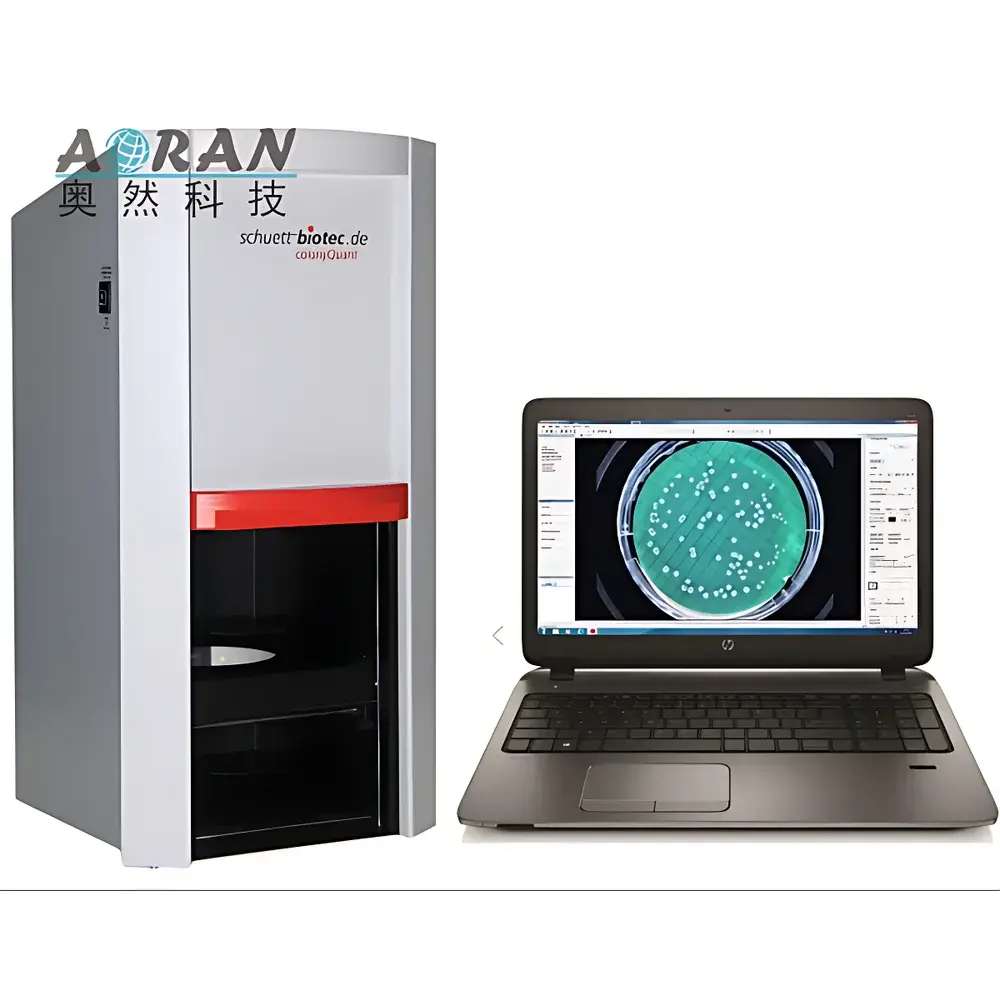
Schuett-biotec ColonyQuant Automated Colony Counter
| Brand | Schuett-biotec |
|---|---|
| Origin | Germany |
| Model | ColonyQuant |
| Instrument Type | Fully Automated Colony Counter |
| Sample Types | Solid Agar Plates, Spiral Plates |
| Counting Speed | 400 plates/hour |
| Minimum Detectable Colony Size | 0.05 mm |
| Camera Resolution | 1920 × 1080 pixels (Auto-Focus CCD) |
| Illumination | Bottom-, Side-, and Top-Lighting LED System |
| Enclosure | Light-Tight Dark Chamber |
| Compliance | GLP-Compliant |
| Dimensions (W×H×D) | 240 × 460 × 240 mm |
| Weight | 11 kg |
| Power Supply | 230 V, 50 Hz, 60 W |
| Interface | FireWire (IEEE 1394) |
Overview
The Schuett-biotec ColonyQuant Automated Colony Counter is an ISO 17025-aligned, GLP-compliant digital imaging system engineered for high-throughput, objective, and traceable microbial colony enumeration in regulated and research environments. It employs high-resolution monochrome CCD imaging combined with multi-angle LED illumination (bottom-transmitted, side-diffused, and top-reflected) to generate consistent contrast across diverse agar formulations—including chromogenic, fluorogenic, selective, and dark-pigmented media. Unlike manual or semi-automated counters, the ColonyQuant applies pixel-level morphometric analysis to distinguish colonies by size, shape, intensity gradient, edge sharpness, and spectral reflectance—enabling reliable detection of colonies as small as 0.05 mm in diameter on standard 60 mm and 90 mm Petri dishes. Its optical architecture eliminates parallax error and shadow artifacts common in single-source lighting systems, ensuring reproducible results across operator shifts and laboratory sites.
Key Features
- Fully automated counting workflow: One-click transition between standard plate mode, spiral plate analysis, inhibition zone measurement, and Ames assay microcolony detection.
- Multi-spectral illumination control: Independently adjustable bottom, side, and top LED arrays optimize contrast for translucent, opaque, pigmented, or fluorescent colonies without manual filter changes.
- Advanced image segmentation engine: Incorporates adaptive thresholding, watershed splitting, and user-defined morphological templates to resolve clustered, overlapping, or irregularly shaped colonies—even at densities up to 1000 CFU per plate.
- Color discrimination capability: Supports simultaneous identification and quantification of up to eight spectrally distinct colony types on a single plate using customizable RGB/HSL thresholds.
- Regulatory-ready data integrity: All raw images, processed overlays, parameter settings, and timestamps are stored with immutable audit trails compliant with FDA 21 CFR Part 11 requirements when integrated with validated LIMS or ELN platforms.
- Compact benchtop footprint (240 × 460 × 240 mm) with low-power consumption (60 W), designed for integration into biosafety cabinets or ISO Class 5 cleanroom environments.
Sample Compatibility & Compliance
The ColonyQuant accommodates standard microbiological sample formats including pour plates, spread plates, membrane filtration units, and spiral dilution plates. It supports routine enumeration on non-selective (e.g., Tryptic Soy Agar), selective (e.g., MacConkey, XLD), chromogenic (e.g., CHROMagar™), and fluorogenic substrates (e.g., BLA, RAPID’E. coli). Validation studies confirm accuracy within ±3% relative standard deviation (RSD) against reference plate counts across 15+ species—including Escherichia coli, Salmonella enterica, Staphylococcus aureus, and Pseudomonas aeruginosa. The system meets ISO 4833-2:2013 (microbiology of food and animal feeding stuffs), ASTM E2923-21 (standard guide for validation of digital colony counters), and EU Pharmacopoeia 2.6.12 (microbiological examination of non-sterile products). Full GLP documentation packages—including IQ/OQ/PQ protocols, calibration certificates, and traceable reference standards—are available upon request.
Software & Data Management
ColonyQuant Control Software v5.x provides a validated, role-based interface with configurable user permissions, electronic signatures, and version-controlled method templates. Each analysis session generates a ZIP archive containing TIFF-formatted raw images, annotated PNG overlays, CSV summary reports, and XML metadata files adhering to MIAME-compliant structure. Export options include Excel-compatible spreadsheets with automatic dilution factor propagation, PDF analytical reports with embedded QC metrics, and direct SQL database ingestion via ODBC drivers. Audit trail logs record every user action—including parameter edits, image reprocessing, and result overrides—with timestamp, IP address, and Windows AD credentials. Optional integration with Thermo Fisher SampleManager LIMS or LabVantage supports end-to-end sample-to-report traceability under GMP conditions.
Applications
- Food & beverage quality control: Enumeration of total viable count (TVC), coliforms, E. coli, and pathogens in raw materials, finished products, and environmental swabs.
- Pharmaceutical microbiology: Bioburden testing per USP , sterility test support, and antimicrobial efficacy evaluation (e.g., zone-of-inhibition measurements per USP ).
- Clinical & public health laboratories: Rapid processing of clinical isolates, water safety testing (ISO 9308-1), and AMES mutagenicity assay scoring.
- Academic & industrial R&D: High-throughput screening of antimicrobial compounds, probiotic viability assays, and biofilm detachment quantification on agar-embedded carriers.
- Environmental monitoring: Air and surface sampling analysis per ISO 14698-1, including low-biomass samples requiring enhanced sensitivity.
FAQ
Does the ColonyQuant require external calibration standards?
No—built-in geometric and photometric calibration routines execute automatically during startup using embedded reference targets. NIST-traceable verification slides are recommended annually.
Can it process plates with condensation or scratches?
Yes—the software includes dew detection algorithms and localized contrast normalization to suppress artifacts while preserving colony integrity.
Is spiral plate analysis validated per ISO 7218?
Yes—method validation data demonstrates linearity (R² ≥ 0.998) and recovery (92–105%) across 10²–10⁶ CFU/mL dilutions using standardized spiral platers.
What file formats are supported for data export?
TIFF (raw), PNG (annotated), CSV (tabular results), PDF (formatted reports), XML (metadata), and direct SQL insertion via ODBC.
How is software validation handled for regulated environments?
Schuett-biotec provides full GAMP 5-compliant validation documentation, including risk assessments, URS, FRS, and executed IQ/OQ/PQ protocols—all editable in Word/PDF format for internal QA review.




