
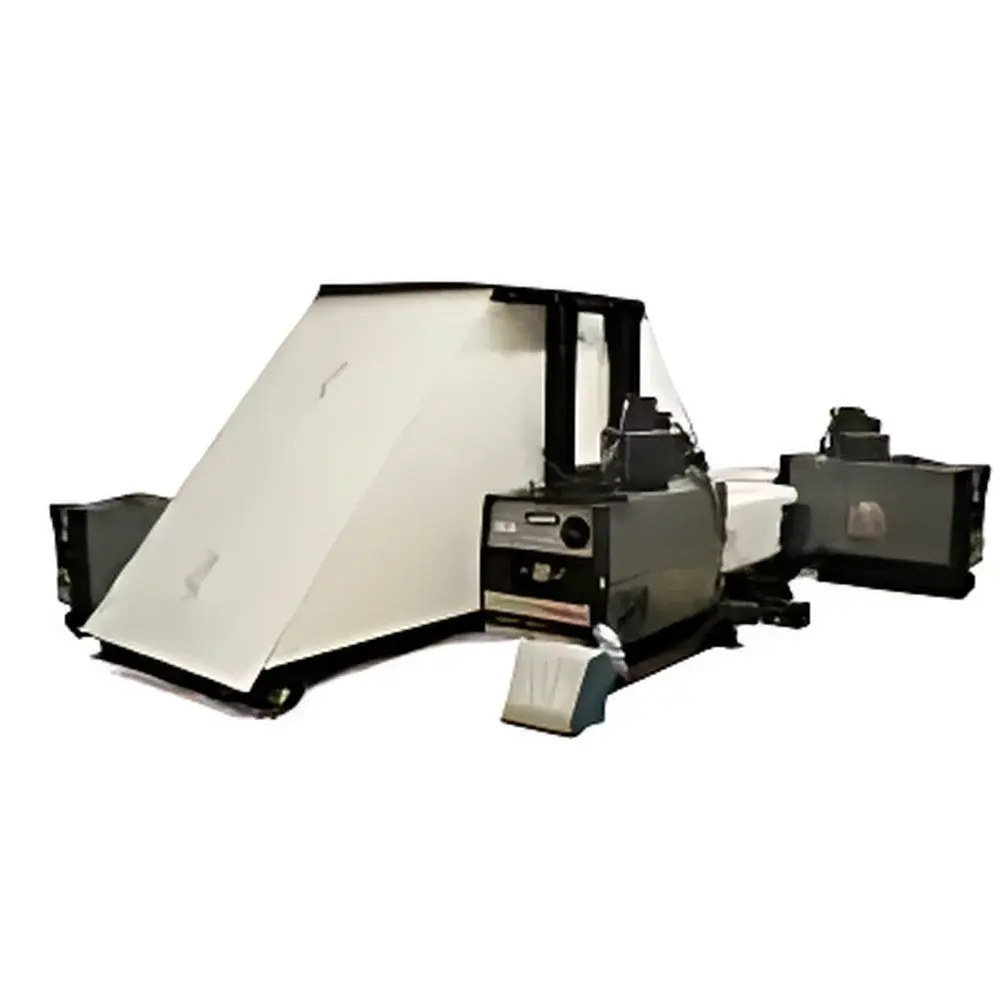
Sciencetech SS 7.5KW Solar Simulator
| Brand | Sciencetech |
|---|---|
| Origin | Canada |
| Model | SS 7.5KW |
| Total Output at Target Area | 1 Sun (1000 W/m²) |
| Uniformity | ±2% over 30 × 30 cm |
| Short-Term Power Stability | ±1% after 30 min |
| Long-Term Power Stability | −20% (lamp aging dependent) |
| Cooling | Air-cooled |
| Optional Features | Electronic shutter, optical feedback stabilization, spectral tuning via removable reflectors/filters |
| Dimensions (excl. power supply) | 2.6035 × 1.5875 × 1.0795 m |
Overview
The Sciencetech SS 7.5KW Solar Simulator is a high-power, Class AAA-compliant broadband light source engineered for photovoltaic (PV) device testing, materials degradation studies, and accelerated environmental exposure protocols under controlled terrestrial solar irradiance conditions. It integrates three independently operated Sciencetech SS 2.5kW full-reflection xenon arc lamp modules—each rated at 2.5 kW—configured in a collimated array to deliver spatially uniform irradiance across a 30 × 30 cm target plane. The system operates on the principle of broadband spectral synthesis, utilizing high-pressure xenon short-arc lamps with precisely engineered ellipsoidal reflectors and secondary optical conditioning elements to approximate ASTM E927-22 and IEC 60904-9 Ed. 3 spectral match (Class A), spatial uniformity (Class A), and temporal stability (Class A) requirements. Unlike pulsed or LED-based simulators, this continuous-wave (CW) architecture supports real-time current–voltage (I–V) characterization, thermal equilibrium studies, and long-duration aging tests where steady-state photon flux is critical.
Key Features
- Triple-module architecture delivering scalable total output up to 7.5 kW optical power, enabling high-flux testing beyond standard 1-Sun conditions when configured for concentrated illumination.
- Guaranteed irradiance uniformity of ±2% across the full 30 × 30 cm test plane, validated per ISO 9050 and IEC 60904-9 Annex B procedures using calibrated reference cells and scanning radiometers.
- Air-cooled thermal management system minimizing infrastructure requirements while maintaining stable lamp junction temperatures during extended operation cycles.
- Optional electronic fast shutter (sub-10 ms actuation) for precise exposure timing control—essential for transient photoresponse analysis and synchronization with external measurement systems.
- Real-time optical feedback loop (optional) employing a reference photodiode array and closed-loop lamp current modulation to maintain ±1% short-term irradiance stability over 30-minute intervals.
- Spectral tunability via interchangeable reflective optics and bandpass filters, supporting customized irradiance profiles for UV-enhanced degradation, IR-heating isolation, or AM1.5G spectral refinement.
Sample Compatibility & Compliance
The SS 7.5KW accommodates flat-panel samples up to 30 × 30 cm in dimension, including silicon, perovskite, CIGS, and organic PV devices; thin-film coatings; and polymer-based encapsulants. Its open-beam geometry allows integration with environmental chambers, temperature-controlled stages, and in-situ electrical biasing rigs. The system complies with international standards governing solar simulation performance: IEC 60904-9:2020 (Class AAA rating achievable with optional spectral correction), ASTM E927-22 (for spectral match and uniformity verification), and ISO 8980-3 (for irradiance homogeneity assessment). All optical components—including fused silica windows, dichroic reflectors, and interference filters—are certified for UV durability and low outgassing, meeting NASA-STD-6002 and ECSS-Q-ST-70-02C specifications for space-grade material testing environments.
Software & Data Management
Control and monitoring are implemented through Sciencetech’s proprietary SimuControl Suite, a Windows-based application supporting IEEE-488 (GPIB), USB 2.0, and Ethernet TCP/IP interfaces. The software provides synchronized logging of irradiance intensity, lamp current/voltage, shutter status, and ambient temperature at user-defined intervals (down to 100 ms resolution). Audit-trail functionality records all parameter changes with timestamped operator ID—supporting GLP/GMP-aligned workflows. Export formats include CSV, HDF5, and MATLAB-compatible .mat files. For regulatory compliance, optional 21 CFR Part 11 modules enable electronic signatures, role-based access control, and immutable data archiving—validated per IQ/OQ protocols upon installation.
Applications
- Primary and secondary calibration of reference solar cells and pyranometers against traceable NIST SRM standards.
- Stability and lifetime assessment of emerging PV technologies under ISOS-L-1 and ISOS-D-1 protocols.
- Photochemical degradation kinetics of UV-curable resins, OLED emissive layers, and aerospace-grade polymers.
- Thermal stress mapping of multi-junction concentrator cells using infrared thermography synchronized with irradiance modulation.
- Validation of optical concentrator designs via far-field irradiance profiling and étendue matching analysis.
FAQ
What lamp technology does the SS 7.5KW use, and what is its typical operational lifetime?
It employs water-cooled, high-pressure xenon short-arc lamps (model-specific, e.g., XBO 2500 W/HS), with a rated lifetime of 1,000–1,500 hours at nominal current. Lamp aging contributes to the observed −20% long-term drift; replacement intervals are tracked via integrated hour-meter logging.
Can the system be upgraded to meet Class AAB or AAA spectral match requirements?
Yes—through optional spectral correction filters, calibrated reflector alignment kits, and post-installation IEC 60904-9 validation services provided by Sciencetech’s metrology team.
Is remote operation supported for unattended long-duration tests?
Yes—via Ethernet-enabled controller with TLS-secured REST API, enabling integration into LabVIEW, Python, or custom SCADA environments for automated test sequencing and failure-mode detection.
Does the system include radiometric calibration documentation?
Each unit ships with a NIST-traceable calibration certificate covering spectral irradiance (W/m²/nm), spatial uniformity map, and temporal stability report—valid for 12 months from date of shipment.
What safety interlocks are integrated?
Interlocked access doors, lamp housing overtemperature cutoff, emergency stop circuitry compliant with IEC 60204-1, and UV-shielded viewing window with EN 170-rated filter.




