
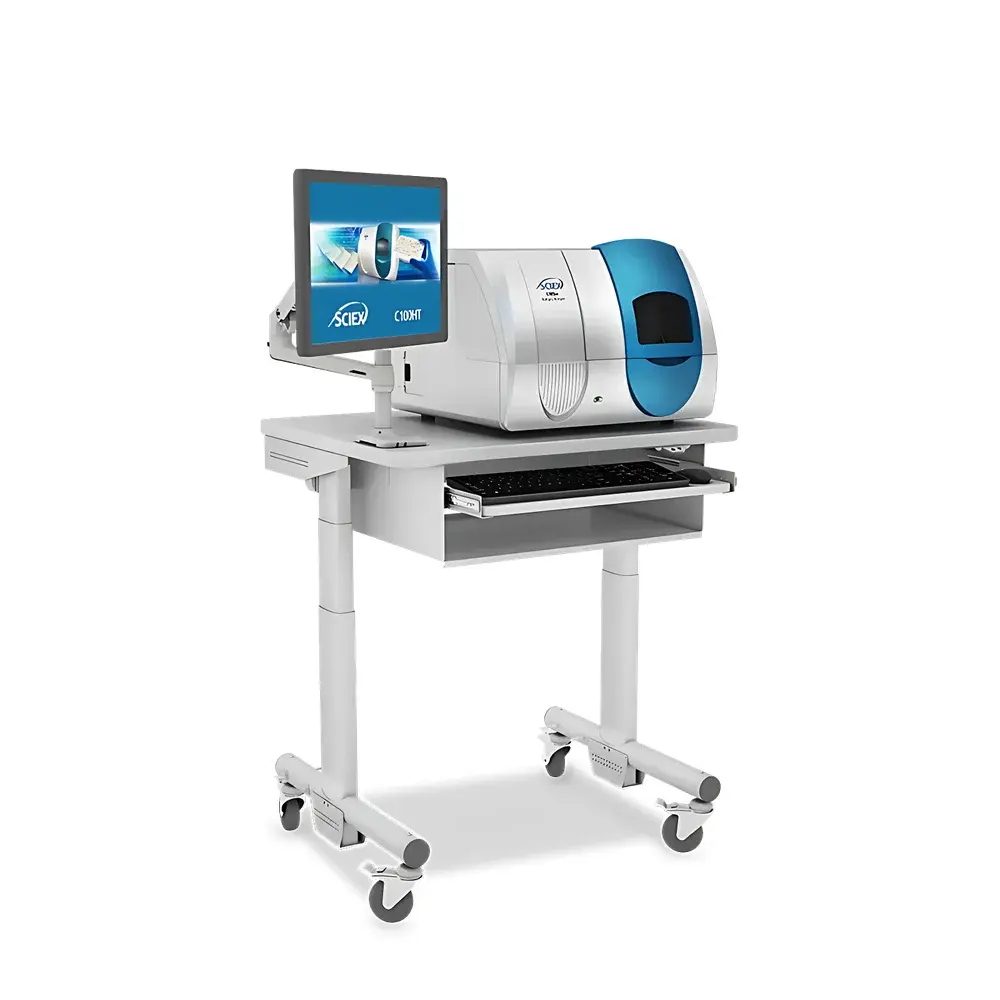
SCIEX C100 HT High-Throughput Capillary Electrophoresis System
| Brand | SCIEX |
|---|---|
| Origin | USA |
| Model | C100 HT |
| Instrument Type | Capillary Electrophoresis (CE) |
| Sample Type | Organic Analysis |
| Voltage Range | 1–25 kV |
| Detection Modes | UV and Laser-Induced Fluorescence (LIF) |
| Injection Method | Pressure-driven |
| Pressure Range | 5–100 psi |
| Cooling System | Liquid-based Temperature Control |
| Operating Mode | Constant Current |
Overview
The SCIEX C100 HT High-Throughput Capillary Electrophoresis System is an engineered solution for rapid, reproducible glycan and glycoprotein analysis in biopharmaceutical development and quality control. Built upon SCIEX’s proprietary separation chemistry platform, the C100 HT leverages capillary electrophoresis principles—electrokinetic separation under high electric fields in fused-silica capillaries—to resolve structurally similar glycans with high resolution and minimal sample consumption. Unlike conventional HILIC-UPLC or MALDI-TOF workflows, CE-based analysis offers superior selectivity for neutral and sialylated glycans without derivatization, enabling direct quantitation of microheterogeneity profiles critical for biosimilarity assessment, lot release, and process characterization. The system is optimized for integration into upstream and downstream bioprocess workflows—including clone selection, cell culture optimization, and stability studies—where timely analytical feedback directly impacts decision latency and development timelines.
Key Features
- High-throughput 96-well plate compatibility with fully automated sample preparation and injection, completing up to 96 glycan analyses in under two hours.
- Programmable voltage control (1–25 kV) and constant-current operation ensure stable electroosmotic flow and migration time reproducibility across runs.
- Dual-detection capability: simultaneous UV absorbance (190–400 nm) and laser-induced fluorescence (LIF) detection enables sensitive, label-free or labeled glycan profiling—critical for low-abundance species and native glycan mapping.
- Liquid-cooled capillary cartridge holder maintains precise thermal control (±0.1 °C), minimizing Joule heating effects and ensuring retention time stability over extended run sequences.
- Pressure-driven sample introduction (5–100 psi) provides robust, low-crosstalk injection for viscous or particulate-containing samples common in enzymatically released glycan preparations.
- Ergonomic, height-adjustable mobile workbench facilitates seamless integration into ISO-classified labs and GMP-compliant environments without fixed infrastructure requirements.
Sample Compatibility & Compliance
The C100 HT supports analysis of N-linked and O-linked glycans released via PNGase F, O-glycosidase, or chemical methods (e.g., hydrazinolysis), as well as intact glycopeptides and small-molecule metabolites. It accommodates derivatized (e.g., 2-AB, Procainamide) and underivatized samples, with demonstrated performance in ICH Q5B-aligned glycan mapping studies. The system architecture complies with design controls per 21 CFR Part 820 and supports audit-trail-enabled operation under FDA 21 CFR Part 11 when deployed with validated software configurations. All method parameters—including voltage ramping, current limits, detection gain, and temperature setpoints—are electronically logged and exportable for GLP/GMP documentation.
Software & Data Management
Powered by SCIEX OS Software, the C100 HT provides intuitive method building, real-time electropherogram visualization, and integrated peak integration using adaptive baseline algorithms. Raw data are stored in vendor-neutral .wiff format and can be exported to third-party platforms (e.g., Waters Empower, Thermo Chromeleon) via ASCII or mzML conversion. Glycan assignment is supported through embedded libraries referencing UniCarb-DB and GlyConnect standards, with optional integration into BioPharmaView™ for multi-attribute monitoring (MAM) reporting. All user actions, method changes, and instrument events are timestamped and archived with role-based access control—enabling full traceability for regulatory submissions and internal QA review.
Applications
- Rapid clone screening during early-stage cell line development, correlating glycosylation profiles with titer and stability metrics.
- In-process monitoring of glycan distribution shifts during fed-batch or perfusion bioreactor runs.
- Comparability assessments across manufacturing scales and process changes per ICH Q5E guidance.
- Stability-indicating assays tracking sialic acid loss, galactose exposure, or high-mannose accumulation under accelerated stress conditions.
- Supporting regulatory filings with orthogonal glycan data compliant with USP , EP 2.2.46, and WHO TRS 1014 Annex 3 requirements.
FAQ
What types of glycan labeling strategies are compatible with the C100 HT?
The system supports both fluorescent (e.g., 2-AB, RapiFluor-MS) and non-fluorescent (native) glycan analysis; LIF detection requires labeling, while UV detection enables label-free quantitation of aromatic-tagged or naturally absorbing species.
Can the C100 HT be used for intact glycopeptide analysis?
Yes—when coupled with appropriate digestion protocols and optimized CE buffers, the system resolves glycopeptide positional isomers and macroheterogeneity with sub-minute resolution.
Is method transfer from legacy CE systems feasible?
SCIEX provides migration support packages including capillary conditioning protocols, buffer formulation guides, and alignment templates to ensure consistent performance across instrument generations.
Does the liquid cooling system require external chillers or recirculators?
The integrated liquid-cooling module operates autonomously; no external chiller is required for standard operation within ambient lab temperatures (18–25 °C).
How is data integrity ensured during long unattended runs?
Real-time checksum validation, automatic file backup on dual storage paths, and hardware-triggered power-fail recovery prevent data loss during extended 24/7 operation sequences.





