
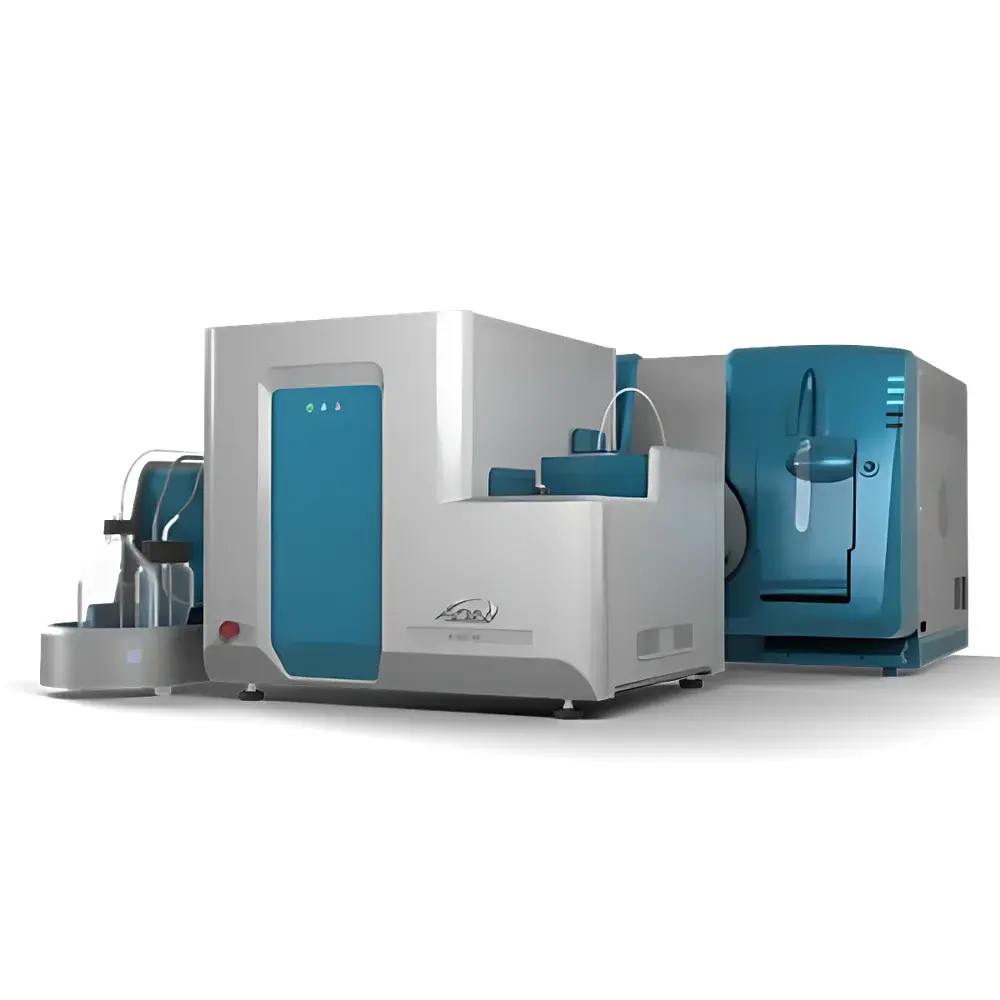
SCIEX Echo MS Acoustic Ejection Mass Spectrometry System
| Brand | SCIEX |
|---|---|
| Origin | USA |
| Model | Echo MS |
| Instrument Type | Ultra-High-Throughput Direct-Infusion Mass Spectrometry System |
| Application Scope | Universal Quantitative Bioanalysis |
| Regulatory Context | Designed for GLP/GMP-aligned workflows, compatible with FDA 21 CFR Part 11-compliant data management frameworks |
| Sample Introduction Method | Contactless Acoustic Droplet Ejection (ADE) coupled to triple quadrupole mass spectrometry |
Overview
The SCIEX Echo MS Acoustic Ejection Mass Spectrometry System represents a paradigm shift in quantitative bioanalysis by eliminating chromatographic separation and replacing conventional autosampler-based liquid introduction with contactless acoustic droplet ejection (ADE). Engineered for ultra-high-throughput direct-infusion mass spectrometry, the system integrates SCIEX’s industry-proven triple quadrupole (QqQ) mass spectrometer platform with a precision acoustic dispenser capable of transferring sub-microliter sample volumes—typically 2.5 nL—with nanoliter-level accuracy. This architecture enables true high-speed, serial analysis at up to three samples per second, delivering quantitative performance comparable to LC-MS/MS but without gradient elution, column equilibration, or carryover-related downtime. The core measurement principle relies on electrospray ionization (ESI) coupled to multiple reaction monitoring (MRM), where analyte-specific precursor-to-product ion transitions are monitored with high selectivity and sensitivity. Unlike traditional LC-MS/MS methods requiring 30–120 seconds per sample, Echo MS achieves full quantitation in under 300 ms—reducing assay cycle time from weeks to days while maintaining robust linearity, precision, and accuracy across complex biological matrices including plasma, serum, cell lysates, and tissue homogenates.
Key Features
- Contactless sample introduction via acoustic droplet ejection (ADE), eliminating pipette tips, syringes, and fluidic pathways—minimizing cross-contamination and maintenance burden.
- Native integration with SCIEX QTRAP® or Triple Quad™ mass spectrometers, leveraging proven MRM sensitivity, dynamic range (>5 logs), and low-picogram detection limits.
- Real-time, software-synchronized ejection and acquisition: each acoustic pulse triggers immediate MS data capture, ensuring temporal alignment between droplet delivery and spectral acquisition.
- Automated calibration and normalization using internal standards co-ejected with each sample, supporting ratio-based quantitation without post-acquisition correction.
- Modular hardware design compliant with standard 96-, 384-, and 1536-well microplate formats—enabling seamless integration into existing HTS laboratory automation ecosystems.
- Robust thermal and vibration isolation architecture to maintain acoustic transducer stability during extended unattended operation (≥72 h).
Sample Compatibility & Compliance
The Echo MS System is validated for use with small-molecule pharmaceuticals, peptides, metabolites, and lipids across diverse biological matrices. It supports both protein precipitation and organic solvent-based extraction workflows—no derivatization or cleanup steps are required prior to plate loading. All instrument control, data acquisition, and processing comply with analytical method validation guidelines outlined in ICH M10 and USP . Audit trails, electronic signatures, and user-access controls align with FDA 21 CFR Part 11 requirements when deployed with compliant LIMS or CDS platforms. The system has been successfully implemented in regulated environments supporting clinical trial bioanalysis, pharmacokinetic studies, and toxicology screening under GLP conditions.
Software & Data Management
Echo MS is operated through SCIEX OS software v2.4 or later, which provides unified control of both acoustic ejection parameters (frequency, amplitude, focus depth) and mass spectrometer acquisition methods (dwell time, collision energy, declustering potential). Raw data files (.wiff) are generated in vendor-native format and fully compatible with SCIEX MultiQuant™ MD software for automated peak integration, calibration curve fitting (weighted 1/x²), and QC acceptance criteria evaluation (e.g., back-calculated standards within ±15% deviation). Data export supports CSV, XML, and SDMX formats for downstream statistical analysis in R, Python (via pyOpenMS), or commercial biostatistics packages. All audit logs—including ejection event timestamps, MS acquisition start/stop markers, and user login/logout records—are retained for ≥10 years as required by GxP data retention policies.
Applications
- High-throughput ADME/PK screening during early drug discovery—enabling >10,000 compounds analyzed per week with full quantitative reporting.
- Metabolomics and lipidomics profiling where rapid turnover of biological replicates demands minimal dwell time between injections.
- Cell-based assay readouts (e.g., cAMP, ATP, cytokine secretion) coupled to endogenous biomarker quantitation in multiplexed formats.
- Reference standard dilution series verification and working stock stability assessment without re-injection delays.
- Method development acceleration—comparing extraction efficiency, matrix effects, and ion suppression across dozens of sample prep protocols in parallel.
FAQ
How does Echo MS achieve quantitative accuracy without chromatographic separation?
It relies on optimized ESI source conditions, narrow MRM dwell times, and rigorous internal standard co-ejection to correct for ionization variability—validated against orthogonal LC-MS/MS methods per ICH M10 guidance.
Is the system compatible with existing SCIEX mass spectrometers?
Yes—Echo MS interfaces directly with Triple Quad 6500+ and QTRAP 6500+ systems via proprietary digital synchronization modules; retrofit kits are available for qualified legacy platforms.
What sample volume is required per analysis?
Typical ejection volume is 2.5 nL per pulse; total assay consumption ranges from 10–50 nL depending on replicate count and calibration scheme.
Can it handle viscous or particulate-containing samples?
Samples must be filtered (≤0.22 µm) and diluted to ≤10% organic content; viscosity above 10 cP requires pre-dilution to ensure reliable acoustic coupling.
Does Echo MS support structural identification or only quantitation?
It is primarily designed for targeted quantitation; untargeted MS/MS scanning is possible but not optimized for library matching due to transient signal duration and lack of retention time anchoring.





