
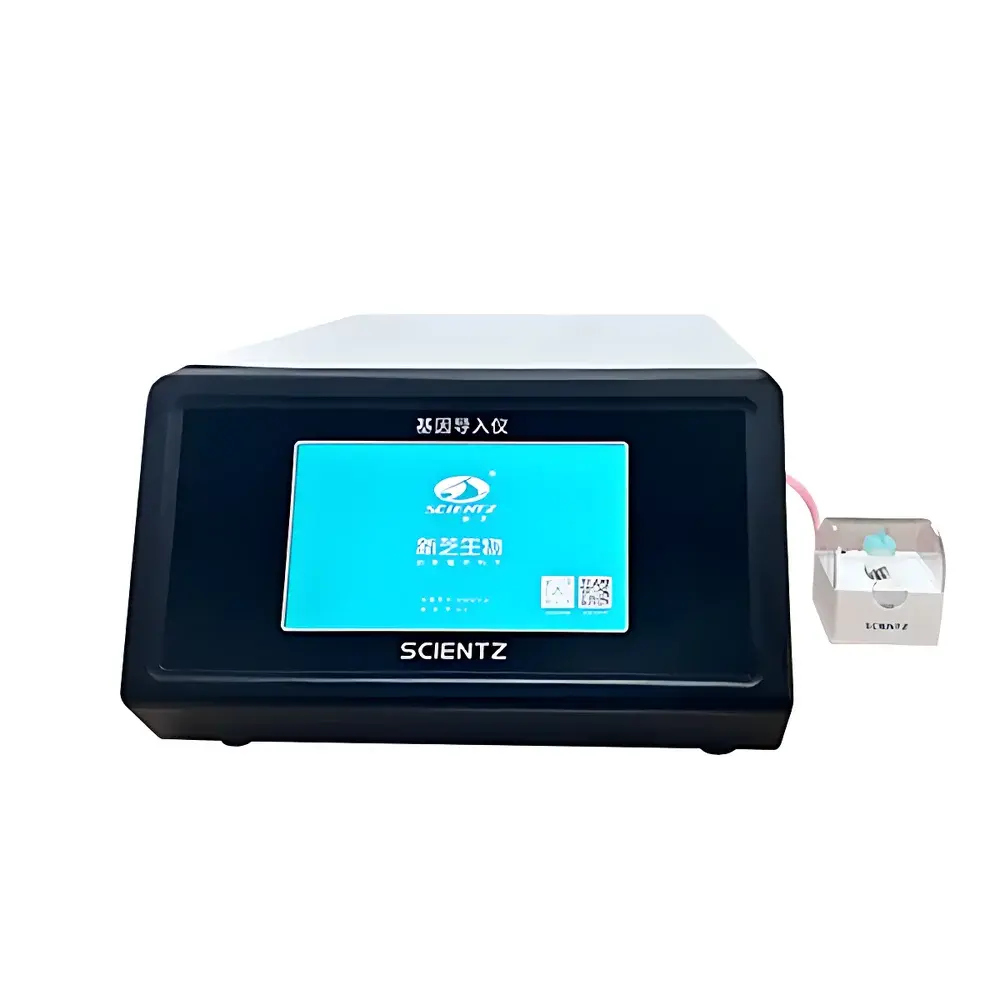
SCILOGEX SCIENTZ-2CS Electroporator
| Brand | SCILOGEX (SCIENTZ) |
|---|---|
| Model | SCIENTZ-2CS |
| Origin | Zhejiang, China |
| Manufacturer | SCILOGEX Instrument Co., Ltd. |
| Type | Benchtop Capacitance-Variable Electroporator |
| High-Voltage Range | 400–2500 V |
| Low-Voltage Range | 50–450 V |
| Capacitance Options | 1, 5, 6, 25, 30, 31 µF |
| Resistance Settings | 30 discrete values (50, 100, 150, 1600 Ω, and open-circuit/∞) |
| Pulse Decay Profile | Exponential decay |
| Compliance | CE-marked |
| Sample Compatibility | Standard 0.1 cm, 0.2 cm, and 1.0 cm electroporation cuvettes (not included) |
Overview
The SCILOGEX SCIENTZ-2CS Electroporator is a benchtop, microprocessor-controlled electroporation system engineered for high-efficiency, reproducible nucleic acid and macromolecule delivery into prokaryotic and eukaryotic cells. It operates on the physical principle of transient electroporation—applying controlled exponential-decay voltage pulses across a conductive cell suspension to induce nanoscale, reversible pores in the phospholipid bilayer. Unlike chemical or viral transfection methods, electroporation bypasses receptor dependency and endosomal entrapment, enabling consistent delivery across diverse cell types—including Escherichia coli, Saccharomyces cerevisiae, mammalian adherent and suspension lines (e.g., HEK293, CHO, Jurkat), plant protoplasts, and primary cells—with minimal genotoxic risk. The instrument’s core architecture leverages precise capacitor-resistor network tuning to deliver defined electric field strengths (V/cm) and pulse time constants (τ = R × C), ensuring deterministic membrane permeabilization while preserving >85% post-pulse viability under optimized conditions.
Key Features
- Capacitance & Resistance Flexibility: Six discrete capacitance values (1–31 µF) and 30-step resistance selection (50 Ω to ∞) allow fine-tuned adjustment of pulse decay kinetics—critical for balancing transfection efficiency and cell survival across divergent cell sizes and membrane resistances.
- Wide Voltage Range: Dual-range output (50–450 V low-voltage mode; 400–2500 V high-voltage mode) supports both sensitive mammalian cells and robust bacterial strains without hardware reconfiguration.
- Microprocessor-Controlled Discharge: Digital timing circuitry ensures sub-millisecond pulse consistency and eliminates analog drift, delivering high inter-run reproducibility (CV < 3% for identical parameter sets).
- Parameter Memory Function: Stores up to 10 user-defined protocols with full voltage, capacitance, and resistance settings—enabling rapid recall and standardized workflows in GLP-compliant labs.
- Integrated Safety Architecture: Automatic discharge detection, short-circuit protection, and insulated cuvette chamber meet IEC 61010-1 requirements for Class II laboratory equipment.
Sample Compatibility & Compliance
The SCIENTZ-2CS is compatible with standard sterile, pre-calibrated electroporation cuvettes (0.1 cm, 0.2 cm, and 1.0 cm gap widths), enabling field strength calibration (V/cm = applied voltage ÷ gap distance). It supports common biological matrices: chemically competent E. coli (DH5α, BL21), electrocompetent yeast, suspension-grown mammalian cells (e.g., K562, U937), adherent monolayers (after trypsinization), plant protoplasts, and insect Sf9 cells. All operational parameters align with established electroporation guidelines in ASTM E2523-21 (Standard Guide for Electroporation of Microorganisms) and ISO/IEC 17025-accredited validation frameworks. While not FDA 21 CFR Part 11–certified out-of-box, audit-ready parameter logs and manual protocol documentation support GMP/GLP traceability when integrated into validated SOPs.
Software & Data Management
The SCIENTZ-2CS operates via front-panel keypad navigation with real-time LED display of selected voltage, capacitance, and resistance values. It does not include embedded data logging or USB/PC connectivity; however, experimental metadata—including operator ID, date/time stamp, and full parameter set—is manually recordable in lab notebooks or LIMS-integrated electronic records. For regulatory environments, users may implement external timestamped video recording of parameter entry and cuvette insertion as part of process verification. Protocol storage is non-volatile and persists through power cycling.
Applications
- High-efficiency plasmid DNA transformation in E. coli and Bacillus spp., achieving >1 × 10⁹ CFU/µg pUC19 under optimized 2.5 kV, 25 µF, 200 Ω conditions.
- siRNA and CRISPR-Cas9 RNP delivery into hard-to-transfect primary T cells and dendritic cells using low-voltage exponential pulses (120–350 V, 6–25 µF).
- Stable line generation via co-electroporation of linearized vector + homology-directed repair templates in CHO-K1 cells.
- Transient expression screening in plant protoplasts (e.g., Arabidopsis thaliana) using 400–600 V pulses with 1–5 µF capacitance.
- Non-nucleic acid delivery: intracellular introduction of fluorescent dextrans (10–70 kDa), antibodies, and small-molecule inhibitors for functional phenotyping.
FAQ
What cell types are compatible with the SCIENTZ-2CS?
Mammalian cell lines, primary cells, bacteria, yeast, fungi, plant protoplasts, and insect cells—all provided appropriate cuvette gap width and empirically optimized voltage/capacitance/resistance combinations are used.
Is the SCIENTZ-2CS suitable for CRISPR editing workflows?
Yes—its exponential decay profile and precise low-voltage control enable efficient RNP delivery into sensitive cells, supporting high-fidelity HDR-mediated knock-in when combined with Cas9-sgRNA ribonucleoprotein complexes.
Does the instrument support square-wave or multipulse protocols?
No—the SCIENTZ-2CS delivers only single exponential-decay pulses. Square-wave or multi-pulse electroporation requires dedicated programmable systems (e.g., BTX ECM 830 or Harvard Apparatus ECM 880).
How is field strength calculated on this device?
Field strength (V/cm) = Applied voltage (V) ÷ Cuvette gap distance (cm); users must select cuvettes with known, calibrated gap widths (e.g., 0.2 cm) to ensure accurate dosing.
Can the SCIENTZ-2CS be validated for regulated GMP production?
While the unit itself lacks built-in 21 CFR Part 11 features, its deterministic analog circuitry, stable component tolerances, and repeatable output characteristics permit IQ/OQ/PQ validation when paired with documented calibration procedures and environmental monitoring.
Related Products



