
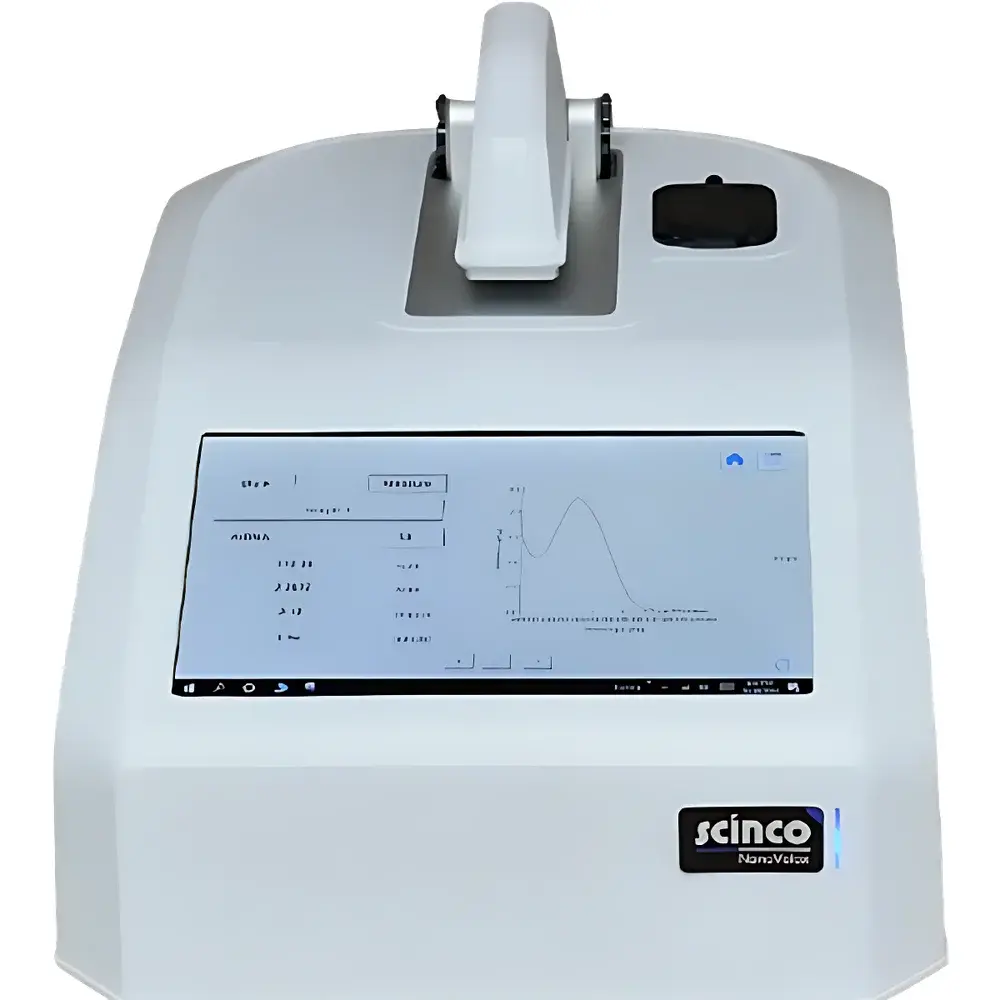
SCINCO NanoVelox Ultra-Micro UV-Vis Spectrophotometer
| Brand | SCINCO |
|---|---|
| Origin | South Korea |
| Model | NanoVelox |
| Wavelength Range | 190–900 nm |
| Wavelength Accuracy | ≤ ±1 nm |
| Sample Volume (Cuvette Mode) | 0.5 µL |
| dsDNA Quantification Range | 2–27,500 ng/µL |
| BSA Quantification Range | 0.06–820 mg/mL |
| Measurement Time | < 8 seconds per sample |
| Operation | Standalone touchscreen interface with internal storage |
Overview
The SCINCO NanoVelox Ultra-Micro UV-Vis Spectrophotometer is an engineered solution for precise nucleic acid and protein quantification in resource-constrained or high-throughput laboratory environments. Based on dual-beam optical architecture with a high-stability deuterium/tungsten-halogen light source and a 256-pixel linear CCD array detector, the instrument delivers full-spectrum acquisition (190–900 nm) with ≤ ±1 nm wavelength accuracy—ensuring compliance with ISO 8579-1:2021 (spectrophotometer performance verification) and supporting traceable calibration protocols required under GLP and ISO/IEC 17025 frameworks. Its micro-volume measurement capability eliminates dependence on traditional 1 cm pathlength cuvettes, enabling reliable absorbance-based quantification from as little as 0.5 µL of undiluted sample—critical for precious clinical isolates, CRISPR editing intermediates, or single-cell lysates where material recovery is limiting.
Key Features
- Standalone operation via integrated 7-inch capacitive touchscreen with onboard data storage (≥10,000 spectra), eliminating dependency on external PCs and reducing software validation overhead in regulated environments.
- Automated pathlength correction algorithm dynamically adjusts effective optical path (0.03–1.0 mm range) based on real-time absorbance feedback—maintaining Beer-Lambert linearity across wide concentration spans without manual dilution or calibration curve revalidation.
- Optimized optical train featuring thermally stabilized grating monochromator and low-stray-light optics (<0.05% at 220 nm), delivering reproducible A260/A280 and A260/A230 ratios essential for RNA integrity assessment and contaminant detection.
- Rugged aluminum alloy chassis with passive thermal management ensures stable photometric performance across ambient lab temperatures (15–30 °C), validated per ASTM E275-22 for spectrophotometric system stability.
- Pre-installed quantification modules for dsDNA, ssDNA, RNA, oligonucleotides, BSA, lysozyme, and IgG—each referencing NIST-traceable extinction coefficients and conforming to USP guidelines for nucleic acid analysis.
Sample Compatibility & Compliance
The NanoVelox supports both microvolume drop-based analysis (via proprietary pedestal design) and conventional 0.5–3.5 mL cuvette measurements—including semi-micro quartz and UV-transparent plastic variants. All quantification algorithms are internally validated against reference materials certified by the National Institute of Standards and Technology (NIST SRM 2086, 2087) and cross-referenced with ISO 14890:2021 (molecular biology—nucleic acid quantification). Instrument firmware complies with FDA 21 CFR Part 11 requirements for electronic records and signatures, including audit trail logging, user role-based access control, and password-protected method locking—enabling direct integration into GMP-compliant QC workflows.
Software & Data Management
Data acquisition, processing, and reporting are managed through SCINCO’s proprietary SpectraView™ software suite (v3.2+), available for optional PC connectivity. The embedded OS supports CSV export with timestamped metadata (operator ID, date/time, instrument serial number, method name), compatible with LIMS platforms via standard FTP/SFTP or USB mass storage protocols. All spectral files retain raw absorbance values at 1 nm intervals, permitting retrospective reprocessing using updated extinction coefficients or custom algorithms—critical for longitudinal studies requiring data harmonization across instrument generations.
Applications
- High-fidelity quantification of CRISPR guide RNAs and Cas ribonucleoprotein complexes prior to electroporation.
- Routine QC of FFPE-derived DNA libraries for next-generation sequencing library preparation.
- Concentration normalization of monoclonal antibody fragments during early-stage bioprocess development.
- Verification of enzymatic digestion efficiency in restriction mapping and methylation-sensitive assays.
- Field-deployable nucleic acid verification in biosafety level-2 mobile laboratories conducting outbreak response.
FAQ
Does the NanoVelox require routine wavelength calibration with holmium oxide filters?
No—its factory-calibrated grating and solid-state detector array maintain wavelength fidelity over 24 months; optional annual verification using NIST-traceable holmium oxide reference standards is recommended per ISO/IEC 17025 Clause 6.4.10.
Can the instrument measure turbid or particulate-containing samples?
Yes—built-in scatter correction algorithms (based on baseline subtraction at 320–360 nm) mitigate interference from cellular debris or liposome suspensions, though centrifugation is advised for samples exceeding OD320 > 0.3.
Is method transfer possible between NanoVelox units in multi-site facilities?
Yes—method files (.spm) include embedded instrument-specific optical gain factors and are digitally signed to ensure cryptographic integrity during import/export across instruments within the same firmware revision.






