
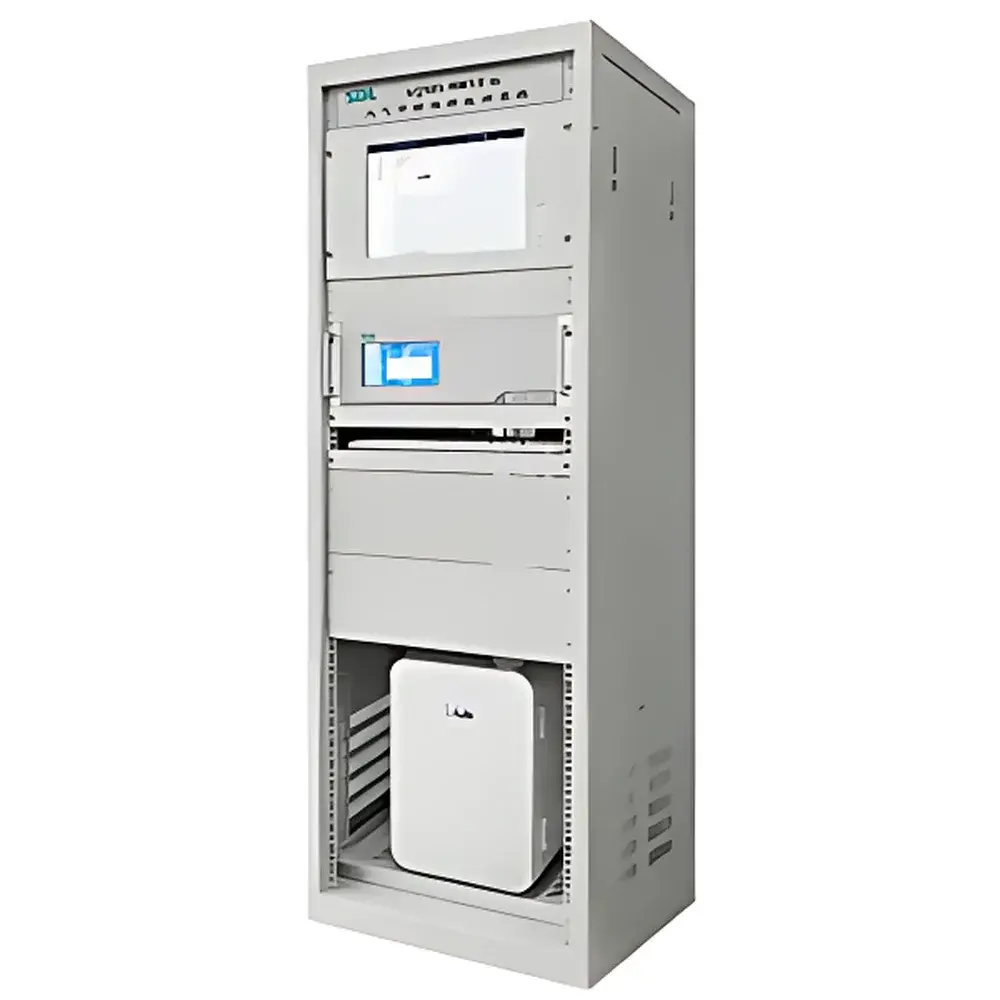
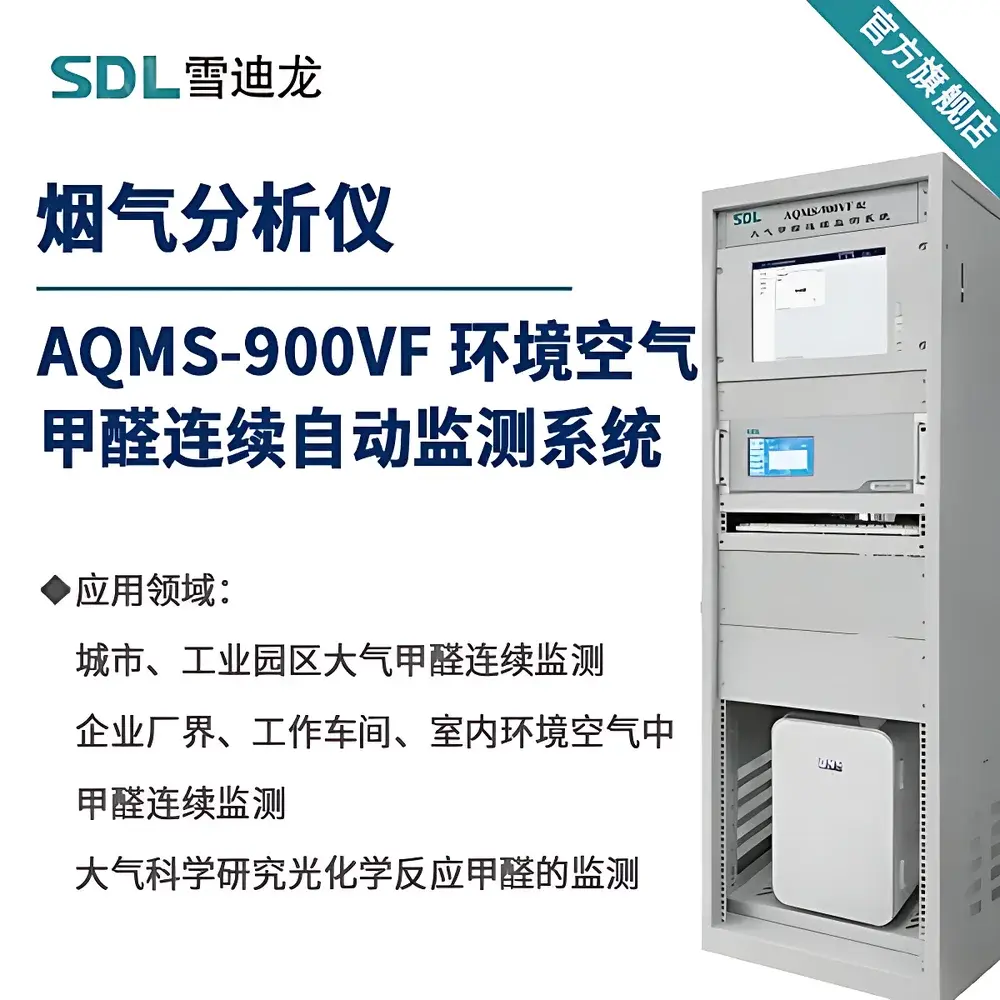
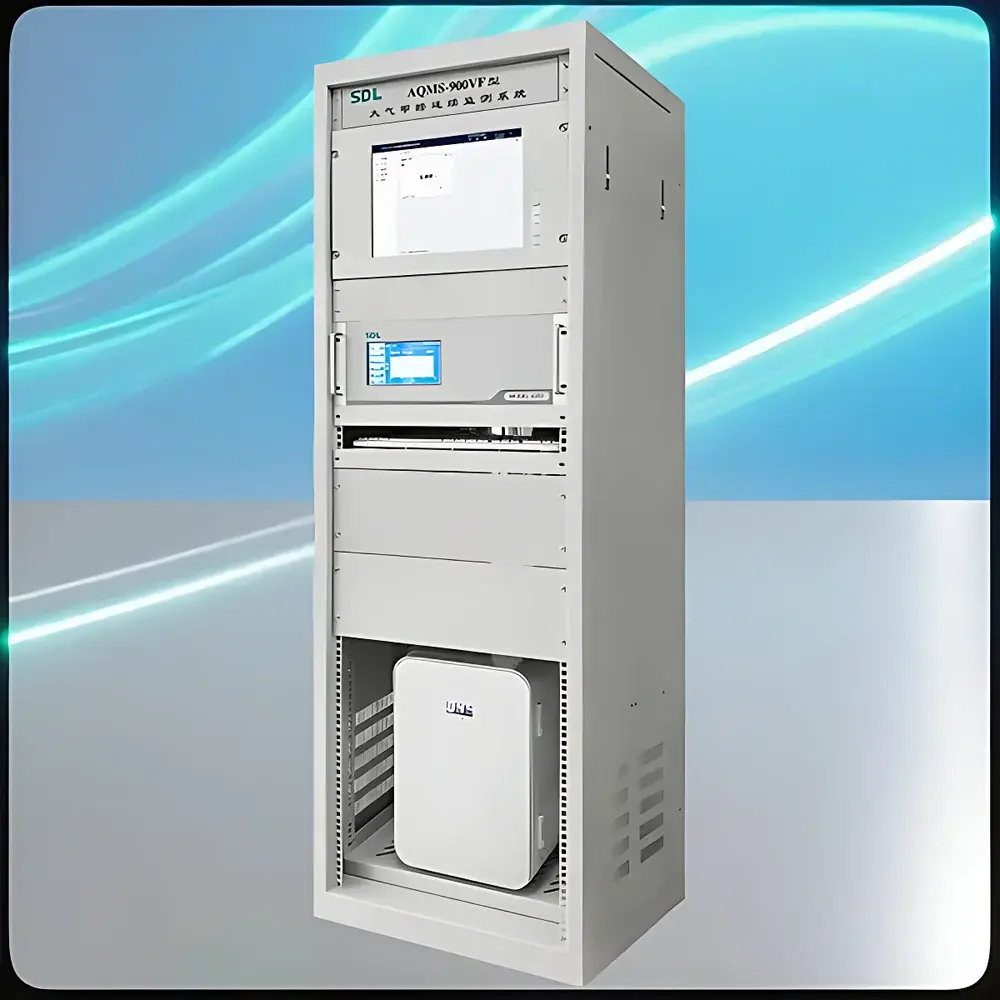
SDL AQMS-900VF Formaldehyde Continuous Ambient Air Monitoring System
| Brand | SDL |
|---|---|
| Origin | Beijing, China |
| Manufacturer Type | Original Equipment Manufacturer (OEM) |
| Country of Origin | China |
| Model | AQMS-900VF |
| Price Range | USD 70,000 – 140,000 |
Overview
The SDL AQMS-900VF Formaldehyde Continuous Ambient Air Monitoring System is a laboratory-grade, field-deployable trace-gas analyzer engineered for real-time, unattended quantification of formaldehyde (HCHO) in ambient air, workplace environments, and industrial emission streams. It operates on the well-established Hantzsch fluorometric reaction principle—where formaldehyde reacts with acetylacetone and ammonium acetate under controlled thermal and acidic conditions to form a highly fluorescent 3,5-diacetyl-1,4-dihydrolutidine (DDL) derivative. This fluorescence intensity, measured at 415 nm excitation / 510 nm emission, is linearly proportional to formaldehyde concentration across a broad dynamic range. Unlike conventional colorimetric methods, the AQMS-900VF integrates temperature-stabilized reaction chambers, dual-wavelength photometric detection, and active humidity compensation to ensure high specificity and minimal interferences from co-occurring carbonyl compounds (e.g., acetaldehyde, acetone) or oxidants (e.g., ozone, NO₂). Designed for compliance with GB/T 15516–1995 and aligned with international methodological frameworks—including EPA TO-11A and ISO 16000-3—the system delivers data suitable for regulatory reporting, atmospheric chemistry modeling, and indoor air quality (IAQ) certification.
Key Features
- Sub-second temporal resolution: Real-time data output at 1 Hz sampling frequency, enabling high-fidelity capture of transient formaldehyde plumes during mobile monitoring (e.g., vehicle-mounted or drone-based surveys).
- Ultra-low detection capability: Method detection limit (MDL) ≤ 50 pptv (parts-per-trillion by volume) at 1-minute integration time, verified per EPA 40 CFR Part 136 protocols.
- Wide linear dynamic range: 0–500 ppbv with <±2% full-scale linearity deviation, supporting both background-level urban monitoring and elevated concentrations near industrial sources.
- Automated calibration architecture: Integrated dual-calibration pathways—liquid standard injection (via precision syringe pump) and certified gas-phase standard delivery (using permeation tube or dynamic dilution system)—both traceable to NIST SRM 2807.
- Self-diagnostic operation: Onboard zero-air generator (catalytic scrubber + activated carbon), automatic baseline drift correction, and scheduled multi-point calibration validation with audit trail logging.
- Robust environmental tolerance: Operating range of −20 °C to +50 °C and 10–95% RH (non-condensing); IP54-rated enclosure for outdoor cabinet or shelter installation.
Sample Compatibility & Compliance
The AQMS-900VF accepts uncompressed ambient air, ducted stack effluent (with optional heated sample line), or conditioned indoor air without pre-concentration or derivatization. Sample flow is maintained at 0.8–1.2 L/min via mass flow-controlled vacuum pump with real-time pressure/temperature compensation. The system meets key regulatory and quality assurance requirements including ISO/IEC 17025:2017 (for testing laboratories), GLP-compliant data integrity per FDA 21 CFR Part 11 (electronic records & signatures), and supports audit-ready reporting for national air quality networks (e.g., China’s CNEMC, US EPA AQS). All firmware and calibration logs are timestamped, user-authenticated, and exportable in CSV/NetCDF format for third-party validation.
Software & Data Management
The embedded Linux-based control unit runs SDL’s AQMS Control Suite v4.2, providing local touchscreen interface and remote web access via HTTPS. Software features include configurable alarm thresholds (pre-set or user-defined), automatic QA/QC flagging (e.g., zero/scale drift >5%, signal noise >3σ), and integrated meteorological data fusion (optional RS-485 or Modbus input for temperature, RH, wind speed). Raw spectral data, calibration history, and diagnostic events are stored onboard for ≥180 days and synchronized hourly to secure cloud storage using TLS 1.3 encryption. Data exports comply with WMO GOS metadata standards and support direct ingestion into national platforms such as China’s MEP-AQMS and Europe’s EEA AirBase.
Applications
- Urban and regional air quality monitoring networks requiring long-term formaldehyde trend analysis alongside O₃, NO₂, and VOCs.
- Industrial fence-line monitoring for petrochemical, resin manufacturing, and composite material facilities subject to VOC emission permits.
- Indoor environmental quality assessment in schools, hospitals, and office buildings per WHO IAQ guidelines and GB/T 18883–2022.
- Atmospheric chemistry research—especially photochemical box modeling and radical budget studies—where formaldehyde serves as a key OH radical precursor and oxidation tracer.
- Mobile emission mapping (e.g., drive-by surveys of traffic corridors or landfill perimeters) leveraging its 1-Hz response and low-power standby mode (<120 W average).
FAQ
What formaldehyde measurement principle does the AQMS-900VF employ?
It uses the Hantzsch fluorometric reaction, optimized for ambient air matrices with active interference suppression and humidity compensation.
Is the system compliant with U.S. EPA or EU regulatory methods?
While certified to GB/T 15516–1995, its methodology is technically equivalent to EPA TO-11A and ISO 16000-3; method validation reports are available upon request for site-specific regulatory acceptance.
Can the AQMS-900VF be integrated into existing air quality monitoring stations?
Yes—it supports Modbus RTU/TCP, DNP3, and analog 4–20 mA outputs, and is compatible with major SCADA platforms including Siemens Desigo, Honeywell Experion, and Campbell Scientific CR-series loggers.
How frequently does it require maintenance or consumables replacement?
The catalytic zero-air generator requires annual catalyst renewal; reagent cartridges (acetylacetone/ammonium acetate) last ≥90 days at continuous operation; optical components are sealed and maintenance-free for 5+ years.
Does it support remote diagnostics and firmware updates?
Yes—via secure SSH and HTTPS interfaces; over-the-air updates preserve calibration constants and historical data integrity per IEC 62443-3-3 cybersecurity standards.







